The condo assembly is, by law, the supreme governing body of any condominium in Mexico. It is the space where the most important decisions are made: from approving the annual budget to electing the administrator and modifying internal regulations. However, the reality in most condos is discouraging: barely 15-20% of owners regularly attend assemblies, meaning a handful of people make decisions that affect the entire community.
"Assemblies that actually work — and where people actually show up." That is the goal every administrator and oversight committee should pursue. A well-organized assembly doesn't just meet legal requirements — it strengthens community bonds, builds trust in the administration, and reduces neighbor conflicts. When owners feel their voice matters and decisions are made transparently, the entire community benefits.
In this comprehensive guide, we will cover everything you need to know to organize successful assemblies: from legal requirements and assembly types to proven strategies for increasing participation and digital tools that are transforming how condos govern themselves. Whether you are a professional administrator, an oversight committee member, or simply an owner committed to your community, this information will be invaluable.
Why Assemblies Are the Heart of Your Condo
The general assembly of condo owners is not just a bureaucratic formality — it is the democratic engine that drives your condo's community life. Under Mexican law, it is the only body with the authority to make the most consequential decisions affecting all property owners.
Key decisions happen here:
- Annual budget: The assembly approves how much will be charged for maintenance fees and how resources will be distributed.
- Administrator election: Whether hiring an external professional or appointing an owner, this decision is voted on in assembly.
- Internal regulations: Rules for coexistence, common area use, and sanctions can only be modified with assembly approval.
- Major works: Any significant renovation, expansion, or improvement requires collective authorization.
- Financial statements: The administrator's accountability report is presented and approved before the assembly.
The low participation problem
When only 20% of owners attend, decisions are made by a minority. This creates a vicious cycle: absentees feel that "others decided for them," resentment builds, and conflicts multiply. Delinquent owners argue they "weren't consulted," projects stall, and the community fragments.
The power of a well-organized assembly
In contrast, when assemblies are organized, transparent, and efficient, the opposite happens: owners feel heard, fees are paid more punctually, projects move forward, and coexistence improves significantly. In Mexico City the Procuraduría Social is the body that handles these disputes, and administrators' experience points the same way: where assemblies are regular and well documented, fewer conflicts escalate. A successful assembly is not just a meeting — it is an investment in the harmony and value of your property.
Types of Assemblies: Ordinary vs. Extraordinary
Mexican law distinguishes two types of assemblies, each with specific purposes and requirements. Understanding the difference is essential for calling the right assembly at the right time.
Ordinary Assembly
This is the mandatory meeting, and its minimum frequency is set by your state, not by custom: every three months in Mexico City (art. 29 sec. I: "Ordinary General Assemblies shall be held quarterly"); every six months in Quintana Roo (art. 28 sec. III), the State of Mexico (art. 28 sec. I), Baja California, Chiapas, Durango, Hidalgo, Oaxaca, Tabasco, Tamaulipas and Tlaxcala; and once a year in Nuevo León (art. 29 sec. II), Jalisco (Civil Code art. 1020, within the first quarter) and Yucatán (art. 31). Its typical agenda includes:
- Administrator's report: Summary of activities, achievements, and challenges for the period.
- Financial statement approval: Detailed review of income, expenses, and reserve fund status.
- Next period budget: Expense projection and maintenance fee definition.
- Election or ratification of positions: Administrator, oversight committee, and board of directors if applicable.
- General matters: Space for owners to raise concerns or proposals.
The ordinary assembly is the backbone of condo governance. Failing to hold one constitutes an administrator's fault and can have legal consequences. Set the whole year's calendar at the first assembly: four dates if you are in Mexico City, two in Quintana Roo or the State of Mexico, one in Nuevo León or Jalisco. Scheduling "the annual assembly" and nothing else breaks the law in the country's three largest condo markets. Publish all of them at once on the community calendar so nobody can claim they never heard.
Extraordinary Assembly
Called when situations arise that cannot wait for the next ordinary assembly. The most common reasons include:
- Urgent repairs: Structural damage, major leaks, elevator or security system failures.
- Internal regulation changes: Modifications to coexistence rules, amenity use, or pet policies.
- Administrator removal: When serious irregularities justify an immediate change.
- Extraordinary expense authorization: Significant investments not foreseen in the original budget.
- Emergencies: Situations requiring immediate collective action (natural disasters, urgent legal issues).
When to call each one?
The rule is simple: if the matter can wait for the ordinary assembly without harming the condo, put it on the next one's agenda — which, depending on your state, is three or six months away, not necessarily next year. If delay could cause damage or losses, call an extraordinary one. Remember that each assembly has costs (time, notifications, preparation), so group topics whenever possible. For more details on the legal framework, check our guide on Mexico's condo law.
Legal Requirements You Must Meet (For Your Assembly to Be Valid)
An assembly that does not meet legal requirements can be challenged and annulled, voiding all decisions made. These are the fundamental requirements you must meet:
Quorum: The magic number
The quorum is the minimum participation percentage needed for the assembly to validly convene. There is no national figure: each state sets its own, and the difference between 51% and 90% decides whether your assembly is valid or challengeable.
- First call: 75% in Mexico City (art. 32 sec. IV), Quintana Roo (art. 29, on undivided interest), Guanajuato, Durango, Querétaro, Sonora, Tamaulipas, Nayarit and Baja California Sur; 90% in Campeche (art. 93), Coahuila and Colima; more than 50% of the owners in the State of Mexico (art. 28 sec. VII); and 51% in Nuevo León (art. 30), Chihuahua and Jalisco (Civil Code art. 1023, for the ordinary assembly).
- Second call: this varies too. Simple majority of all owners in Mexico City (art. 32 sec. IV); 51% of undivided interest in Quintana Roo (art. 29); 51% of voters in Campeche, Coahuila and Colima; and in the State of Mexico, Nuevo León, Chihuahua and Jalisco simply whichever owners attend.
- Third call: where it exists, the assembly opens with whoever attends and resolutions pass by majority of those present — Mexico City (art. 32 sec. IV) and Quintana Roo (art. 29) say so expressly. This is not something "some bylaws allow": it is statutory in much of the country, and non-existent in other states.
The five states that hold most of Mexico's condo stock, side by side. Find yours before you draft the notice:
| State | First call | Second call | Quorum and votes counted by | Notice period | Minutes book authorised by |
|---|---|---|---|---|---|
| Mexico City | 75% of owners (art. 32 sec. IV) | Simple majority of all owners (art. 32 sec. IV) | Undivided interest (art. 31 sec. III) | 7 calendar days; 30 min between calls (art. 32 sec. IV) | Procuraduría Social (art. 31 sec. VIII) |
| Quintana Roo | 75% of undivided interest (art. 29) | 51% of undivided interest (art. 29) | Undivided interest — except electing the administrator and committees: one vote per unit (art. 28 sec. VI) | 15 calendar days (art. 30 sec. II) | Oversight Committee (art. 36 sec. I) |
| State of Mexico | More than 50% of owners (art. 28 sec. VII) | Whoever attends (art. 28 sec. VII) | By head, not by undivided interest (art. 28 sec. II) | 10 days for general, 5 for extraordinary (art. 28 sec. VI) | Municipal secretary (art. 28 sec. V) |
| Nuevo León | 51% of undivided interest (art. 30) | Whoever attends (art. 30) | Undivided interest (art. 29 sec. IV) | 10 calendar days (art. 30) | No external authorisation (art. 29 sec. IX) |
| Jalisco | 51% of the rights (CC art. 1023) | Whoever attends (CC art. 1023) | Rights over the condominium (CC art. 1023) | 15 days ordinary, 20 extraordinary (CC art. 1025) | No external authorisation |
Swipe horizontally to see the full table
Two warnings the table cannot hold. In Nuevo León the extraordinary assembly requires 51% of the undivided interest on the first call and on every later one: there is no "whoever turns up" there (art. 30). And in Jalisco the extraordinary assembly may be held with any number of attendees, but its resolutions are valid only if approved by owners representing at least 75% of the rights — a percentage that can be completed within the following thirty calendar days by absent owners who authentically state their approval (CC art. 1023).
Notification: Do it right or risk validity
- The notice period is set by state law: 7 calendar days in Mexico City (art. 32 sec. IV), Baja California, Chiapas, Oaxaca, Tabasco and Tamaulipas; 8 days in Nayarit; 10 days in Nuevo León (art. 30), Puebla and Veracruz; 10 days for general and only 5 for extraordinary assemblies in the State of Mexico (art. 28 sec. VI); 15 calendar days in Quintana Roo (art. 30 sec. II) and Hidalgo; and in Jalisco 15 days for the ordinary assembly and 20 for the extraordinary.
- It must be in writing and include: who is calling it, the type of assembly, date, time, a place inside the condominium, and a detailed agenda. Further down there is a model notice with all of it in brackets.
- It must be delivered to each owner's address or by the means established in the regulations.
- Keep proof of delivery (acknowledgment of receipt, photograph of the notice on the bulletin board, or digital delivery record).
Voting rights: Who can vote?
- The vote belongs to the owners. Proxy does not always require a notary: Mexico City accepts a simple written proxy where the internal bylaws allow it, and nobody may represent more than two owners (art. 31 fr. IV); Quintana Roo accepts a proxy signed before two witnesses and caps representation at 20% of owners (art. 28 fr. VII); Nuevo León allows a simple proxy when the representative is another owner and requires a notarised power when they are not, capped at four principals (art. 29 fr. V). In Mexico City the administrator cannot represent any owner at an assembly; in Quintana Roo neither the administrator nor Oversight Committee members can.
- Delinquent owners have their vote restricted by statute, not only by bylaws: Mexico City art. 34, always keeping the right to speak, except at assemblies called to amend the constitutive deed, wind up the regime or affect title to the property.
- And there is a detail in that same art. 34 that decides whether your assembly opens at all: delinquent owners do not count toward the installation quorum, and cannot be elected Administrator or Oversight Committee members. Art. 32 sec. III also strips them of the right to convene. In a building with 30% arrears that changes the arithmetic at the door completely, so compute the quorum on the undivided interest that actually counts. In Nuevo León one unpaid fee is enough to be delinquent (art. 34), against two in Mexico City.
- Quintana Roo has both routes, and mixing them up is costly: art. 32 suspends the vote by operation of law "for as long as the non-payment subsists" and excludes that undivided interest "for the purposes of installing the Assembly", while always preserving the right to speak — exactly as Mexico City does. Separately, art. 67 sec. IV lets the Assembly impose vote restriction as a sanction, and only that second route requires summoning the owner "so that they may say what is in their interest" (art. 68).
- Each owner votes according to their undivided interest percentage in Mexico City (art. 31 sec. III), Quintana Roo (art. 28 sec. VI) and Nuevo León (art. 29 sec. IV); in the State of Mexico the vote is by head — one vote per owner regardless of how many units they hold, except in commercial and industrial condos (art. 28 sec. II) — and statutes such as Campeche's compute quorum and voting by voters. Check which applies before you count.
Minutes: The document that backs everything
- Every assembly must be documented in formal minutes that include: attendance list with signatures, quorum verification, agenda, session development, agreements reached, and voting results. The minutes and attendance-list templates are further down.
- Minutes are entered in the minutes book, and who authorises that book changes by state: in Mexico City the Procuraduría Social (arts. 31 sec. VIII and 43 sec. I), in Quintana Roo the Oversight Committee (art. 36 sec. I), and in the State of Mexico the municipal secretary (art. 28 sec. V). Minutes recorded in an unauthorised book in the State of Mexico are challengeable minutes, and it is the requirement most often overlooked.
- They are signed by the assembly's president and secretary and, in Mexico City, also by the oversight committee members who attend and any owners who ask to (art. 31 fr. VIII). There it is not a recommendation: it is statute.
- If the assembly was lawfully called and there is no minutes book, Mexico City allows the minutes to be drawn up on separate sheets recording that fact, and requires notifying the Procuraduría within fifteen business days. The administrator must also inform each owner of the resolutions in writing within 7 business days (art. 31 fr. VIII and IX).
State-by-state variations
- Mexico City (CDMX): the Condominium Property Law requires seven calendar days' notice for the ordinary assembly, and thirty minutes between first and second call (art. 32 fr. IV). Its text contains no provision for electronic assemblies or voting: if you want to meet remotely in Mexico City, take legal advice first.
- Quintana Roo: the most advanced state on this point. Since the 2021 reform it expressly regulates the remote assembly (art. 28 sec. V, with prior registration by email, live video, microphones muted except when speaking, and the recording attached to the minutes' appendix) and electronic voting by owners who are not at the condo (art. 28 sec. XIV), with fifteen calendar days' notice (art. 30 sec. II).
- State of Mexico: the state with the most condominium units in the country, and the one guides forget most often. Quorum by head, not by undivided interest (art. 28 secs. II and VII), 10 days' notice for general and 5 for extraordinary assemblies (art. 28 sec. VI), and a minutes book authorised by the municipal secretary (art. 28 sec. V).
- Jalisco: the Civil Code requires 51% of the rights to open the ordinary assembly on first call, and the second call proceeds with whoever attends; the extraordinary assembly may be held with any number, but its resolutions are valid only if approved by owners representing at least 75% of the rights (art. 1023). It also allows remote sessions with visual identification, real-time interaction, roll-call voting and an audiovisual record (art. 1025 bis).
- Nuevo León: allows a written proxy when the representative is another owner; if they are not, a notarised power is required, and nobody may represent more than four owners (art. 29 fr. V).
Knowing your state's specific legislation is crucial. Check our complete legal guide for more details.
Notice and Minutes Templates You Can Copy
The two documents that make an assembly challengeable are always the same: the notice and the minutes. Here are both as fill-in models, with the variables in brackets. They are drafted against Mexico City's requirements (arts. 31 and 32) because that is the most demanding statute in the country; if you administer elsewhere, adjust the notice period, the quorum and who authorises the minutes book using the table in the previous section before you use them.
Model notice of an Ordinary General Assembly
CONDOMINIUM [name], located at [street and number], [neighbourhood], [borough or municipality], [state].
NOTICE OF ORDINARY GENERAL ASSEMBLY
Pursuant to [article of your state's statute] and to the condominium's Internal Bylaws, [full name of the convener], acting as [Administrator / Oversight Committee / group of owners representing __% of the units], summons the owners and occupants of Condominium [name] to the Ordinary General Assembly to be held on [day] [month] [year], at [exact location inside the condominium], under the following
AGENDA
- Attendance list, quorum verification and lawful opening of the assembly.
- Appointment of chair, secretary and two vote counters.
- Administrator's report for the period [date] to [date].
- Presentation and, where applicable, approval of the period's statements of account, endorsed by the Oversight Committee.
- Presentation and, where applicable, approval of the expense budget for [period] and of the monthly ordinary fee per unit.
- [Specific item: election of administrator, major works or extraordinary fee. Write it with its amount and scope, never as "financial matters".]
- General matters.
- Assignment of owners and deadlines for each resolution.
FIRST CALL: [time]. Should the quorum of [percentage set by your state] not be reached, the assembly will be held on SECOND CALL at [time + 30 minutes] with [second-call quorum] and, where applicable, on THIRD CALL at [time + 60 minutes] with whichever owners attend, resolving by majority of those present.
The supporting documents for items 3, 4 and 5 are available as of today at [document hub / management office] for prior review.
Representation is accepted by [simple written proxy / proxy signed before two witnesses / notarised power of attorney], and no one person may represent more than [number] owners. The Administrator may not represent any owner at the assembly.
Resolutions adopted by the assembly bind every owner, including those absent and those who dissent.
[Place], [date of issue]. [Name and signature of the convener].
Model minutes of a General Assembly
MINUTES OF THE [ORDINARY / EXTRAORDINARY] GENERAL ASSEMBLY OF CONDOMINIUM [name].
In [city], at [time] on [date], the owners and occupants listed in the attendance list attached as Annex 1 having gathered at [exact location inside the condominium], following the notice issued on [date] and served in accordance with [article of your state's statute], the following took place.
FIRST. Quorum verification. Attendance was recorded of [number] owners, representing [percentage] of the [undivided interest / total number of owners, per your state]. [Number] units were excluded from the count for being in arrears under [applicable article]. The [first / second / third] call quorum having been reached, the assembly was declared lawfully opened.
SECOND. Appointment of the table. [Name] was appointed chair, [name] secretary, and [name] and [name] vote counters, all of whom accepted.
THIRD. [Agenda item]. [Description of what was presented and of the supporting document] was presented. After deliberation it was put to a vote, with the following result: in favour [votes or percentage of undivided interest], against [ ], abstentions [ ]. Accordingly the following RESOLUTION is adopted: [verbatim text of the resolution, with amount, scope and deadline]. Responsible for execution: [name]. Committed date: [date].
[Repeat one numbered item per agenda point, always with the same structure: what was presented, how it was voted, what was resolved, who executes it and by when. A resolution with no owner and no date is the one nobody carries out.]
[NUMBER]. Dissenting votes. [Name] asked that their vote against resolution [number] be recorded for the following reasons: [text exactly as dictated].
There being no further business, the assembly closed at [time] on the same day.
ANNEXES: 1) Attendance list with signatures. 2) Proxies received. 3) Notice and proof of service. 4) Supporting documents presented.
SIGNATURES: Chair [name and signature]. Secretary [name and signature]. Oversight Committee members in attendance [names and signatures]. Owners who asked to sign [names and signatures].
Model attendance list
This is Annex 1 to the minutes and the document that decides whether your quorum survives a challenge. Print it with the register already filled in, not blank:
| Unit | Owner or representative | % undivided interest | Current on fees | Attending as | Signature |
|---|---|---|---|---|---|
| [A-101] | [name] | [2.34%] | [Yes / No] | [Self / Proxy] | |
| [A-102] | [name] | [2.34%] | [Yes / No] | [Self / Proxy] | |
| Total attending | [sum] |
Swipe horizontally to see the full table
Four things people forget before using them
- Record the minutes in the minutes book authorised by the right body in your state: the Procuraduría Social in Mexico City (art. 31 sec. VIII), the Oversight Committee in Quintana Roo (art. 36 sec. I), the municipal secretary in the State of Mexico (art. 28 sec. V). If the assembly was lawfully called and there is no book, Mexico City allows the minutes to be drawn up on separate sheets recording that fact, and requires notifying the Procuraduría within fifteen business days.
- In Mexico City the Administrator must inform each owner of the resolutions in writing within 7 business days (art. 31 sec. IX). That is not a courtesy: it is the statutory deadline.
- If the resolution amends the constitutive deed or the internal bylaws, it must be notarised and registered wherever your state requires. In Mexico City the deed amendment goes to the Public Property Registry and the bylaws amendment is registered with the Procuraduría (art. 31, paragraphs a and b); in Quintana Roo both go to the Public Registry of Property and Commerce (art. 28).
- Publish the signed minutes and their annexes on the document hub and announce it by push notification. Minutes that exist only in the outgoing administrator's folder are the minutes that vanish at the next handover.
Before the Assembly: 10-Step Preparation
Preparation is what separates a chaotic assembly from a productive meeting. Follow these 10 steps to ensure success before the day arrives:
- Choose the date and time strategically: Pick a day and time that maximizes attendance. Weekend mornings (9-11 AM) or weekday evenings (7-8 PM) tend to work best. Avoid long weekends, vacations, and holidays. Publish the date at least a month in advance and send it through announcements to the whole community to reach all residents.
- Create a clear, detailed agenda: Each item should be specific. Instead of "Financial matters," write "Approval of January-December 2026 financial statement and 2027 budget." A well-structured agenda reduces tangents and maintains focus.
- Prepare supporting documentation: Financial statements, budgets, work quotes, regulation proposals — everything should be ready and available for prior review. Upload documents to the document hub so owners can review them before the meeting.
- Send the formal notice: Comply with legal deadlines (minimum 7 days, ideally 15). Include all required information: date, time, place, agenda, and assembly type. Use multiple channels: push notifications, email, common area postings, and condo social media.
- Verify the owner registry: Make sure you have an updated list of owners, their undivided interest percentages, and payment status — without it you cannot compute the quorum or know who votes. A resident directory carrying undivided interest and a current payment status keeps the maths off a six-month-old spreadsheet.
- Prepare voting ballots: For important decisions, have ballots ready with clear options. Consider using condo polls and voting for more agile and transparent voting.
- Organize venue logistics: Enough chairs, audio system for large condos, projector for presentations, registration table, water and coffee. Small details make a big difference in the attendee experience.
- Assign key roles: Assembly president (usually the committee chair), secretary (who will draft the minutes), vote counters, and a moderator if controversial topics are anticipated.
- Prepare an executive summary: Not all owners will read the full documentation. Create a one-page summary with the most important points and decisions to be made. Send it along with the notice.
- Anticipate questions and objections: Think about questions owners might ask and have answers prepared with data and evidence. This demonstrates professionalism and builds trust.
The key is advance preparation. An administrator who arrives at the assembly with everything ready conveys confidence and facilitates a productive meeting.
During the Assembly: 8 Rules for a Productive Meeting
The assembly day has arrived. These 8 principles will help you maintain control, productivity, and a constructive atmosphere:
1. Start on time with proper registration
Open the registration table 30 minutes before the scheduled time. Verify each attendee's identity and ownership status, and collect signatures. Calculate quorum before starting. If there is no quorum, document the situation and announce the second call date. Never start without verifying quorum — this is the most common cause of challenges.
The register, the undivided interest and who is current, on one screen. Computing the quorum at the door means adding up undivided interests and discounting delinquent owners while everyone waits. Koti keeps the owner directory with each unit's undivided interest and payment status current, and polls and voting leave every resolution recorded with a name and a timestamp.
2. Establish ground rules from the start
Before the first agenda item, the president should explain: estimated meeting duration, maximum time per intervention (3-5 minutes), how to request the floor (raise your hand), that the agenda will be followed, and that topics not included will be addressed under "general matters" at the end.
3. Follow the agenda strictly
Every deviation lengthens the meeting and frustrates attendees. If an important unplanned topic arises, note it for general matters or a future assembly. The moderator must be firm but respectful when redirecting discussion.
4. Present information clearly and transparently
Use visual aids: project financial statements, show comparative graphs, present quotes side by side. Transparency builds trust. Koti's financial management tools generate clear, professional reports that facilitate these presentations.
5. Handle conflicts professionally
Disagreements are natural and healthy. What is unacceptable is disrespect. If someone raises their voice, the moderator should intervene firmly: "We understand your concern, we ask that you express it respectfully so we can find a solution together." If conflict escalates, propose a vote to resolve the point and move on.
6. Document each agreement in real time
The secretary should record each agreement as it is made, including: the exact text of the agreement, the voting result (in favor, against, abstentions), and who will be responsible for execution. Reading agreements at the end of each item prevents misunderstandings.
7. Vote clearly and transparently
For each vote, clearly explain what is being voted on, present the options and the method (show of hands, secret ballot, digital poll). Announce the result with exact numbers. Voting transparency is the antidote to subsequent challenges.
8. Close with a summary and next steps
Before adjourning, the secretary should read all agreements made. Define compliance dates, responsible parties, and the tentative date for the next assembly. Thank everyone for participating — a positive closing motivates future attendance.
Ideal duration: Keep the assembly between 60 and 90 minutes. Meetings lasting more than 2 hours lose attention and quorum (owners start leaving). If there are many topics, prioritize the most important and schedule a second session for the rest.
After the Assembly: Follow-Through That Makes the Difference
What happens after the assembly is just as important as the meeting itself. Proper follow-through demonstrates seriousness, builds trust, and ensures agreements are fulfilled. These are the critical post-assembly steps:
Distribute the minutes within 48 hours
The minutes are the official document backing all decisions made. They must be finalized, signed, and distributed to all owners (not just attendees) within the first 48 hours. Include:
- Complete list of attendees and representatives
- Quorum verification with exact percentages
- Each agreement made with its voting result
- Dissenting votes or registered objections
- Date and signatures of the president and secretary
Use Koti's document hub to publish the minutes and ensure all owners can access them easily. Automatic notifications ensure no one misses the information.
Create an action plan with responsible parties and deadlines
Each agreement must become a concrete task with:
- Assigned responsible party: Who will execute the agreement
- Deadline: When it must be completed
- Required resources: Budget, authorizations, or necessary hires
- Success indicator: How fulfillment will be measured
Communicate progress periodically
Don't wait for the next assembly to report on progress. Send monthly or quarterly updates on the status of each agreement. Koti's communication tools allow you to send these updates through multiple channels: push notifications, email, and platform announcements.
Archive documentation properly
Store the original signed minutes, attendance list, supporting documents, and recordings (if any) in a safe, organized place. This documentation is your backup against any future challenges or disputes. Digital storage on the documents platform ensures nothing gets lost and everything is accessible when needed.
Evaluate and improve for next time
After each assembly, reflect: Was the full agenda covered? How long did it last? Were there conflicts that could have been prevented? What feedback did you receive from attendees? Use these lessons to improve the organization of the next assembly. Condos that implement a continuous improvement cycle achieve increasingly efficient assemblies with higher participation.
How to Boost Participation: From 20% to 70% Attendance
Low attendance is the number one enemy of condo assemblies. But it is not a problem without a solution. Understanding why people don't attend is the first step to changing the situation.
Why don't owners attend?
- "They're boring and long": 3+ hour meetings without structure drive anyone away.
- "Nothing changes": If agreements from previous assemblies weren't fulfilled, why go?
- "I didn't know about it": The notice was posted on a bulletin board nobody reads.
- "The schedule doesn't work for me": A fixed schedule that doesn't consider community diversity.
- "They're just fights": Meetings dominated by personal conflicts are demotivating.
Proven strategies to increase attendance:
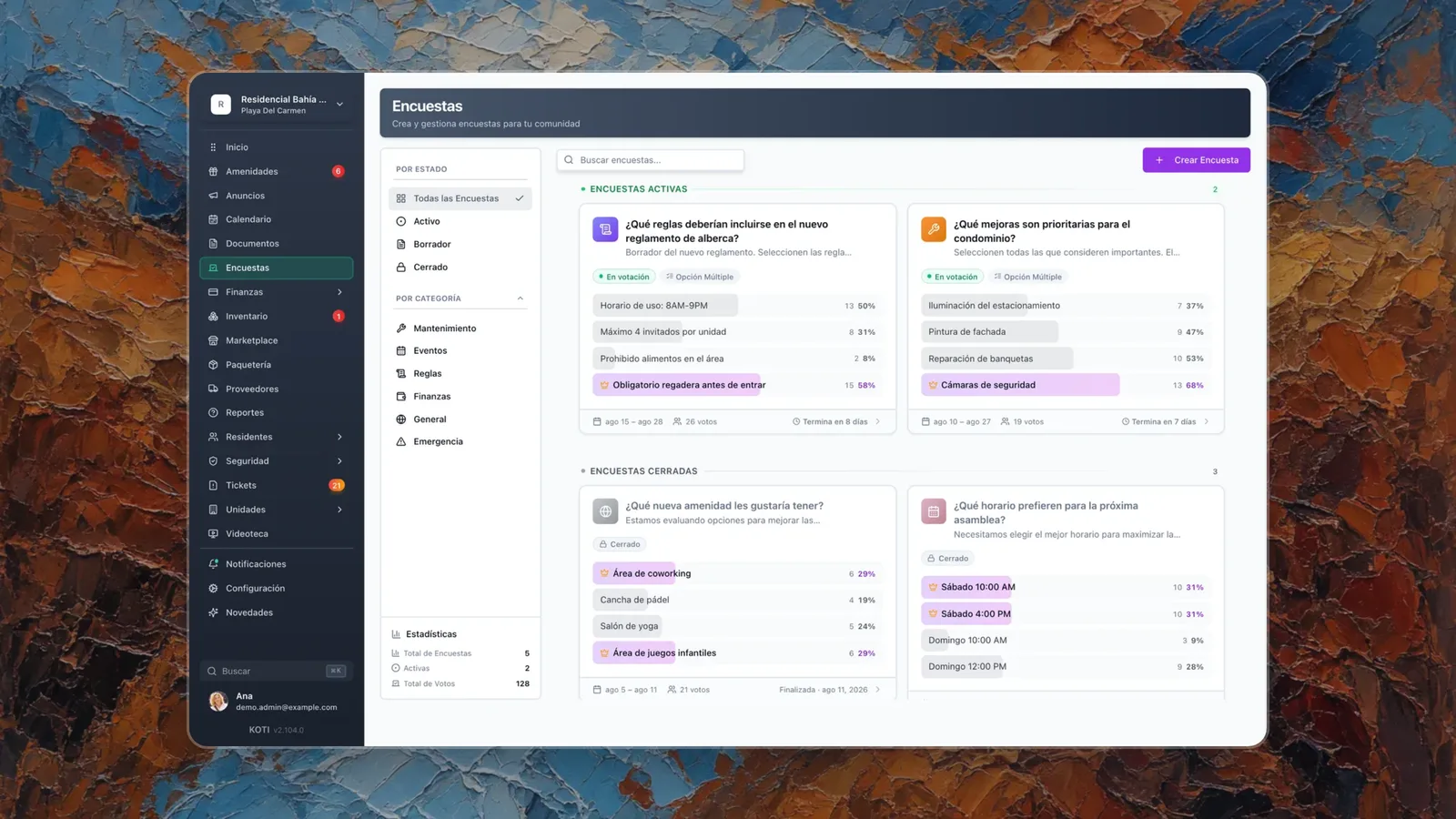
- Share the agenda in advance and ask for input: Don't wait for the assembly to listen to owners. Use condo polls and voting to ask what topics matter to them and include those in the agenda. When people see their concerns are on the agenda, they have a reason to attend.
- Keep meetings short (90 minutes maximum): Set a time limit and respect it. Prioritize the most important topics first and leave secondary ones for general matters. If time runs out, schedule a second session instead of extending the first.
- Show results from previous decisions: At the beginning of each assembly, present a summary of the previous assembly's agreements and their fulfillment status. When owners see their decisions become real actions, their trust — and attendance — increases.
- Offer hybrid options — but check first whether your state recognises them: Quintana Roo expressly allows the remote assembly (art. 28 sec. V) and electronic voting (art. 28 sec. XIV), and Jalisco permits remote sessions with full visual identification, real-time interaction, roll-call voting and an audiovisual record (Civil Code art. 1025 bis). Mexico City's statute contemplates neither: there you can stream the assembly so those who cannot attend can follow it, but quorum and votes must come from those present and from written proxies, not from the video call. Confirm it with a lawyer before you count a single remote vote.
- Send attractive, multi-channel reminders: A bulletin board notice isn't enough. Send reminders via push notification, email, WhatsApp, and condo social media. Do it 7 days before, 3 days before, and the day before. Include a message highlighting why attending benefits them: "The budget that defines your monthly fee will be voted on."
- Create a positive atmosphere: Offer coffee, cookies, or a small gathering afterward. Publicly recognize owners who pay on time or contribute to the community. Assemblies don't have to be only about problems — they can also celebrate achievements.
- Be clear about what happens if you don't show up: Don't invent sanctions. No set of bylaws can strip an owner of the right to challenge a resolution, and a clause attempting it is a dead letter. What the statute does say is simpler and more useful to communicate: assembly resolutions bind every owner, including those absent and those who dissented (Mexico City art. 32 sec. IV; Quintana Roo art. 30; Nuevo León art. 30; State of Mexico art. 28). Put it in the notice in those words: not attending does not exempt you, it only leaves you out of the decision.
None of these measures is a one-assembly trick: the administrators who sustain them across two or three consecutive notices are the ones who see attendance rise and stay risen. Start with the two cheapest — an agenda published well in advance and multi-channel reminders — and measure your own attendance before and after. The number that matters is your condo's, not an internet average.
The Modern Assembly: Digital Tools That Transform the Experience
Technology is revolutionizing the way condos organize and execute their assemblies. Digital tools don't replace human interaction, but they enormously enhance it, making assemblies more efficient, transparent, and participatory.
How Koti enables modern assemblies:
- Share documents before the assembly: Upload financial statements, budgets, and quotes to the document hub. Owners can review them from their phone before the meeting, arriving prepared and reducing time spent on basic explanations.
- Automated multi-channel notice: Forget posting notices in the elevator and hoping someone reads them. With announcements to the whole community, send the notice via push notification, email, and platform announcement simultaneously. Confirm everyone received the information with digital read receipts.
- Digital polls and voting: Before the assembly, use polls to consult topics of interest and prioritize the agenda. During the assembly, conduct real-time voting with instant, transparent results. Owners can vote from their device, eliminating manual counting and disputes over results.
- Push notifications that actually reach the neighbour: Send instant updates about schedule changes, reminders, and results. Unlike a notice on the board, every send leaves a record of who it went to and when — exactly what you will have to prove if someone claims they were never summoned.
- Digitized post-assembly tracking: Publish the minutes on the document hub, assign tasks with deadlines, and send periodic updates on agreement progress through the residents panel.
Before and after: The impact of digitization
| Aspect | Without digital tools | With Koti |
|---|---|---|
| Notice | Bulletin board, no record of who saw it | Multi-channel send with per-owner delivery record |
| Prior documents | Photocopies at the guard booth | Digital access from any device |
| Voting | Show of hands, manual counting | Digital, instant, documented |
| Minutes | Handwritten, gets lost | Digital, signed, permanently stored |
| Follow-up | Promises that are forgotten | Tasks with responsible parties and dates |
| Quorum verification | Spreadsheet with stale undivided interests | Live register with undivided interest and payment status |
Swipe horizontally to see the full table
The transition is easier than you think
You don't need to be a tech expert to modernize your assemblies. Platforms like Koti are designed to be intuitive for both administrators and owners of all ages. The learning curve is minimal and the benefits are immediate.
The future of condo assemblies is digital, transparent, and participatory. Condos that adopt these tools don't just improve their governance — they also increase their property values and resident satisfaction. Learn about all the features on our resident communication page and document management page.
Organizing a successful condo assembly is not a matter of luck — it is the result of meticulous preparation, professional execution, and consistent follow-through. The key takeaways to remember are: always comply with legal requirements (notice, quorum, minutes), prepare everything in advance and keep meetings focused and brief, document every agreement and follow up on it, and use technology as your ally to increase participation and transparency.
Well-organized assemblies, supported by modern digital tools, transform condo governance. They go from being dreaded and avoided meetings to becoming spaces of active participation where the community makes informed decisions and commits to their fulfillment. The result: better-managed condos, more satisfied neighbors, and properties that increase in value.
Ready to transform your condo's assemblies? Discover how Koti's communication tools allow you to convene, inform, and follow up professionally, and how the document hub centralizes all the information your community needs. Take the first step toward assemblies that actually work — and where people actually show up.
A note on sources. The articles cited in this guide were verified against the official text in force: Mexico City's Ley de Propiedad en Condominio de Inmuebles para el Distrito Federal (as amended 4 August 2023), Quintana Roo's Ley de Propiedad en Condominio de Inmuebles (as amended 12 November 2021), Nuevo León's Ley de Propiedad en Condominio de Inmuebles (as amended 11 October 2023), the State of Mexico's Ley que Regula el Régimen de Propiedad en Condominio (as amended 29 April 2024) and the Civil Code of the State of Jalisco. This guide is informational and does not replace a lawyer's advice on your specific case.
Try Koti for free
Simplify your condo management: dues, access and announcements in one place. 14 days free, no credit card.
Official sources
Every article cited in this guide was checked against the text published by the body that issued it. Condominium law in Mexico is state law: always read your own state’s, and confirm the date of the latest amendment before acting.
- Ley de Propiedad en Condominio de Inmuebles del Estado de Quintana Roo
Quintana Roo · Last amended: 12-11-2021 (P.O. del Estado) · Checked: 2026-08-09
- Ley de Propiedad en Condominio de Inmuebles para el Estado de Nuevo León
Nuevo León · Last amended: 11-10-2023 (P.O. del Estado No. 128) · Checked: 2026-08-09
- Código Civil del Estado de Jalisco
Jalisco · Last amended: 18-06-2026 (Decreto 30196/LXIV/26, P.O. secc. VII) · Checked: 2026-08-09
- Ley de Propiedad en Condominio de Inmuebles para el Distrito Federal
Mexico City · Last amended: 04-08-2023 (G.O. CDMX) · Checked: 2026-08-09
- Ley que Regula el Régimen de Propiedad en Condominio en el Estado de México
State of Mexico · Last amended: 29-04-2024 (P.O. «Gaceta del Gobierno») · Checked: 2026-08-09
- Ley de Fraccionamientos, Unidades Habitacionales, Condominios y Uso de Inmuebles en Tiempo Compartido del Estado de Campeche
Campeche · Last amended: — sin reformas · expedida por Decreto 202, P.O. 15-05-1980 · Checked: 2026-08-09
- Ley sobre el Régimen de Propiedad en Condominio de Bienes Inmuebles para el Estado de Tamaulipas
Tamaulipas · Last amended: 21-12-2016 (Decreto LXIII-103 del 14-12-2016, anexo al P.O. No. 152 — reforma el art. 75) · Checked: 2026-08-09
This guide is general information, not legal advice. For a specific matter, consult a lawyer in your state.
Written by
Equipo Koti
Condo Management Experts
The Koti Smart Communities team shares knowledge and best practices for efficient condo and residential community management.