Managing a condominium in Mexico demands very different kinds of knowledge, from the legal side to communication and handling money. Whether you run a vertical condominium, a coto, a privada or a fraccionamiento, and whether you are starting out as a professional administrator or sitting on the board, this guide gives you the tools to run it efficiently.
According to the extended questionnaire of INEGI's 2020 Population and Housing Census, Mexico has 34.9 million occupied private dwellings: 5.6% are apartments in a building and another 18.1% share a plot with another dwelling, the statistical class that horizontal cotos, privadas and fraccionamientos fall into. That is millions of families whose quality of life depends, literally, on how well their community is run: good management keeps the common areas in shape, encourages neighbourly relations and protects property values.
What is a Condo Administrator?
The condo administrator is the individual or company responsible for executing the decisions of the general assembly and managing the day-to-day operations of the condominium. According to Mexican law, the administrator can be an owner elected by the assembly or an external professional hired for this purpose.
The main responsibilities of the administrator include:
- Financial management: Collecting maintenance fees, managing the reserve fund, paying suppliers, and presenting financial statements.
- Maintenance: Coordinating preventive and corrective maintenance of common areas, from gardens to elevators.
- Communication: Serving as a liaison between owners, convening assemblies, and communicating relevant information.
- Legal compliance: Ensuring the condo complies with all applicable regulations, including civil protection and local rules.
- Staff management: Supervising security, cleaning, and maintenance staff.
Legal Obligations of the Administrator
In Mexico, condominium law is state law, not federal law: there are 32 separate instruments and on several points they genuinely disagree. Most states have their own condominium property act, but not all: in Aguascalientes, Querétaro and Zacatecas the rules live inside the Código Urbano, and in Chihuahua and Jalisco inside the Civil Code. Before you take any deadline or percentage as given, check the instrument that governs your state. These are the obligations that recur most often:
Registration and documentation
- Keep the assembly minutes book up to date. In Mexico City it must be authorised by the Procuraduría Social (art. 43 fr. I); in Quintana Roo the Oversight Committee authorises it (art. 36 fr. I).
- Gather and preserve the condo's books and documentation. Note one Mexico City wrinkle: art. 43 fr. IV only requires making them available to owners who are current on their ordinary and extraordinary fees; in Quintana Roo (art. 36 fr. III) any owner may consult them at any time. Neither statute sets a retention period in years — accounting and tax retention deadlines should be confirmed with your accountant.
- Hand everything over to the incoming administration. In Mexico City that duty is not in art. 43 but in art. 44: seven calendar days from the day after the new appointment, covering account statements, the minute book, securities, movable and immovable property, with a record signed by everyone involved; once those seven days pass the incoming administration may start whatever administrative, civil or criminal action applies. In Quintana Roo the handover duty sits inside art. 36 fr. III.
- Have the internal regulations and constitutive deed available
Assemblies
- Convene the ordinary general assembly as often as your state requires. In Jalisco (Civil Code art. 1020) and Yucatán (art. 31) once a year is enough; Baja California, Chiapas, Durango, Hidalgo, Oaxaca, Tabasco, Tamaulipas and Tlaxcala require it every six months.
- Give the notice period your state law demands, not the one that suits you: 7 calendar days in Mexico City (art. 32 fr. IV), Baja California, Chiapas, Oaxaca, Tabasco and Tamaulipas; 10 days in Nuevo León (art. 30), Puebla, State of Mexico and Veracruz; 15 calendar days in Quintana Roo (art. 30 fr. II) and Jalisco, which also requires 20 days for extraordinary assemblies.
- Verify quorum before opening the assembly, because it varies too: 75% on first call in Mexico City (art. 32 fr. IV) and Quintana Roo (art. 29), 90% in Campeche (art. 93), Coahuila and Colima, and 51% in Nuevo León and Chihuahua.
Finances
- Deliver the account statement as often as your law requires: monthly in Mexico City, with proof of receipt (art. 43 fr. XII), and monthly or bimonthly in Quintana Roo (art. 36 fr. X). "Quarterly" is not enough in either.
- Contract, in the condominium's name, the banking services the assembly authorises (Quintana Roo art. 36 fr. VII; Nuevo León art. 38 fr. VII)
- Manage the maintenance and administration fund and the reserve fund separately (Mexico City art. 55 fr. I and II)
It is essential that as an administrator you know your specific state's law. Mexico City applies the Condominium Property Law — and that is exactly where condo software in Mexico City earns its keep, flagging deadlines before they lapse — while Quintana Roo has its own state act, with deadlines and quorums that are not the same.
Effective Maintenance Fee Collection
One of the biggest challenges in condo management is maintaining healthy cash flow through timely fee collection. Delinquency directly affects the ability to properly maintain common areas.
Strategies to improve collection:
- Make payment easy: take the friction out of the channel your owners already use. Publish the community's CLABE in one place, always ask for the same reference, and stop chasing receipts over WhatsApp. With Koti the resident transfers by SPEI to the community's own account and uploads the proof from the app, so the payment is tied to their unit; in-app card collection is in development.
- Communicate clearly: Send reminders before the due date and detailed account statements showing how resources are used.
- Establish clear consequences: The regulations should specify late fees and restrictions for delinquent owners (such as amenity use). Before setting the rate, check your state's ceiling: Mexico City caps it at the legal interest rate, which may not exceed 9% per year (art. 33 fr. V), while Quintana Roo leaves the rate to the bylaws or the assembly but forbids compounding it (art. 43).
- Act quickly: Don't let debt accumulate. Contact delinquent owners from the first month of delay.
- Document everything: Keep detailed records of all payments, reminders sent, and communications with delinquent owners.
How much should the maintenance fee be?
The fee should be calculated considering:
- Monthly operating expenses (security, cleaning, services)
- Reserve fund. The percentage is set by the assembly or the bylaws, not by statute: Mexico City's law requires the fund (art. 55 fr. II) but sets no minimum, so check your state's instrument before taking the 5-10% rule of thumb as given
- Scheduled preventive maintenance
- A margin for unforeseen events
Common Area Maintenance
Proper maintenance of common areas is essential to preserve property value and ensure resident safety. A well-structured maintenance program includes:
Preventive maintenance
Create an annual calendar that includes:
- Monthly review of electrical and plumbing systems
- Periodic elevator maintenance per the vendor contract and local civil-protection and building rules (state condominium statutes set no frequency; confirm it with your municipality)
- Roof waterproofing every 2-3 years
- Facade painting as required by regulations
- Periodic fumigation of common areas
Corrective maintenance
Establish a protocol for urgent repairs:
- 24/7 reporting line for emergencies
- List of trusted vendors for different services
- Contingency budget for unexpected repairs
Maintenance documentation
It is important to keep records of:
- Dates and description of work performed
- Contracted vendors and quotes
- Equipment and service warranties
- Before and after photographs
Digital management tools greatly facilitate this documentation and allow generating reports for assemblies.
Technology in Condo Management
Digital transformation has also reached condo management, offering tools that significantly simplify management:
Management software
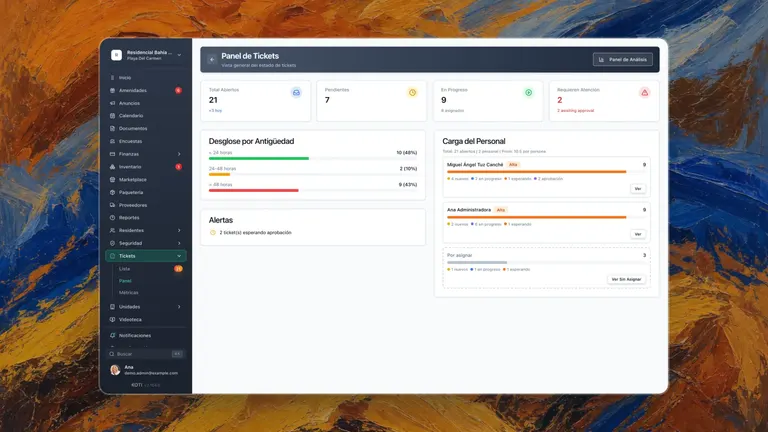
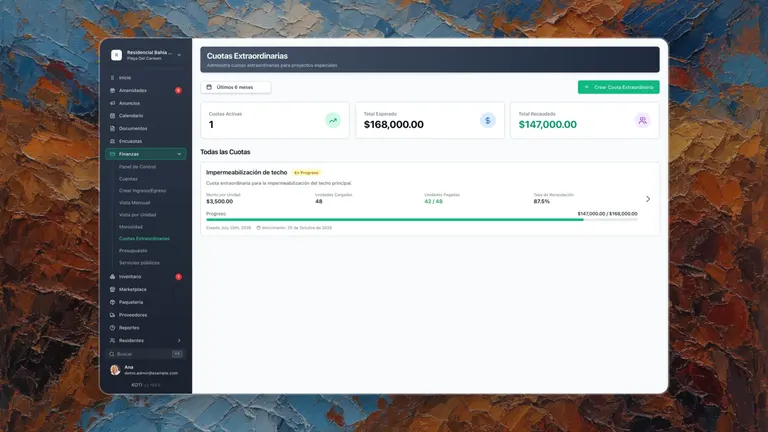
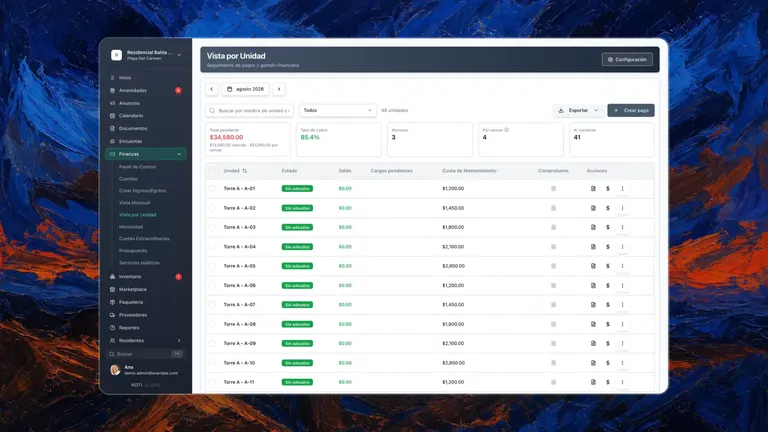
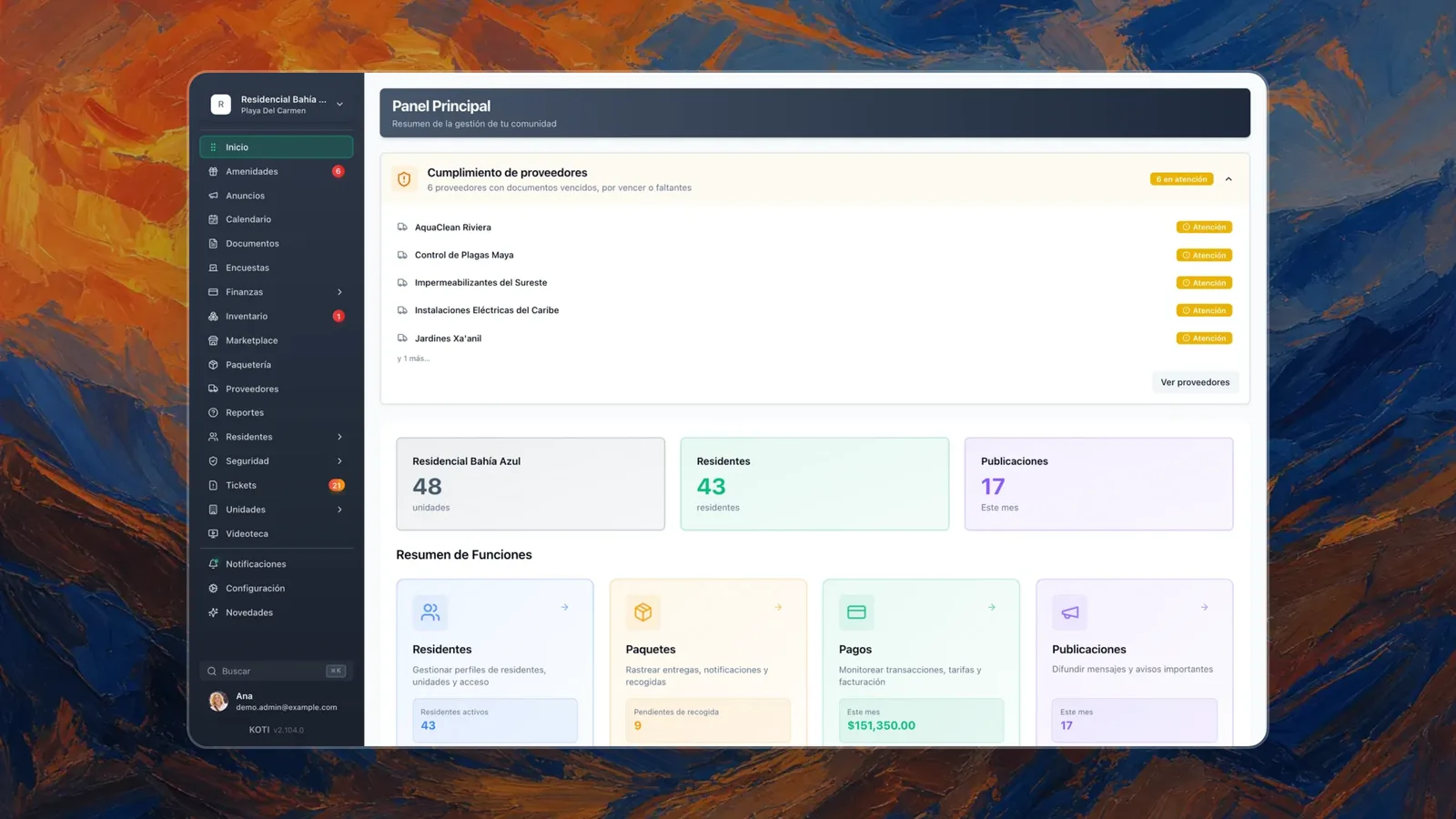
Modern platforms like Koti offer:
- Resident management with digital directory
- QR code access control for visitors
- Financial administration with automated collection
- Amenity booking online
- Package tracking with notifications
Benefits of digitalization
- Fewer hours of data entry and chasing: statements, receipts and reminders stop being done by hand
- Greater transparency with real-time information access
- Better communication between management and residents
- Complete and accessible history of all operations
- Reduction of errors in financial management
Digital security
Digital access control not only improves the physical security of the condo but also provides:
- Record of all entries and exits
- Unique codes for visitors with limited validity
- Real-time alerts for the administrator
- Activity reports for assemblies
Communication with Residents
Effective communication is the foundation of a good relationship between management and owners. Conflicts in condos frequently arise from misunderstandings or lack of information.
Recommended communication channels
- Bulletin board: For official and emergency communications
- App or digital platform: For daily communication and notifications
- Email: For formal documents and meeting notices
- WhatsApp group: For informal communication and emergencies (with clear usage rules)
Communication best practices
- Be proactive: Don't wait for residents to ask. Regularly inform about the condo's status.
- Be transparent: Share financial statements and explain how resources are used.
- Listen actively: Create mechanisms to receive suggestions and complaints.
- Respond promptly: Establish maximum response times for different types of requests.
- Document communications: Keep records of important notices and requests handled.
Conflict management
When conflicts arise between neighbors or with management:
- Listen to all parties before acting
- Refer to internal regulations to resolve disputes
- Document incidents and actions taken
- Consider mediation for complex conflicts
Managing a condo in Mexico is a responsibility that requires dedication, knowledge, and the right tools. Professional management not only maintains the property in optimal condition but also contributes to the quality of life of all residents and protects one of their most important investments: their home.
Current technology allows simplifying many administrative tasks, freeing up time to focus on what really matters: creating communities where people enjoy living. If you're looking to modernize your condo management, learn how Koti can help with a comprehensive solution specifically designed for the needs of Mexican condominiums.
Do you have questions about managing your condo? Don't hesitate to contact us for personalized advice.
Try Koti for free
Simplify your condo management: dues, access and announcements in one place. 14 days free, no credit card.
Official sources
Every article cited in this guide was checked against the text published by the body that issued it. Condominium law in Mexico is state law: always read your own state’s, and confirm the date of the latest amendment before acting.
- Ley de Propiedad en Condominio de Inmuebles del Estado de Quintana Roo
Quintana Roo · Last amended: 12-11-2021 (P.O. del Estado) · Checked: 2026-08-09
- Ley de Propiedad en Condominio de Inmuebles para el Distrito Federal
Mexico City · Last amended: 04-08-2023 (G.O. CDMX) · Checked: 2026-08-09
- Ley de Propiedad en Condominio de Inmuebles para el Estado de Nuevo León
Nuevo León · Last amended: 11-10-2023 (P.O. del Estado No. 128) · Checked: 2026-08-09
- Código Civil del Estado de Jalisco
Jalisco · Last amended: 18-06-2026 (Decreto 30196/LXIV/26, P.O. secc. VII) · Checked: 2026-08-09
- Ley que Regula el Régimen de Propiedad en Condominio de Inmuebles para el Estado de Oaxaca
Oaxaca · Last amended: 18-09-2021 (Decreto Núm. 2646, P.O. Núm. 38 Décimo Primera Sección; aprobado 18-08-2021) · Checked: 2026-08-09
This guide is general information, not legal advice. For a specific matter, consult a lawyer in your state.
Written by
Equipo Koti
Condo Management Experts
The Koti Smart Communities team shares knowledge and best practices for efficient condo and residential community management.