Condo management in Mexico is regulated by a specific legal framework that every administrator must know thoroughly. Understanding these laws is not only a professional obligation but also protects you from legal liabilities and allows you to manage the condo more effectively.
Let's start with the thing everyone gets wrong: there is no federal condominium law in Mexico. The subject matter is state-level — 32 separate instruments that do not agree with each other on deadlines, quorums or late-payment interest. The law that binds you is your own state's — and in Aguascalientes and Zacatecas it is not even a condominium act but the Urban Code; in Chihuahua and Jalisco, the Civil Code. This guide breaks down the rules that repeat most often, with the exact Mexico City and Quintana Roo article so you can check them yourself, plus the tax obligations almost nobody explains.
Legal Framework for Condos in Mexico
First, the most important clarification: there is no federal condominium law in Mexico. The subject matter is state-level — 32 separate instruments. Any "one guide, one law" claim for the whole country is simply wrong. What does exist is several layers of legislation that combine:
Federal Level
- Federal Civil Code: Sets general principles of property and co-ownership, but applies only to federal matters; it does not govern condos in your state.
- Housing Law: Defines general housing policies that may affect condos.
- Tax laws (ISR, VAT): Applicable to the condo's economic activities.
State Level
This is where the rules that actually bind you live. In most states it is a Condominium Property Law (or similar designation); in others there is no standalone law and the regime sits inside the Civil Code (Chihuahua, Jalisco) or the Urban Code (Aguascalientes, Zacatecas). These rules vary between states, but generally regulate:
- Constitution and extinction of the condo regime
- Rights and obligations of owners
- Administrative bodies
- Assemblies and quorums
- Maintenance fees
- Penalties for non-compliance
Internal Documents
- Constitutive Deed: Establishes the condo regime and distribution of undivided interests.
- Internal Regulations: Defines specific rules for coexistence and condo use.
- Assembly Minutes: Document decisions made by owners.
Key state laws include:
- Mexico City (CDMX): Ley de Propiedad en Condominio de Inmuebles para el Distrito Federal, published on 27 January 2011, last amended in the Gaceta Oficial on 4 August 2023. Note: this is still the law in force. A bill for a new law sits in the Mexico City Congress, but until it is passed and published, the 2011 law is the one that binds you.
- State of Mexico: Ley que Regula el Régimen de Propiedad en Condominio en el Estado de México.
- Jalisco: no standalone condo law — the condominium regime is regulated inside the Civil Code of the State of Jalisco.
- Nuevo León: Ley de Propiedad en Condominio de Inmuebles para el Estado de Nuevo León (Decreto 251, published 2 May 2017, last amended 11 October 2023). Watch out for the one still circulating online: the Ley del Régimen de Propiedad en Condominio para el Estado de Nuevo León, published 2 April 1993 (Decreto 163), is repealed — the Second Transitory article of the law in force says so. Download it from the State Congress site, not from an aggregator.
- Quintana Roo: Ley de Propiedad en Condominio de Inmuebles del Estado de Quintana Roo, last amended in the Periódico Oficial del Estado on 12 November 2021.
It is essential that as an administrator you have access to and know all these documents, especially your state's law and your condo's internal regulations. And always read them from the official source — your state congress's site. Third-party mirrors and aggregators routinely publish repealed texts without saying so.
Condo Administrative Bodies
The law establishes three main bodies for condo management:
1. General Assembly of Owners
It is the supreme decision-making body of the condo. All owners have the right to participate with voice and vote. Its powers include:
- Approving the annual budget and maintenance fees
- Appointing and removing the administrator and oversight committee
- Modifying internal regulations
- Authorizing major works and improvements
- Approving financial statements
There are two types of assemblies:
- Ordinary: Reports on the state of the administration and approves accounts and budget. The frequency is not annual by default — each state law sets it. Mexico City requires them quarterly (art. 29 sec. I); Quintana Roo and the State of Mexico, at least once every six months (Quintana Roo art. 28 sec. III; State of Mexico art. 28 sec. I); Nuevo León and Jalisco accept one a year (Nuevo León art. 29 sec. II; Jalisco, Civil Code art. 1020, within the first quarter). Check your state's interval before assuming one a year is enough: in Mexico City that assumption leaves you three assemblies short.
- Extraordinary: Called for urgent matters or for the topics the law expressly reserves (amending the constitutive deed or the regulations, terminating the regime, new construction works).
2. Administrator
Can be an owner or an external professional. Their legal responsibilities include:
- Executing assembly agreements
- Keeping minutes and accounting books
- Collecting maintenance fees
- Making authorized expenses
- Hiring and supervising staff
- Representing the condo in minor legal matters
3. Oversight Committee
Supervisory body generally composed of owners. Their functions are:
- Supervising the administrator's management
- Reviewing financial statements
- Approving extraordinary expenses
- Calling assemblies when the administrator doesn't
- Reporting irregularities to the assembly
Assemblies and Legal Quorum
Assemblies must meet specific requirements to be valid:
Notice
- Must be in writing with the advance notice set by the state law or the regulations, and that period varies widely by state: in Mexico City, notice of an Ordinary General Assembly is given 7 calendar days in advance, with thirty minutes between calls (art. 32 sec. IV); in the State of Mexico it is 10 days for general and only 5 for extraordinary assemblies (art. 28 sec. VI); in Nuevo León, 10 calendar days (art. 30); and in Quintana Roo, unless the condo regulations set another period, it cannot be less than 15 calendar days (art. 30 sec. II).
- Must include who is calling it, the type of assembly, agenda, date, time, and place.
- All owners must be notified at their address or by means established in the regulations, and the notice must also be posted in visible places within the condo.
Quorum to session
This is where most administrators get it wrong: on first call the quorum is not a simple majority, it is a qualified one.
- First call: 75%. Mexico City requires 75% of owners to attend (art. 32, sec. IV); Quintana Roo requires a quorum of 75% of the undivided interest (art. 29).
- Second call: the quorum drops, but it does not disappear. Mexico City: simple majority of all owners; Quintana Roo: at least 51% of the undivided interest.
- Third call: only here can the assembly proceed "with whoever shows up" — it is legally installed with the owners in attendance and resolutions pass by majority of those present.
- Special decisions: amending the constitutive deed or the internal bylaws requires an extraordinary assembly and 75% of the condo's total value in Mexico City (art. 11); winding up the regime requires the same 75% there (art. 13). Quintana Roo's art. 11 says something different, and mixing them up makes the resolution challengeable: it requires at least 75% of the undivided interest to attend, with resolutions passed by a majority of the votes cast. Selling a common area is not on this list, and that is not an oversight: no majority can authorise it.
Voting
- As a general rule each owner votes according to their percentage of undivided interest, not per unit (Mexico City art. 31 sec. III; Quintana Roo art. 28 sec. VI). The State of Mexico is the exception that catches people out: there the vote is by head — one vote per owner regardless of how many units they hold — except in commercial and industrial condos (art. 28 sec. II).
- But there are important exceptions: in Quintana Roo, electing, re-electing, or removing the administrator and the oversight committee is voted one vote per residential unit, not by undivided interest.
- Decisions are made by simple majority of those present, unless the law, the deed, or the regulations require a special majority.
- The delinquent owner's vote works differently by state, and the difference decides whether your assembly is challengeable. In Mexico City it happens by operation of law: art. 34 strips the vote (never the right to speak), their undivided interest does not count toward the installation quorum, and they cannot be elected Administrator or Oversight Committee member; the vote comes back only at assemblies called to amend the constitutive deed, wind up the regime, or affect title to the property. Nuevo León follows the same automatic scheme (art. 34), but there one unpaid fee makes you delinquent, against two in Mexico City. Quintana Roo follows the same automatic scheme and adds a second route on top, which is worth not confusing: art. 32 suspends the right to vote by operation of law "for as long as the non-payment subsists", the owner always keeps the right to speak — they "may attend assemblies freely and give their opinion" — and their undivided interest "shall not be counted for the purposes of installing the Assembly". Separately, art. 67 sec. IV lets the Assembly impose vote restriction as a sanction, and that route does require summoning the owner "so that they may say what is in their interest" (art. 68). The automatic suspension needs no prior resolution; the sanction does.
Documentation
- All assemblies must be documented in minutes.
- Minutes must include: attendance list, quorum, agenda, agreements made, and votes.
- Must be signed by the assembly president and secretary.
Digital management tools facilitate keeping this record organized and accessible.
Maintenance Fees: Legal Aspects
Maintenance fees are mandatory for all owners and are backed by law:
Types of fees
- Ordinary fee: For regular operating expenses (security, cleaning, services, minor maintenance).
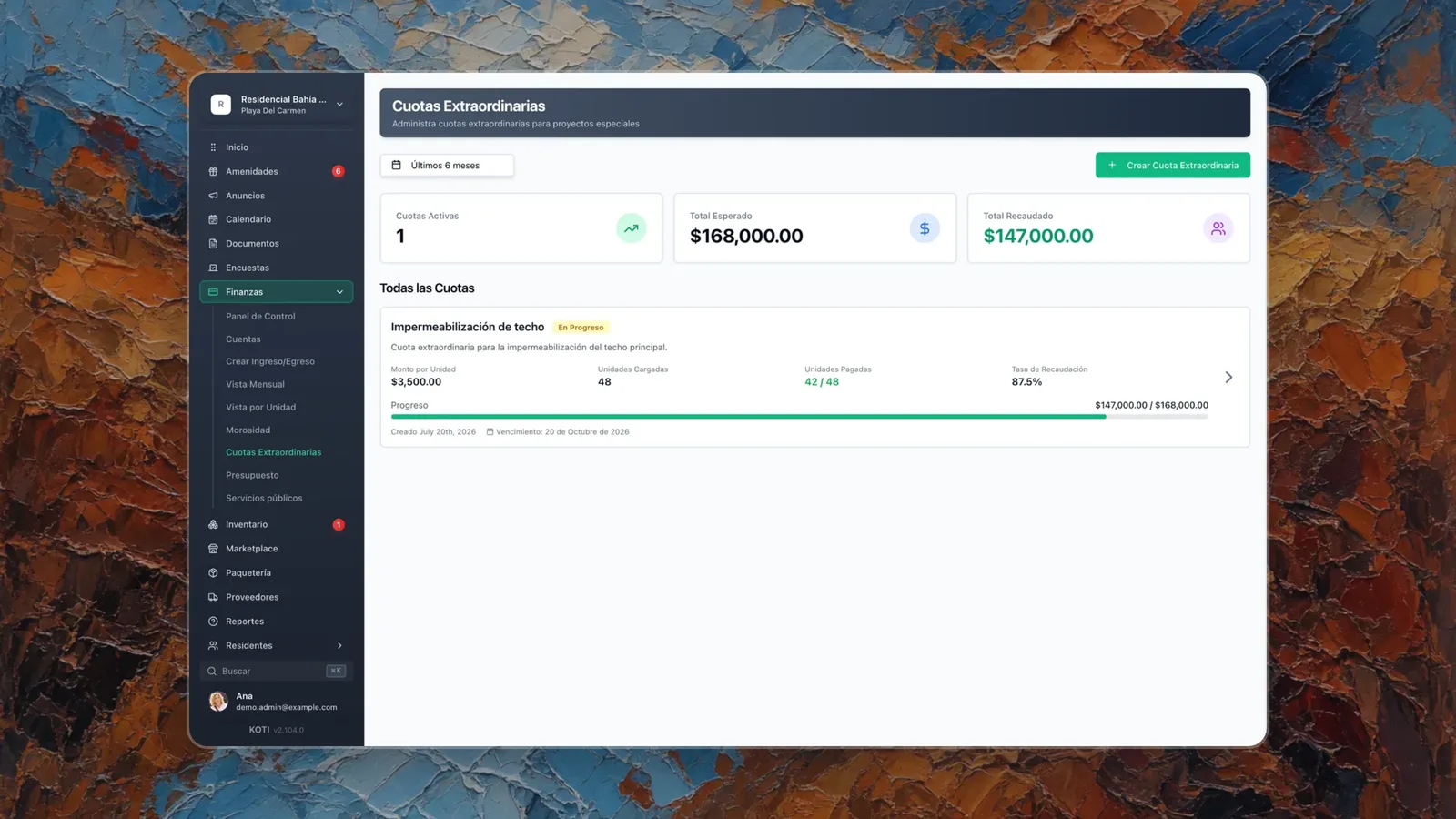
- Extraordinary fee: For unexpected expenses or major improvements, approved by assembly.
- Reserve fund: Percentage allocated for major repairs and contingencies.
Payment obligation
- Payment is mandatory regardless of whether the owner uses common areas.
- The debt follows the unit: the buyer becomes jointly liable for existing arrears, unless the administrator has issued a no-debt certificate (Mexico City art. 60). That certificate is your main leverage at closing.
- Late-payment interest is not set freely. In Mexico City the statutory rate applies and may not exceed 9% per year (art. 33, sec. V, referring to the local Civil Code). In Quintana Roo it is set by the condo regulations or the assembly and expressly may not be capitalized (art. 43). Check your state's cap before charging a surcharge.
Collection from delinquent owners
Legal mechanisms for collection include:
- Restricting the services paid for out of the fees (electricity, gas, and others), subject to approval by the competent body. In Mexico City, potable water can never be cut off (art. 33, sec. XII).
- Suspension of the delinquent owner's voting right by operation of law, while always keeping the right to speak.
- Judicial collection through the civil executive procedure — not the commercial one. The statement of account or liquidation of arrears, signed by the administrator and the president of the oversight committee and accompanied by the unpaid receipts and the assembly minutes or regulations setting the fees, is directly enforceable (Mexico City art. 59; Quintana Roo art. 43).
- That action is not available from day one: it can be brought after two ordinary fees or one extraordinary fee are overdue in Mexico City, and three ordinary or one extraordinary in Quintana Roo.
- In states such as Quintana Roo, arrears are secured preferentially by the exclusive-property unit itself, and only alimony credits rank ahead of them, even if the unit is transferred to third parties (art. 49).
Financial transparency
The administrator is obligated to:
- Deliver statements of account at the frequency their state law requires: monthly to each owner in Mexico City, signed off by the oversight committee and with proof of receipt (art. 43 sec. XII); monthly or bimonthly, or as the assembly decides, in Quintana Roo (art. 36 sec. X). On top of that, the assembly reviews and approves semi-annual statements of account (Mexico City art. 33 sec. VIII). Keeping per-unit statements current is what turns that duty into a few minutes' work.
- Allow any owner to review receipts
- Keep condo money separate from personal funds
Digitized financial management simplifies compliance with these obligations and generates trust among owners.
Rights and Obligations of Owners
Rights of owners:
- Use and enjoyment: Use their unit and common areas according to their purpose.
- Participation: Attend assemblies with voice and vote.
- Information: Access financial statements and condo documents.
- Challenge: Question assembly agreements they consider illegal.
- Proposal: Request that topics be included in the assembly agenda.
Obligations of owners:
- Fee payment: Pay ordinary and extraordinary fees on time.
- Maintenance: Keep their unit in good condition so as not to affect others.
- Proper use: Respect the purpose of common and private areas.
- Coexistence: Comply with internal regulations and not cause disturbances to neighbors.
- Notification: Report changes of address, sale, or rental of their unit.
- Construction: Request authorization for modifications that affect structure or facade.
Liability for damages
Owners are responsible for:
- Damages caused to common areas by them, their family members, employees, or visitors
- Leaks or problems originating in their unit
- Damages caused by unauthorized construction
Tax Obligations of the Condo
Let's start with the question every administrator types into Google before their first assembly.
Does the condo pay income tax?
On maintenance fees, no. Article 79 section XVIII of the Income Tax Law places "civil associations of residents and civil associations dedicated exclusively to the administration of a condominium property" among the legal entities that are not taxpayers for income tax purposes. They sit in Title III, the non-profit legal entities.
That "not a taxpayer" has a limit worth knowing before you sign anything: if the condo sells assets other than its fixed assets or provides services to persons other than its own members, it pays income tax on the profit from those activities under Title II, provided that income exceeds 5% of its total income for the year (art. 80). Renting the rooftop to a telecom antenna or the event hall to an outsider can cross that threshold without anyone on the board noticing.
Tax ID (RFC) and tax mailbox
- The condo needs its own RFC to operate: receive invoices in its name, open a bank account and pay over withholdings.
- Keep the SAT tax mailbox active with current contact details. SAT notices land there, not in the administrator's WhatsApp.
- Keep receipts for five years.
Withholdings: the three that are almost always applied wrong
- Income tax on professional services: when the condo pays fees to an individual for professional services, it withholds 10% as a provisional payment (Income Tax Law art. 106, final paragraph). The same 10% withholding applies to rent paid to individuals (art. 116).
- It does not apply to individuals with business activity, nor to purchases of goods: there is no income tax withholding there. Withholding anyway — the most common error on this list — leaves the condo having paid over a tax with no legal basis and a supplier demanding the difference.
- VAT: on those same professional fees and rents, two-thirds of the VAT charged is withheld (VAT Law art. 1o.-A sec. II subsec. a, read with art. 3 sec. I of its Regulation).
- Payroll income tax and social security: if the condo has its own staff — caretaker, gardener, guard — it is an employer, withholds and pays over payroll income tax, and pays social-security contributions.
Returns
- Monthly income tax and VAT withholding returns.
- DIOT: the informative return of transactions with third parties, where supplier transactions are reported.
- Withholding certificates for suppliers and payroll CFDI for staff.
Do maintenance fees need a CFDI?
At federal level the practical rule has not changed: the condo requests a CFDI for every expense — it is its only backup before the assembly and before the SAT — and issues a CFDI for fees when an owner asks for one.
In Quintana Roo it stopped being optional through a side door almost nobody sees coming: since the 2021 reform, article 46 requires the notary handling a sale to demand from the seller the no-debt certificate and the CFDIs for the last three maintenance-fee payments. A condo that does not invoice its fees blocks the sale of any of its units. We cover this in the guide to Quintana Roo's Condominium Property Law.
Recommendation: hire an accountant with condo experience and record in the assembly minutes which ordinary and extraordinary fees are charged, how they are calculated and how they are invoiced. That resolution is also the document you will need later to collect through the civil executive procedure.
Security and Cleaning: the Condo and REPSE
Security and cleaning are almost never done by in-house staff: they are contracted out. Since the April 2021 subcontracting reform, that contract comes with new rules — and the condo is on the side that answers for them.
What changed
- Personnel subcontracting is prohibited: nobody may place their own workers at another party's disposal (Federal Labour Act art. 12).
- What is allowed is contracting specialised services that are not part of the recipient's corporate purpose or predominant economic activity — a condo's security and cleaning fit there — provided the contractor is listed in the public registry held by the Ministry of Labour, known as REPSE (art. 13).
- The contract must be in writing, stating the object of the services and the approximate number of workers who will perform them (art. 14).
Why this is your problem and not only your supplier's
Article 14 puts it bluntly: a party that contracts specialised services from a contractor who fails to meet the obligations arising from its employment relationships is jointly liable with respect to the workers used for that contract. If the security company stops paying severance, social-security contributions or back wages, the condo — and with it the administrator who signed — is named in the claim.
What to demand from your security and cleaning supplier
- A current REPSE registration. It is renewed every three years (art. 15) and the registry is public: check it on the Ministry's portal rather than trusting the PDF they emailed you.
- A written contract stating the service's object and the approximate number of workers.
- Every month: payroll CFDI and proof of social-security contributions for the staff assigned to your condo.
- Immediate notice if their registration changes or is cancelled — the Ministry may refuse or cancel it at any time.
Keep all of it in the document hub, by supplier and by month. The day a labour claim arrives, a complete folder is the difference between proving you contracted properly and discovering nobody kept the receipts.
Sanctions and Legal Responsibilities
Sanctions for owners
Regulations may establish sanctions for non-compliance:
- Economic fines (within reasonable limits).
- Temporary amenity restriction.
- Voting right limitation (only for delinquent owners, according to state law).
- Collection of damages.
Sanctions must:
- Be provided for in regulations approved by assembly.
- Be proportional to the offense committed.
- Be applied uniformly to all owners.
Administrator liability
The administrator may be liable for:
- Civil: Damages caused by negligence or mismanagement of resources.
- Criminal: Fraud, breach of trust, or document forgery.
- Tax: Omission of the condo's tax obligations.
To protect yourself as an administrator:
- Document all your actions and decisions.
- Obtain written authorization for major expenses.
- Maintain bank accounts with joint signatures.
- Provide periodic and transparent reports.
Conflict resolution
When there are legal disputes, options are:
- Mediation: Through alternative justice centers.
- PROFECO: For consumer service-related complaints.
- PROSOC (Mexico City) or state equivalent: For condo conflicts.
- Judicial route: When there is no agreement, through civil lawsuits.
Legal Regime of Common Areas
Common areas are owned by all owners in proportion to their undivided interest:
Legal characteristics
- They are indivisible: the right over them is inseparable from the privately owned unit and cannot be sold separately.
- They cannot be sold. Article 23 of Mexico City's Condominium Property Law is categorical: common property "may not be the object of exclusive possession and/or usufruct by owners, occupants or third parties and may under no circumstances be transferred to a private party, nor form part of another condominium regime, with the exception of movable goods that have fallen into disuse, subject to prior approval by the General Assembly." No majority — not even unanimity — validates the sale of a common area in Mexico City, and whoever signs the deed ends up with a void transaction and the administrator in the middle of it.
- What the assembly can do is exploit them without transferring ownership: the administrator represents the owners in contracting common premises, spaces or installations for lease or loan for use (comodato), or assigning them to commercial use, on the terms the assembly resolves (Mexico City art. 43 sec. XIV). Quintana Roo regulates the same thing from the other side: it is the Assembly that sets the terms for contracting those areas out to third parties, fixing duration and security (art. 42 sec. IV).
- They are for common use: All owners have the right to use them.
Types of common areas
- By purpose: Hallways, stairs, elevators, roofs, facades.
- By accessory: Service installations (pumps, cisterns, transformers).
- By assembly decision: Areas the community decides to keep as common.
Modifications
To modify common areas requires:
- Assembly approval (qualified majority depending on the type of modification).
- Compliance with urban and civil protection regulations.
- In some cases, modification of the constitutive deed.
"Exclusive use": the most expensive confusion
This is where most assemblies go wrong. Two things look alike and are not the same:
- Annexed elements. The parking space, service room, drying cages and laundry areas that the constitutive deed assigns to a unit are not common area: they are an integral part of that owner's property and exclusive-use right (Mexico City art. 14). Even so, the statute shields them — they cannot be sold, attached, leased or lent independently of the unit.
- Common property. A hallway, a courtyard, a rooftop or a parking space the deed never assigned as privative cannot be handed over for anyone's exclusive use — not by assembly resolution, not by twenty years of custom: art. 23 expressly forbids exclusive possession and usufruct in favour of owners, occupants or third parties.
Before "assigning" any space, read the constitutive deed. If it is not listed there as a unit's annexed element, all the assembly can do is regulate its use for everyone, or lease it under article 43 section XIV. Keeping unit management and the condominium regime documented per unit — undivided interest, annexed elements, fee — is what keeps that argument out of the assembly.
Knowledge of the legal framework is fundamental for successful and problem-free management. As an administrator, your responsibility is to ensure that the condo operates within the law, protecting both the community's interests and your own professional liability.
Remember that laws vary between states, so it's important to consult your locality's specific legislation and rely on legal advisors when necessary.
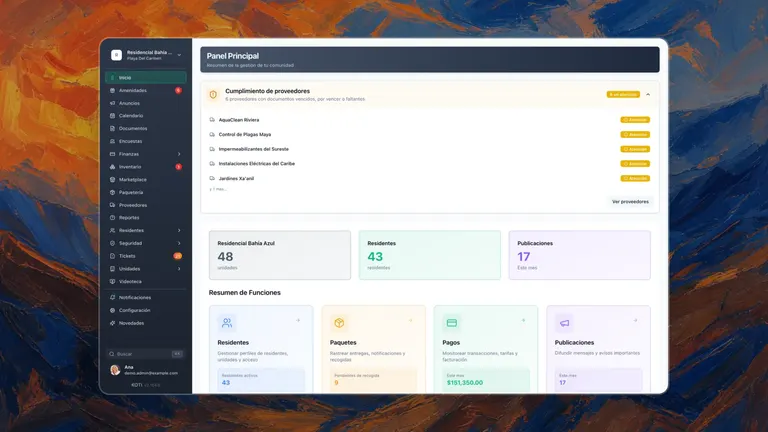
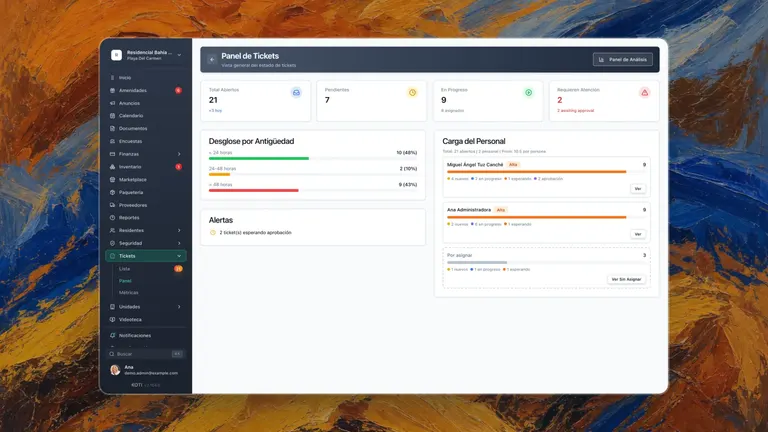
Modern technological tools can help you comply with many of these obligations more efficiently: from assembly registration to transparent financial management and documented access control.
Need more information about condo management? Check our complete management guide, learn how to run an assembly that cannot be challenged, or read about the most common problems and their solutions.
A note on sources. Every article cited in this guide was verified against the official text published by the relevant congress or authority: Mexico City's Ley de Propiedad en Condominio de Inmuebles para el Distrito Federal as amended 4 August 2023 (PAOT), Quintana Roo's Ley de Propiedad en Condominio de Inmuebles as amended 12 November 2021 (State Congress), Nuevo León's Ley de Propiedad en Condominio de Inmuebles as amended 11 October 2023 (State Congress), the State of Mexico's Ley que Regula el Régimen de Propiedad en Condominio as amended 29 April 2024, the Civil Code of the State of Jalisco, and the federal statutes (Income Tax Law, VAT Law and its Regulation, Federal Labour Act) published by the Chamber of Deputies. This guide is informational and does not replace a lawyer's advice on your specific case.
Try Koti for free
Simplify your condo management: dues, access and announcements in one place. 14 days free, no credit card.
Official sources
Every article cited in this guide was checked against the text published by the body that issued it. Condominium law in Mexico is state law: always read your own state’s, and confirm the date of the latest amendment before acting.
- Ley de Propiedad en Condominio de Inmuebles del Estado de Quintana Roo
Quintana Roo · Last amended: 12-11-2021 (P.O. del Estado) · Checked: 2026-08-09
- Ley de Propiedad en Condominio de Inmuebles para el Distrito Federal
Mexico City · Last amended: 04-08-2023 (G.O. CDMX) · Checked: 2026-08-09
- Ley de Propiedad en Condominio de Inmuebles para el Estado de Nuevo León
Nuevo León · Last amended: 11-10-2023 (P.O. del Estado No. 128) · Checked: 2026-08-09
- Código Civil del Estado de Jalisco
Jalisco · Last amended: 18-06-2026 (Decreto 30196/LXIV/26, P.O. secc. VII) · Checked: 2026-08-09
- Ley que Regula el Régimen de Propiedad en Condominio en el Estado de México
State of Mexico · Last amended: 29-04-2024 (P.O. «Gaceta del Gobierno») · Checked: 2026-08-09
This guide is general information, not legal advice. For a specific matter, consult a lawyer in your state.
Written by
Equipo Koti
Condo Management Experts
The Koti Smart Communities team shares knowledge and best practices for efficient condo and residential community management.