A condo's internal bylaws are far more than a legal document filed away in a drawer: they are the backbone of community coexistence. Without clear rules, conflicts between neighbors multiply, common areas deteriorate, and management becomes chaotic. In Mexico City, the Procuraduría Social is the body that receives and mediates these disputes, and most neighbour complaints that reach it come from the same root: rules that are unclear, or that nobody enforces.
Good bylaws aren't kept in a drawer — they are lived every day. They are a living instrument that sets clear expectations, reduces ambiguity, and provides a fair framework for resolving disagreements before they escalate. When residents know the rules and understand the consequences of not following them, coexistence improves dramatically. And the difference is almost never having bylaws — nearly every condo has them, filed away — but having them clear, published, and enforced the same way for everyone.
In this complete guide, we will cover everything you need to know to create, update, and enforce effective condo bylaws: from the 10 essential elements that cannot be missing, through the legal framework you must respect, to the digital tools that make it possible for your bylaws to be a living, accessible document for all residents.
What Are Internal Bylaws and Why Are They Essential?
A condo's internal bylaws are the set of rules governing coexistence, common area usage, and property management. They are a legally binding document that all owners, tenants, and visitors must respect. Unlike informal verbal agreements, bylaws have legal force and can serve as the basis for applying sanctions or even initiating legal proceedings.
It is important to distinguish between the three fundamental documents that govern a condo:
- Constitutive deed (founding document): The foundational document that establishes the condominium property regime, defines private and common areas, and determines each unit's percentage of undivided interest. It is registered with the Public Property Registry and can only be modified with a qualified majority before a notary.
- Internal bylaws: Establish coexistence rules, administrative procedures, owner obligations, and penalties for non-compliance. They must be approved by the general assembly and can be modified by a majority vote of owners.
- Operational rules: Practical day-to-day provisions that management can issue to detail specific procedures (amenity usage hours, moving protocols, etc.), always within the framework of the internal bylaws.
Why are well-structured bylaws essential?
- Conflict reduction: Clear bylaws eliminate ambiguity. The argument stops being "is this allowed or not?" and becomes "the rule says this," which is a much shorter conversation.
- Legal backing: In a legal dispute, bylaws serve as documented evidence of the rules agreed upon by the community.
- Clear expectations: New residents can learn the coexistence rules from day one, facilitating their integration.
- Property value protection: A well-regulated condo maintains its common areas in good condition, directly reflected in property values.
- Easier management: The administrator has an objective framework for making decisions without appearing arbitrary.
Without effective bylaws, management relies on improvised decisions that generate resentment and erode community trust.
The 10 Essential Elements of Every Bylaws Document
A complete condo bylaws document must cover at least these 10 fundamental elements. Omitting any of them can create gaps that become sources of conflict:
- Owner rights and obligations: Clearly define what each owner can and cannot do within their private unit and in common areas. Example: "Owners have the right to use common areas according to their intended purpose and the obligation to maintain their unit in conditions that do not affect adjacent units."
- Fees and collection procedure: Establish the amount or percentage of ordinary fees, the process for approving extraordinary fees, and late payment surcharges. Before writing a percentage, find your state's ceiling: Mexico City caps delinquency interest at the legal rate, which may not exceed 9% per year (art. 33 fr. V) — a "2% monthly" charge would be unlawful there; Oaxaca caps it at 20% of the principal (art. 59); Quintana Roo leaves the rate to the bylaws or the assembly but forbids compounding (art. 43). Example drafted for Mexico City: "Ordinary fees shall be calculated proportionally to each unit's undivided interest and must be paid within the first 5 days of each month. Late payment shall accrue interest at the legal rate, not exceeding the 9% per year provided in article 33 fraction V of the Law."
- Payment schedule and frequency: Specify exact payment dates, accepted payment methods, and grace periods. This eliminates discussions about "when payment is due." Example: "Payment may be made by bank transfer, deposit, or through the online payment platform."
- Maintenance standards: Define maintenance responsibilities for both the administrator (common areas) and owners (private units). Include protocols for reporting issues and expected response times.
- Organizational structure: Detail the roles and responsibilities of the administrator, oversight committee, and general assembly. Establish management periods and accountability mechanisms.
- Vendor hiring criteria: Establish the process for selecting service providers (cleaning, security, maintenance). Example: "For contracts exceeding $10,000 MXN per month, at least three quotes must be obtained and the decision must be approved by the oversight committee."
- Assembly types and procedures: Define how ordinary and extraordinary assemblies are called, required quorums, voting procedures, and documentation of agreements. For more detail, see our assembly guide.
- Administrator functions and requirements: Specify the required profile, detailed functions, authority limits, and grounds for removal. Example: "The administrator must present a monthly financial report no later than the 15th of the following month."
- Bylaws modification process: Establish who can propose changes, what majority is needed to approve them, and how updates are communicated. Generally, a qualified majority (two-thirds of undivided interests) is required.
- Pet, noise, parking, and common area policies: These are the rules that most directly affect daily coexistence. They must be specific and realistic. Example: "Up to 2 pets per unit are allowed. Dogs must be on a leash in common areas and muzzled if they weigh over 20 kg."
Each of these elements must be written clearly, specifically, and without ambiguity. Good bylaws leave no room for subjective interpretation. If you would rather start from a finished text, all ten elements are drafted further down in a model set of internal bylaws you can copy and adapt.
Legal Framework: What the Law Requires (and What You Can't Include)
Condo bylaws don't exist in a legal vacuum. They must be framed within each state's Condominium Property Law and respect citizens' constitutional rights. Understanding these boundaries is crucial for creating bylaws that are legally valid and enforceable.
What the law requires:
The Condominium Property Law (which varies by state) generally mandates that every condo must have internal bylaws addressing, at minimum:
- Owner rights and obligations
- Coexistence rules and common area usage
- Assembly procedures
- Fee collection and management rules
- Penalties for non-compliance
- Bylaws modification procedures
This is where circulating information gets it wrong most often. Where the bylaws are registered is not the same across the country. In Mexico City, when the assembly amends the internal bylaws, the minutes are notarised and registered with the Procuraduría Social; the Public Property Registry is reserved for amendments to the constitutive deed (art. 31, paragraphs a and b). Quintana Roo is the reverse: if the resolution amends the deed and/or the bylaws, the minutes are notarised for entry in the Public Registry of Property and Commerce (art. 28), and the bylaws must additionally be attached as a certified copy to the appendix of the constitutive deed and given to each acquiring owner (art. 41).
Approval and registration:
- Approving or amending the internal bylaws is a power of the general assembly (Mexico City art. 33 fr. I; Quintana Roo art. 31). The quorum and majority are set by your state's statute and are not uniform: check the applicable article before calling the meeting.
- Minimum content is also prescribed in several statutes. Quintana Roo lists, among others, rights and obligations over common-use property, the basis for setting fees, administration and maintenance measures, how assemblies are called, and how the Administrator and committees are appointed and what they owe (art. 41).
- Notarising and registering where the law requires it is not an optional extra: follow the procedure in your state's article.
- Amendments must follow the same approval and registration procedure.
Important state variations:
Each state has its own particularities. For example, in Jalisco, condo regulations are governed by the Civil Code, while Quintana Roo has a specific law. Always consult the legislation applicable to your state to ensure compliance with all requirements.
What you CANNOT include in your bylaws:
While bylaws have broad freedom to regulate coexistence, there are clear limits:
- Discriminatory rules: You cannot prohibit residency or access based on race, religion, sexual orientation, disability, marital status, or any other constitutionally protected category.
- Restrictions on essential rights: You cannot prohibit basic use of private property (such as cooking, receiving visitors, or having pets outright). You can regulate conditions, but you cannot prohibit fundamental rights.
- Rules contradicting state law: where the statute requires fees to be apportioned by undivided interest (Mexico City art. 55 fr. I and II), bylaws cannot set equal fees for every unit. And water needs care: Mexico City flatly forbids restricting the potable water service (art. 33 sec. XII), Quintana Roo expressly exempts that service from any suspension (art. 43), and Guanajuato (art. 27 sec. XVII) and Sonora (art. 28 sec. XVII) allow it to be restricted but under no circumstances suspended. Guerrero is the opposite case and worth knowing: its article 71 leaves the suspension of services in the administrator's hands, on the sole prior authorisation of the Oversight Committee, and carves out no exception for water — if you administer there, the protection will have to come from your internal bylaws, not from the statute. Nor can bylaws set late interest above the state ceiling.
- Disproportionate sanctions: Fines and restrictions must be reasonable and proportional to the offense. You cannot impose sanctions equivalent to confiscation or that restrict fundamental housing rights.
- Retroactive clauses: New rules only apply from their approval date onward and cannot penalize prior conduct.
Bylaws containing illegal clauses can be legally challenged, potentially invalidating the entire document. Therefore, it is always advisable to have a real estate law specialist review the document before approval.
How to Draft Your Bylaws in 5 Steps
Creating effective condo bylaws isn't a one-person or one-day task. It's a collaborative process involving the community, legal professionals, and management. Following these 5 steps will help you produce a robust document that reflects your community's real needs.
Step 1: Diagnosis — Understand your community's needs
Before writing a single word, you need to understand current problems and residents' priorities. Conduct a survey among owners using Koti's polling tools to identify:
- The most frequent conflicts (noise, parking, pets, cleanliness)
- Existing rules that aren't being followed and why
- Areas where residents feel clear rules are lacking
- Community priorities regarding coexistence
This diagnosis gives you a solid foundation for drafting rules that actually address your condo's problems, rather than copying generic bylaws that no one will feel ownership over.
Step 2: Draft — Write based on data and legal requirements
With survey results and an analysis of applicable state law, begin drafting. Keep in mind:
- Use clear, direct language that anyone can understand, avoiding unnecessary jargon
- Organize rules by topic (coexistence, finances, common areas, sanctions)
- Be specific: instead of "reasonable hours," write "from 8:00 AM to 10:00 PM, Monday through Saturday"
- Include the 10 essential elements mentioned above — or start from the model internal bylaws and work through the brackets
- Clearly define consequences for non-compliance for each rule
Step 3: Legal review — Professional verification
Once you have a complete draft, it is essential to have a lawyer specializing in real estate or condo law review it. The lawyer will verify that:
- No clauses contradict state or federal law
- Assembly procedures meet legal requirements
- Sanctions are proportional and legally enforceable
- The document is sufficiently clear to be enforceable in case of a dispute
This step may cost between $5,000 and $15,000 MXN depending on the condo's complexity, but it's an investment that prevents costly legal issues down the road.
Step 4: Assembly approval
The bylaws must be presented to the general assembly for discussion and approval. To maximize participation and legitimacy:
- Distribute the draft to all owners at least 15 days in advance
- Allow a period for written comments and suggestions
- At the assembly, discuss the most relevant rules and proposed modifications
- Vote on the complete document or by sections, as determined by the assembly
- Document everything in the assembly minutes, including votes for, against, and abstentions
Step 5: Registration and distribution — Make it accessible to everyone
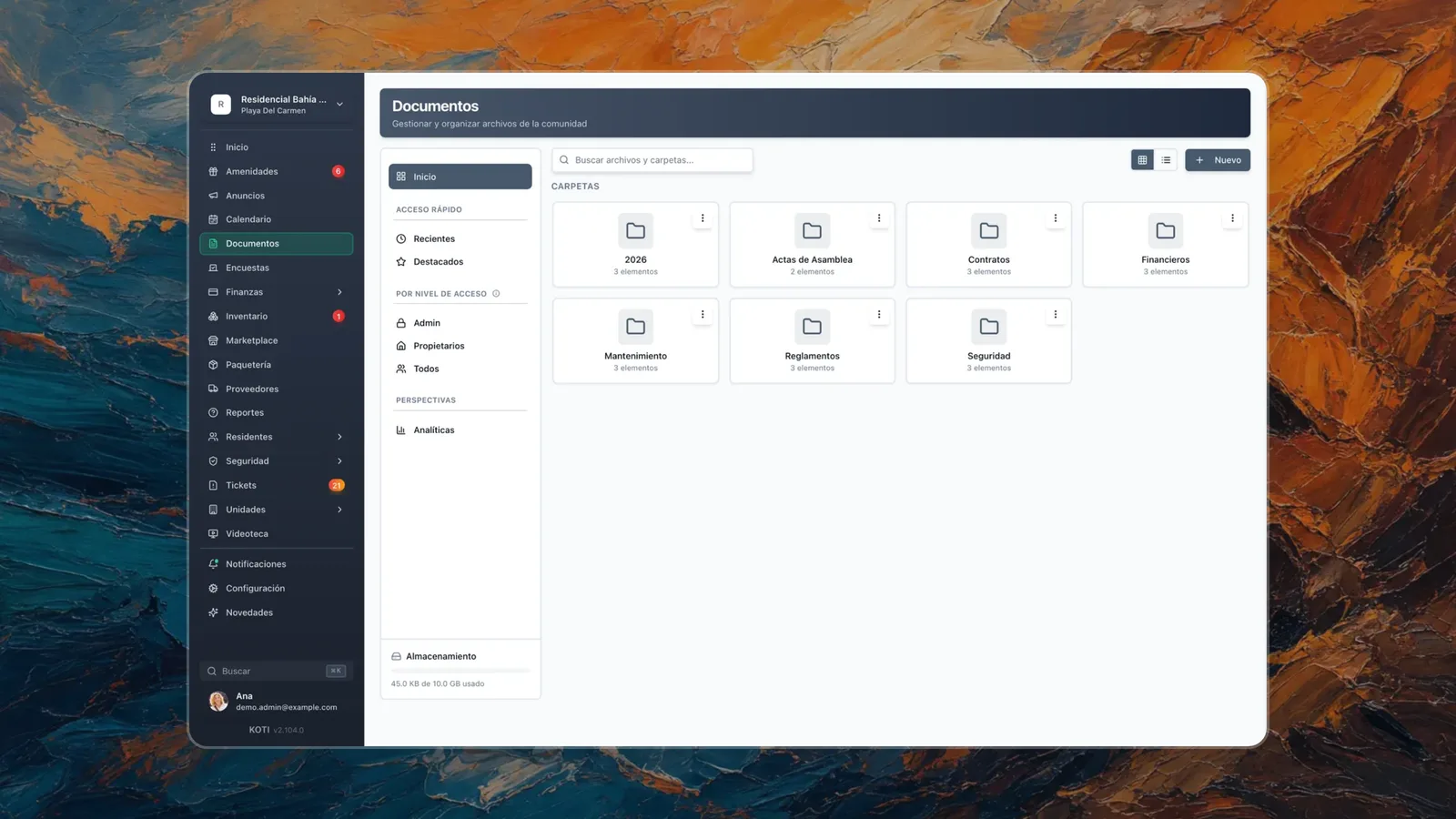
Once approved, the bylaws must be made accessible to all residents. The most effective way is to upload them to the Koti document hub, where all residents can consult them anytime from their phone. If you do not yet have the document to upload, the model internal bylaws in the next section are the starting point. Additionally:
- Notarize if state law requires it or for greater legal certainty
- Register with the Public Property Registry if applicable
- Provide a copy to each new owner or tenant upon move-in
- Post a summary of the most important rules in common areas
The 8 Rules Every Condo Needs (With Examples)
Beyond the structural elements of the bylaws, there are 8 practical coexistence rules that every condo should include with clear, specific wording. Here is each one with a sample text you can adapt for your community:
1. Noise and quiet hours
Noise conflicts are the number one cause of complaints in condos. Your bylaws must be precise:
"Noise that disturbs neighbors' peace is prohibited outside the hours of 8:00 AM to 10:00 PM Monday through Friday, and 9:00 AM to 10:00 PM on weekends. Renovation work may only be performed from 9:00 AM to 6:00 PM Monday through Friday."
2. Parking: assignment and visitors
Parking generates frequent conflicts. Clearly define allocation and usage:
"Each unit is assigned the parking space(s) indicated in the deed. Visitor spaces are for temporary use (maximum 12 hours) and may not be used by residents. Parking in circulation aisles, ramps, or in front of hydrants is prohibited."
3. Pets: conditions and responsibilities
Pet rules must balance owners' rights with everyone's peace of mind:
"Up to 2 domestic pets per unit are allowed. Owners are responsible for picking up their pets' waste immediately. Dogs must be on a leash in common areas and muzzled if they weigh over 20 kg. Leaving pets unsupervised in common areas is prohibited."
4. Common areas: reservations and schedules
Common areas need clear usage rules to prevent monopolization. You can manage amenity reservations through digital tools like Koti:
"The event hall may be reserved a minimum of 5 days in advance through the management platform. Usage costs $500 MXN, which includes post-event cleaning. Maximum usage hours are 10:00 AM to 11:00 PM."
5. Moving: schedules and deposits
Moves can cause damage and disturbances if not regulated:
"Moves may only take place Monday through Saturday from 9:00 AM to 6:00 PM, with 48 hours' prior notice to management. A $3,000 MXN deposit is required to guarantee repair of any damage to common areas, which will be refunded within 5 business days if no damage is reported."
6. Renovations: permits and restrictions
Uncontrolled construction can affect the building's structure and disturb neighbors:
"Any renovation that modifies plumbing, electrical, gas, or structural elements must have written authorization from the administrator and, when affecting common elements, from the assembly. Work may only be performed from 9:00 AM to 6:00 PM Monday through Friday."
7. Trash: schedules and separation
Waste management is essential for hygiene and coexistence:
"Trash must be placed in designated containers, separated into organic and inorganic. Bulky waste (furniture, appliances) must be coordinated with management for special collection. Leaving trash bags in hallways, stairways, or common areas is prohibited."
8. Visitors and access: registration and responsibility
Access control is fundamental for security:
"All visitors must register at the guard booth with official identification. Residents are responsible for their guests' conduct within the condo. Service providers (plumbers, electricians, etc.) must be previously authorized by the hiring resident."
Remember that these rules should be adapted to your community's specific needs. The important thing is that they are clear, specific, and enforceable.
Model Internal Bylaws: Copy and Adapt This Document
Here is the document you came for. It is a complete set of internal bylaws, with the ten elements from the previous section already drafted and the variables in brackets: copy it, replace the brackets, delete what does not apply to your community, and take it to legal review before the assembly. It is a starting point, not a substitute for a lawyer — and three of its articles depend on the state you administer in. We flag those with "Check your state" so you do not sign them blind.
INTERNAL BYLAWS OF CONDOMINIUM [name]
Approved by the General Assembly of Owners held on [date], recorded in minutes number [number] of the minutes book authorised by [Procuraduría Social / Oversight Committee / municipal secretary, per your state]. Version [1.0], in force from [date].
CHAPTER I. General provisions
Article 1. These Bylaws govern coexistence, the use of common areas and property, and the administration of Condominium [name], located at [full address], constituted under the condominium property regime by public deed number [number] dated [date], executed before notary public number [number] of [state], registered in the Public Property Registry under folio [number].
Article 2. They are binding on owners, occupants, tenants, family members, domestic staff, visitors and suppliers. Each owner is responsible for ensuring that anyone occupying or visiting their unit knows and follows them.
Article 3. Anything not covered here is governed by [exact name of your state's statute], by the constitutive deed, and by the resolutions of the General Assembly. No provision of these Bylaws may contradict them: one that does is treated as unwritten.
CHAPTER II. Owner rights and obligations (element 1)
Article 4. Owners have the right to: use their private unit and the common areas according to their purpose; attend assemblies with voice and vote under the statute; inspect statements of account, receipts and minutes; request in writing that items be added to the agenda; and challenge resolutions they consider contrary to the law or to these Bylaws.
Article 5. Owners are obliged to: pay ordinary fees, extraordinary fees and reserve-fund contributions on time; keep their unit in a condition that does not affect adjacent units or common areas; use it for the purpose set out in the constitutive deed; notify the administration, within [10] calendar days, of any sale, lease or change of occupant, and of the address and email where they wish to receive notices; and answer for damage caused by them, their occupants, their staff or their visitors to common areas or third parties.
CHAPTER III. Fees, payment schedule and late charges (elements 2 and 3)
Article 6. Ordinary fees are calculated by distributing the annual budget approved by the Assembly in proportion to each private unit's percentage of undivided interest, payable in advance within the first [5] calendar days of each month.
Check your state: where the statute requires apportionment by undivided interest — as Mexico City does in article 55 sections I and II — the bylaws cannot set equal fees for every unit, no matter what the assembly approves.
Article 7. Extraordinary fees and reserve-fund contributions are approved by the General Assembly, which sets in the same resolution their amount, their specific purpose and the payment schedule.
Article 8. Payment may be made by electronic transfer, bank deposit or through the condominium fee platform. The receipt must identify the unit and the period covered; payments that cannot be identified are held in suspense until the owner proves their origin.
Article 9. Late payment accrues interest at [rate] on the outstanding balance, calculated separately on each overdue fee and not compounded.
Check your state: this is the article that makes more bylaws unlawful than any other. Mexico City caps the charge at the statutory rate, which may not exceed 9% per year (art. 33 sec. V) — a "2% monthly" charge is unlawful there. Oaxaca caps it at 20% of the principal (art. 59). Quintana Roo leaves the rate to the bylaws or the assembly but forbids compounding (art. 43). Find your article before you write a number.
Article 10. The administration issues a receipt for every payment received and delivers a [monthly] statement of account to each owner, endorsed by the Oversight Committee and with proof of receipt.
CHAPTER IV. Maintenance and reporting (element 4)
Article 11. The administration is responsible for preventive and corrective maintenance of common areas and property, under the annual programme approved by the Assembly. Each owner is responsible for the interior of their unit, including its plumbing, sanitary, electrical and gas installations up to the point of connection with the common ones.
Article 12. Faults in common areas are reported to the administration through [channel: app, email or on-call phone] and recorded with a ticket number, date and owner. The administration acknowledges the report within [24] hours and attends to faults in this order of priority: emergencies (major leaks, general power failure, people trapped in a lift) immediately; urgent within [48] hours; ordinary within [5] business days.
Article 13. Where a fault originates inside a unit and affects others or the common areas, the cost of repair is borne by the owner of the unit where it originated.
CHAPTER V. Condominium bodies (elements 5, 7 and 8)
Article 14. The condominium's bodies are the General Assembly of Owners, the Administration and the Oversight Committee, with the powers granted to them by the statute, the constitutive deed and these Bylaws.
Article 15. The Ordinary General Assembly is held [frequency] and the Extraordinary one whenever called. Notice is issued [number] calendar days in advance, in writing, stating who is calling it, the type of assembly, date, time, a place inside the condominium and a detailed agenda, and is served on each owner in addition to being posted in [number] visible places within the condominium.
Check your state: frequency, notice period and quorum are not negotiable by bylaw. Assemblies are quarterly in Mexico City (art. 29 sec. I), six-monthly in Quintana Roo (art. 28 sec. III) and the State of Mexico (art. 28 sec. I), and annual in Nuevo León (art. 29 sec. II) and Jalisco (Civil Code art. 1020). Each state's periods and quorums are in the table in our assembly guide.
Article 16. Every assembly is documented in minutes containing the attendance list with signatures, quorum verification, agenda, proceedings, resolutions with each voting result, and the owner and deadline for each. The minutes are recorded in the authorised book and the administration informs each owner of the resolutions in writing within [7] business days.
Article 17. The Administrator is appointed by the General Assembly for a term of [1] year, renewable. They must prove they are current on their obligations to the condominium throughout their term, and post [a bond / security] of [amount] when handling condominium funds.
Article 18. In addition to the duties set by statute, the Administrator must: execute the Assembly's resolutions; keep the accounts and the minutes book; collect fees and issue receipts; present the report and statements of account within the periods set out here; hold condominium funds in a bank account in the condominium's name, separate from any personal account and with joint signatures with [the chair of the Oversight Committee]; hire and supervise staff and suppliers; and keep documentation available for any owner to inspect.
Article 19. The Oversight Committee is made up of [3] owners appointed by the Assembly for [1] year. It supervises the Administrator's management, endorses the statements of account and extraordinary expenses, calls an assembly when the Administrator fails to, and reports annually to the Assembly.
CHAPTER VI. Supplier contracting (element 6)
Article 20. For contracts above [$10,000] MXN per month, at least [3] quotes are obtained and the engagement requires the Oversight Committee's endorsement. Contracts are always in writing and in the condominium's name.
Article 21. For security, cleaning and gardening services contracted with a company, the administration must demand and retain: the provider's current registration in the Ministry of Labour's specialised-services registry (REPSE), the written contract stating the object of the service and the approximate number of workers, and monthly proof of social-security contributions for the staff assigned to the condominium. Missing any of these documents is grounds for termination.
CHAPTER VII. Coexistence rules (element 10)
Articles 22 to 29. The eight coexistence rules are incorporated here with the wording you saw in the previous section: noise and quiet hours, parking and visitors, pets, use and booking of common areas, moving, renovations, refuse, and registration of visitors and suppliers. Replace each one's hours, amounts and deadlines with those your assembly approves; what should not change is the format — specific conduct, exact limit or schedule, and who answers for it.
CHAPTER VIII. Breaches and sanctions
Article 30. Breaches of these Bylaws are handled in escalating steps: first a general reminder through the condominium's communication channels; then a formal written warning to the owner, describing the conduct, citing the article breached, granting [5] business days to correct it and stating the consequence of repetition; and only then the sanction.
Article 31. The applicable sanctions are: a fine of [amount or range]; temporary restriction of the use of [specific amenities] for up to [15] days; and payment of the cost of repairing the damage caused. They are applied uniformly, regardless of who commits the breach, and always after a documented warning.
Article 32. No sanction under these Bylaws may consist of restricting the potable water service, denying access to the private unit, or forfeiting the right to challenge the Assembly's resolutions.
Check your state: Mexico City expressly forbids restricting potable water (art. 33 sec. XII) and Quintana Roo exempts it from any suspension (art. 43); Guanajuato (art. 27 sec. XVII) and Sonora (art. 28 sec. XVII) allow it to be restricted but never suspended. And in Quintana Roo the administrator does not apply the delinquent owner's voting restriction: the Assembly imposes it, after hearing the offender (arts. 67 sec. IV and 68).
CHAPTER IX. Amending the Bylaws (element 9)
Article 33. Any owner, the Administrator or the Oversight Committee may propose amendments in writing. The draft is distributed to all owners at least [15] calendar days before the assembly that will discuss it. Approval requires [the quorum and majority set by your state's statute] and, once approved, the minutes are notarised and registered wherever the statute requires.
Check your state: in Mexico City an amendment to the internal bylaws is registered with the Procuraduría Social, and only an amendment to the constitutive deed goes to the Public Property Registry (art. 31, paragraphs a and b). In Quintana Roo both are entered in the Public Registry of Property and Commerce (art. 28).
CHAPTER X. Transitory provisions
First. These Bylaws take effect on [date] and supersede those approved on [date of the previous version].
Second. Their provisions apply from the date they take effect and cannot sanction earlier conduct.
Third. The administration publishes the version in force on [the condominium's document hub] and hands a copy to every owner and every new occupant on move-in.
Before you take it to the assembly
- Replace every bracket. Bylaws with unfilled brackets are bylaws nobody will take seriously.
- Settle the three "Check your state" points with the exact article of your statute, not with what the condo next door does.
- Have a specialist lawyer review it. One unlawful clause can bring down the whole document, and the review costs a fraction of a lawsuit.
- Circulate it [15] days in advance and take written comments before the assembly. Bylaws that were debated get followed; bylaws that were imposed get ignored.
- Once approved, upload it to the document hub with a version number and date, and announce the change through the community's communication channels. The version nobody can find is the version nobody follows.
How to Enforce Rules Without Creating Conflicts
Having excellent bylaws on paper is worthless if they aren't enforced. But enforcing them rigidly and impersonally can create more conflicts than it solves. The key is following a graduated enforcement pyramid, where most problems are resolved at the first levels without needing formal sanctions.
Level 1: Prevention — Make it visible and accessible
The best way to enforce a rule is to ensure everyone knows it. This requires the bylaws to be permanently available and easy to consult. Upload the complete document to the Koti document hub so any resident can access it from their phone at any time. Complement with:
- Clear signage in common areas (pool hours, parking rules, etc.)
- A visual summary of the most important rules in high-traffic areas
- Delivery of the bylaws (or a summary) to each new resident as part of their welcome process
Level 2: Education — Regular reminders and proactive communication
Don't assume that because the rule is written, everyone knows it. Send periodic reminders through Koti's communication channels about:
- Seasonal rules (summer pool usage, garden hours)
- Frequently violated rules, presented educationally rather than threateningly
- Recent bylaws changes
- Good coexistence practices
Tone is fundamental: a message saying "Let's remember to keep volume down after 10:00 PM to respect everyone's rest" is much more effective than "Anyone making noise after 10:00 PM will be sanctioned."
Level 3: Formal warning — Documented and direct
When prevention and education don't work, it's time to issue a formal written warning to the offending owner. The warning must:
- Describe the specific conduct violating the bylaws
- Cite the article or section being violated
- Grant a reasonable period to correct the behavior
- Inform of consequences for repeat offenses
Document each warning and preserve evidence (photos, videos, witness statements).
A warning with no date is not a warning. Publish the bylaws in force on the document hub, send the warning through community announcements and keep the receipt: version, date and recipient are recorded for you. That is exactly the evidence you will be asked for if the case escalates.
Level 4: Sanction — Amenity restriction or fines
If the formal warning has no effect, apply the sanctions prescribed in the bylaws. The most common sanctions include:
- Temporary restriction of amenity use (event halls, pool, gym)
- Application of financial penalties according to the bylaws' fee schedule
- Suspension of voting rights in assemblies (for delinquent owners)
Sanctions must be applied uniformly: the same conduct receives the same consequence regardless of who commits it.
Level 5: Escalation — PROSOC or legal action
As a last resort, when an owner persistently refuses to comply with bylaws, management can:
- Go to your state's body: PROSOC exists only in Mexico City, and there article 59 of the statute requires the administrator to prove, before starting the procedure, that they completed a documented internal mediation and conciliation. In Quintana Roo the route is the Centro de Justicia Alternativa (Title IX of the state act).
- Initiate a conciliation procedure at the relevant alternative justice center
- Pursue the appropriate civil action: for unpaid fees, the route is the civil executive proceeding, using the account statement signed by the Administrator and the president of the Oversight Committee (Mexico City art. 59; Quintana Roo art. 43). Watch out for the State of Mexico: there the statute creates no executive title. Article 36 says fees "constitute obligations of a civil nature and may therefore be enforced through the appropriate judicial route" — an ordinary lawsuit — and in exchange opens a door other states do not have: you may seek a precautionary attachment of assets to secure payment. Asking for "the civil executive procedure" in Toluca or Ecatepec is asking for something that statute does not provide.
The good news is that most conflicts are resolved at levels 1 and 2 when communication is effective and the rules are clear: almost nobody deliberately breaks a rule they knew about. Investing in prevention and education is always more cost-effective and less taxing than resorting to sanctions or legal action.
When and How to Update Your Bylaws
Condo bylaws are not a static document. Communities change, laws are updated, and new needs arise. Keeping outdated bylaws is almost as problematic as having none, as they lose credibility and may contain provisions that are no longer legally valid.
Signs it's time to update:
- Recurring conflicts on topics not covered by current bylaws (for example, electric scooters in common areas, rental platforms like Airbnb, or drone usage)
- New amenities that have been built or enabled (gym, coworking space, rooftop garden) that need specific usage and reservation rules
- Legislative changes at the state or federal level requiring adjustments to procedures or rights
- Rules nobody follows because they are impractical or disproportionate — a rule that 90% of residents ignore is a rule that needs revision, not stricter enforcement
- Condo growth from new phases or towers that change community dynamics
- More than 3 years have passed since the last comprehensive document review
Update process:
- Proposal: Any owner, the administrator, or the oversight committee can propose modifications. Collect suggestions and classify them by priority.
- Draft preparation: The administrator, ideally with legal support, prepares a draft of proposed modifications. Clearly mark what is being modified, added, and removed compared to current bylaws.
- Prior consultation: Distribute the draft to all owners at least 15 days in advance so they can review it and prepare their comments.
- Assembly approval: Call an assembly (ordinary or extraordinary depending on urgency) to discuss and vote on the modifications. Generally, a qualified majority of two-thirds of represented undivided interests is required.
- Update and redistribution: Once modifications are approved, update the complete document and distribute it to all residents. If the original bylaws were registered with the Public Property Registry, modifications must also be registered.
The importance of version control:
One of the most common problems is different versions of the bylaws circulating, creating confusion about which rules are in effect. It is essential that residents always have access to the current, official version of the document. The most effective way to achieve this is to maintain a single centralized digital version in the Koti document hub, where each update automatically replaces the previous one and all residents receive a change notification.
Practical recommendation: Schedule a comprehensive bylaws review every 2-3 years, even if there are no urgent issues. This allows for gradual improvements and keeps the document relevant to the community's current reality.
From PDF to Digital Bylaws: The Technology Advantage
The reality in most condos in Mexico is that the internal bylaws are a PDF document — or worse, on paper — delivered at the time of purchase and never consulted again. This disconnect between bylaws and the condo's daily life is one of the main reasons rules aren't followed: simply nobody remembers them.
The problem with paper or PDF bylaws:
- Nobody reads them: A 20-30 page document delivered once is rarely read in full, let alone consulted when a problem arises.
- Outdated versions circulate: If the bylaws were modified two years ago, residents who bought five years ago probably have a previous version. Which one is official? Nobody knows.
- Not searchable: When a resident wants to know the pet rule, they have to read through pages to find it. In practice, they end up calling management or asking in the WhatsApp group.
- Cannot be easily updated: Each modification requires reprinting or redistributing the document, generating unnecessary costs and logistics.
- No accountability: There is no way to confirm that the resident received, read, and accepted the rules.
The solution: a centralized digital document hub
Technology solves all these problems. With a digital document hub like Koti's, your bylaws become a living, accessible document:
- 24/7 access from any device: Residents can consult the bylaws from their phone at any time, whether they're in the elevator, at the pool, or in a discussion with a neighbor.
- Instant search: Instead of reading 30 pages, the resident types "pets" and finds the relevant section in seconds.
- Automatic version control: There is always a single official version. When updated, the previous one disappears and there's no confusion about which rules apply.
- Update notifications: When bylaws are modified, all residents receive a push notification on their phone, ensuring they're aware of changes.
- Access permissions: You can control who can see which documents, ensuring only appropriate information is available to residents, tenants, or staff.
How Koti enhances bylaws management:
Koti isn't just a document repository. It's a complete ecosystem that facilitates rule creation, communication, and compliance:
- Document hub: Store and share bylaws, assembly minutes, and any relevant document with all residents instantly.
- Polls and voting: Collect resident opinions for diagnostics and votes on bylaws modifications.
- Direct communication: Send reminders, formal warnings, and updates directly to each resident's phone.
- Amenity management: Apply common area reservation rules automatically, eliminating misuse conflicts.
- 24/7 mobile access: Everything from an intuitive app that requires no training.
The transition from paper to digital bylaws isn't a technological luxury — it's a practical necessity that transforms how your community lives by and respects its own rules.
Creating effective condo bylaws is one of the most important steps a community can take to ensure harmonious coexistence and protect property values. As we've covered in this guide, good bylaws must include the 10 essential elements, respect the legal framework, be drafted collaboratively, and above all, be accessible and applicable in daily life.
Remember the fundamental principles: rules must be clear and specific, not ambiguous; they must respect all owners' rights; they must be applied uniformly and gradually; and they must be living — updating when the community needs it. Bylaws that nobody knows about or can't access are bylaws that don't exist in practice.
The difference between a condo with constant conflicts and one where coexistence flows naturally isn't in the strictness of the rules, but in their clarity, accessibility, and how they are communicated and enforced. Digital tools like the Koti document hub and resident communication tools make it possible for your bylaws to stop being a forgotten document in a drawer and become the active foundation of coexistence in your community.
A note on sources. The articles cited in this guide were verified against the official text in force: Mexico City's Ley de Propiedad en Condominio de Inmuebles para el Distrito Federal (as amended 4 August 2023), Quintana Roo's Ley de Propiedad en Condominio de Inmuebles (as amended 12 November 2021), Nuevo León's Ley de Propiedad en Condominio de Inmuebles (as amended 11 October 2023), the State of Mexico's Ley que Regula el Régimen de Propiedad en Condominio (as amended 29 April 2024) and the Civil Code of the State of Jalisco. This guide is informational and does not replace a lawyer's advice on your specific case.
Try Koti for free
Simplify your condo management: dues, access and announcements in one place. 14 days free, no credit card.
Official sources
Every article cited in this guide was checked against the text published by the body that issued it. Condominium law in Mexico is state law: always read your own state’s, and confirm the date of the latest amendment before acting.
- Ley de Propiedad en Condominio de Inmuebles del Estado de Quintana Roo
Quintana Roo · Last amended: 12-11-2021 (P.O. del Estado) · Checked: 2026-08-09
- Ley de Propiedad en Condominio de Inmuebles para el Distrito Federal
Mexico City · Last amended: 04-08-2023 (G.O. CDMX) · Checked: 2026-08-09
- Ley de Propiedad en Condominio de Inmuebles para el Estado de Guanajuato
Guanajuato · Last amended: 30-11-2022 (P.O. Número 238, Tercera Parte) · Checked: 2026-08-09
- Ley de Propiedad en Condominio de Inmuebles para el Estado de Sonora (Núm. 101)
Sonora · Last amended: 21-06-2018 (Decreto No. 217, B.O. No. 21 Secc. II — reforma el primer párrafo del art. 36) · Checked: 2026-08-09
- Ley que Regula el Régimen de Propiedad en Condominio de Inmuebles para el Estado de Oaxaca
Oaxaca · Last amended: 18-09-2021 (Decreto Núm. 2646, P.O. Núm. 38 Décimo Primera Sección; aprobado 18-08-2021) · Checked: 2026-08-09
- Ley de Propiedad en Condominio de Inmuebles para el Estado de Nuevo León
Nuevo León · Last amended: 11-10-2023 (P.O. del Estado No. 128) · Checked: 2026-08-09
- Ley Número 240 de Propiedad en Condominio para el Estado de Guerrero
Guerrero · Last amended: — sin reformas · publicada 27-05-2025 (P.O. No. 42, Alcance I) · Checked: 2026-08-09
This guide is general information, not legal advice. For a specific matter, consult a lawyer in your state.
Written by
Equipo Koti
Condo Management Experts
The Koti Smart Communities team shares knowledge and best practices for efficient condo and residential community management.