Delinquency in maintenance fee payments is, without a doubt, the number one problem facing condominiums in Mexico. Nobody knows exactly how much of it there is: no national official statistic is published, and the estimates circulating among professional administrators run from 30% to 50% depending on the area and the type of development. Treat it as an order of magnitude — but the order of magnitude already says plenty: in a 100-unit community that would be between 30 and 50 families behind on payments.
There's a truth few administrators grasp in time: delinquency isn't collected — it's prevented. The communities with the best collection rates don't get there through legal threats or intimidation tactics. They get there through transparency, proactive communication, and above all a system that makes paying easier than not paying.
In this guide you'll find the legal framework that backs your role — article by article and state by state, because in Mexico condominium law is state law — a 4-stage collection protocol, the prevention actions that keep the problem from appearing, and the digital tools that take collections off your memory. If what you're after is the other side of the problem — how to build the collection process, the payment methods and the reminders — we cover it in depth in our guide on improving maintenance fee collection.
Condo Delinquency: A Problem That Affects Everyone
Behind every unpaid fee there is a physical consequence in the community, and that is where to look before looking at percentages.
The direct impact is devastating:
- Accelerated deterioration of common areas: without enough budget, gardens are neglected, water pumps fail, elevators stop receiving preventive maintenance, and recreational areas decay. What should be a pleasant place to live becomes a constant source of frustration.
- Reduction of essential services: security is cut to minimum shifts, cleaning goes from daily to weekly, and urgent repairs are postponed because there simply is not enough money. In extreme cases, some communities have had to drop security altogether.
- Devaluation of every property: a community with a neglected facade, a stopped elevator and an empty pool sells worse and rents worse. That affects all owners, including the ones who have always paid on time.
- Neighbour conflicts that fracture the community: tension between those who pay and those who do not breeds resentment, arguments at assemblies, and in the worst cases direct confrontation. Living together becomes unsustainable.
Perhaps the most dangerous effect is the vicious cycle of delinquency: when residents who do pay see that their fees are not reflected in improvements, that delinquent owners face no consequences, and that the community deteriorates despite their effort, they lose motivation. "If they don't pay and nothing happens, why should I pay?" is the thought that turns a good payer into a new delinquent. And so delinquency grows like a snowball until the community enters a financial crisis it is very hard to escape.
Breaking that cycle takes a comprehensive strategy combining prevention, communication, legal framework and technology. Let's see how to do it step by step.
Why Don't They Pay? The 5 Root Causes of Delinquency
Before jumping to solutions, you need to understand why residents don't pay. Delinquency is not a monolithic problem: it has several causes and each one calls for a different approach. These are the 5 main reasons:
1. Lack of financial transparency
This is by far the most common cause and the easiest to solve. When residents don't know exactly how their money is being spent, they lose trust in management. "Why should I pay if I don't know where my money goes?" is the phrase administrators hear most often. The fix is simple: publish clear, detailed, accessible financial statements. Per-unit account statements a resident can open whenever they want remove this objection entirely.
2. Real financial hardship
It is essential to recognise that some residents genuinely cannot pay. Unemployment, medical emergencies, economic crises, or unexpected extraordinary expenses can make covering the fee impossible. These cases call for empathy and flexibility: instalment plans, partial forgiveness of late interest, or temporary agreements. Treating a neighbour in financial trouble as a wilful delinquent only worsens the conflict.
3. Disagreement with the fees or with management
Some residents withhold payment as a form of protest. Perhaps they disagree with the fee amount, with an assembly decision, with work approved without their consent, or with the quality of management. Although that attitude is not legally valid as a justification for not paying, ignoring it only deepens the problem. The way out is to create formal channels for dialogue and participation.
4. Forgetfulness and lack of access to payment methods
Surprisingly, many delinquency cases are simply forgetfulness. The fee comes due, the resident didn't get a reminder, didn't have time to go to the bank, couldn't find the payment reference. If paying a maintenance fee takes more than three clicks, the process is failing. Automatic maintenance-fee billing, with the charge generated on its own and the reminder going out before the due date, removes this cause almost entirely.
5. The "if others don't pay, neither will I" culture
This is the contagion effect of delinquency, and it is the most dangerous one. When a resident perceives that a significant share of their neighbours don't pay and face no consequences, their motivation collapses. "Why should I be the only one who pays?" This social phenomenon is fought with two weapons only: transparency about the state of the receivables (without violating anyone's privacy, as we'll see) and clear, consistent consequences.
Understanding these causes does not mean justifying delinquency. It means designing strategies that attack the root of the problem instead of chasing its symptoms. An effective administrator is not a debt collector: they are someone who creates the conditions where paying is the natural, easy choice.
Legal Framework: What You Can and Cannot Do as an Administrator
Knowing the legal framework is essential to act firmly without crossing into illegality. And the first thing to say is that in Mexico condominium law is state law, not federal law: there are 32 separate instruments and they disagree precisely on the numbers that matter most to you. Everything below comes with an article and a state; always check the one that governs yours.
What the law allows you to do:
- Charge late interest, within a ceiling: in Mexico City the governing provision is article 33 fraction V — each unpaid fee accrues the legal interest rate, which may not exceed nine percent per year, and article 59 cross-references it for late interest. That is under 0.8% a month: the "2% to 5% monthly" repeated on forums would be unlawful there. Other states resolve it differently: Oaxaca requires late interest not to exceed 20% of the principal (art. 59), and Quintana Roo (art. 43) and Nuevo León (art. 48) leave the rate to the bylaws or the assembly but forbid compounding it. Delinquency control with automatic late fees exists precisely so the surcharge comes out of a written rule rather than a manual calculation.
- Condition benefits on compliance: Mexico City empowers the Assembly to "grant benefits to owners or possessors… in relation to the fulfilment of their obligations" (art. 33 fr. XIV), and reserves consultation of the community's books to those "who are current on ordinary and extraordinary fees" (art. 43 fr. IV). Rewarding the compliant owner is firm ground; punishing the delinquent one by restricting amenities is contested ground, and we cover it below.
- Suspend a delinquent owner's vote: this does not depend on the bylaws, the statute says so. Mexico City sets it out in article 34, which also defines a delinquent owner as one owing two maintenance fees or one extraordinary fee; Quintana Roo provides for it in articles 32 and 67 fraction IV; Nuevo León in article 34, always preserving the right to speak.
- Go to your state's mediation body: in Mexico City that is the Procuraduría Social (PROSOC), a free procedure and faster than a lawsuit — but note that article 59 requires you to prove to it beforehand that you completed a prior internal mediation and conciliation procedure, with demands, meetings, notices, formal reminders, invitations and/or settlement proposals. PROSOC exists only in Mexico City: in Quintana Roo the equivalent is the Centro de Justicia Alternativa, and other states use their own centres.
- Start the civil executive proceeding: it is not simply "suing in civil court", and it is not a commercial executive proceeding. The instrument that carries enforceability is the signed statement of liquidated arrears, accompanied by the unpaid receipts and a certified copy of the assembly minutes or the bylaws where the fees were set. The threshold varies by state: two ordinary fees or one extraordinary fee in Mexico City (art. 59) and Oaxaca (art. 59); three ordinary or one extraordinary in Quintana Roo (art. 43), Nuevo León (art. 48), Baja California (art. 63), Tabasco (art. 47) and Guerrero (Law No. 240, art. 85). Article 55 of the Mexico City statute is the one that establishes every owner's and possessor's obligation to pay fees punctually.
- Report payment status to owners: Mexico City requires the administrator to include in the monthly account statement "a detailed list of delinquent owners and the amounts of their debt" (art. 43 fr. XII (e)). That is informing the community — not posting names on the notice board: see below.
Three details of the executive bundle that get claims thrown out
The statement of liquidated arrears is not signed the same way everywhere, and that is where months get lost:
- Mexico City (art. 59): it is signed by the Administrator and the president of the Oversight Committee, with the unpaid receipts and a certified copy of the minutes or the bylaws by a Notary Public or by the Procuraduría itself — the second option is considerably cheaper and almost nobody uses it.
- Nuevo León (art. 48): the account statement may be signed by the Administrator only if they are a certified public accountant; if they are not, it must be signed by the public accountant empowered by the Condominium through the General Assembly, together with the president of the Comité Consultivo y de Vigilancia. An administrator who signs without being an accountant files a defective title.
- Estado de México: there is no executive title here at all. Article 36 says fees "constitute civil obligations" and "may be enforced through the corresponding judicial route", i.e. an ordinary suit — but in exchange it opens a door other states do not have: "precautionary attachment of assets may be requested to secure payment". There is no arrears threshold to wait for and no signature formula to satisfy: you sue and you ask for the attachment. If you manage in Ecatepec, Naucalpan, Cuautitlán, Atizapán, Toluca or Metepec, asking your lawyer for "la vía ejecutiva civil" is asking for something your state does not have.
What the law FORBIDS you from doing:
- Cutting off the water: this is the country's most consistent prohibition, and it is worth starting with the Mexico City statute, where most of the market lives. Its article 33 fraction XII closes with nine words that leave nothing to interpret: "No se podrá restringir el servicio de agua potable" — the drinking water service may not be restricted. Quintana Roo allows suspending services paid from the common fund, with prior authorisation of the Oversight Committee, but "except where it concerns the water service" (art. 43); Nuevo León repeats the same exception (art. 48); Guanajuato (art. 27 fr. XVII) and Sonora (art. 28 fr. XVII) state that "in no case may the drinking water service be suspended, it may only be restricted"; and Guerrero goes further than any of them: its statute in force forbids suspending drinking water, electricity or domestic gas (Law No. 240, art. 86). To learn more about the legal framework, see our guide to Mexican condominium law.
- Restricting services on your own authority: where restriction is allowed, it is not yours to order. In Mexico City it is provided for — worth saying, because many administrators believe it is not — but article 33 fraction XII reserves it to the General Assembly, which may resolve on restricting electricity, gas and other services for non-payment "provided such services are covered by those ordinary fees". Do it on your own and you are acting outside your powers. Quintana Roo (art. 43) and Nuevo León (art. 48) do leave it with the administrator, but with prior authorisation of the Oversight Committee; in Guanajuato and Sonora the Assembly resolves it; and Guerrero (Law No. 240, art. 86) allows suspending only non-essential common services, with express Oversight Committee authorisation and written or emailed notice at least 48 hours in advance.
- Posting a named delinquency list in common areas: Mexico City requires the personal data in the detailed arrears list to be withheld for safety, accessible only to Oversight Committee members or an authority that requests it on duly founded and reasoned grounds (art. 43 fr. XII (b)). Quintana Roo goes further: its article 69 forbids the Administrator from sharing owners' sensitive or personal information without written consent or the grounds set out in the Federal Law on Protection of Personal Data Held by Private Parties.
- Restricting amenities with nothing behind it: no condominium statute in the country expressly authorises cutting a delinquent owner off from the gym or the pool. It is the only item on this list with no article to cite, so it is worth being honest about it: if you do it, do it with a bylaw clause approved at assembly, applied uniformly, and only over non-essential amenities — never over access to their home or to circulation routes. The route with text behind it is the inverse one: conditioning benefits on compliance (art. 33 fr. XIV).
- Intimidation or harassment: posting signs with a delinquent resident's name and photo, calling at inappropriate hours, sending threatening messages, or publicly confronting the resident are illegal practices that can lead to complaints for harassment, defamation, or moral damages.
- Preventing access to their home: no resident may be prevented from reaching their property, whatever their payment status. Blocking doors, withholding keys, or denying vehicle access to their private parking space are illegal acts.
- Making unilateral decisions about sanctions: any sanction or restriction must be backed by the internal bylaws and approved at assembly. An administrator acting on their own may face legal consequences.
Key recommendation: document absolutely everything. Every communication, every notice, every payment agreement, every receipt. If the case reaches legal proceedings, documentation is your best defence — and in Mexico City it is not optional, because article 59 will ask for it before your procedure is admitted. A financial module that records every charge, every reminder and every payment on its own saves you from reconstructing that history afterwards.
Prevention Strategy: 6 Actions That Eliminate Delinquency Before It Happens
The best strategy against delinquency isn't collecting better — it's keeping it from happening. The communities with the highest collection rates share one trait: they have built a system where paying is easy, transparent and even rewarding. These are the 6 key actions:
1. Total financial transparency
Publish a real-time financial dashboard where any resident can see exactly how every peso is spent: income, expenses, budget versus actuals, reserve fund, vendors. When residents see their money is well managed, the "I don't know where my money goes" objection runs out of argument — and it is cause number one on the list above.
2. Multiple payment channels
Not all residents can or want to pay the same way. SPEI transfer, direct debit with their bank, over-the-counter or convenience-store deposit: each channel you add reduces friction and captures a different segment. What matters is that the reference is unique per unit, so the payment identifies itself instead of landing as an anonymous deposit on the community's bank statement.
3. Automatic reminders
Set up a sequence: 7 days before the due date ("your fee is due next week"), 3 days before, on the due date, and the day after if no payment was recorded ("your fee is overdue, avoid late charges"). They should be friendly, informative, and carry the payment details inside. Automation removes forgetfulness as a cause of delinquency — and it is the only one of the six actions that keeps working while the administrator is on holiday.
4. Fair fees, justified with a transparent budget
Present a detailed breakdown at every assembly: what security costs, cleaning, maintenance, insurance, the reserve fund. When residents understand why the fee is what it is, they accept it far more easily. Use charts, comparisons with similar communities, and projections. An informed owner is a paying owner.
5. Payment culture and positive recognition
Instead of only pointing at delinquents, recognise those who pay on time. Publish compliance statistics by building or section and thank current owners in community communications. That motivates good payers and creates positive social pressure. Some communities also offer small incentives: an early-payment discount, a monthly raffle among those who paid on time, or priority for amenity bookings. Remember that rewarding compliance has statutory text behind it (Mexico City art. 33 fr. XIV); punishing non-compliance by restricting amenities does not.
6. Payment ease: the fee from the phone
If a resident needs more than a minute to pay their fee, the process is failing. Offer a resident mobile app where they can see their statement, their history and the community's payment details: they transfer by SPEI to the community's own CLABE, attach the proof from their phone, and stop posting screenshots to the WhatsApp group. Because the money lands straight in the community's account, there is no gateway fee in between. In-app card payment is in development.
Combining these 6 actions doesn't just reduce delinquency: it prevents it. And they have one advantage over any collection strategy — they don't depend on somebody having the awkward conversation.
4-Stage Collection Protocol (From Friendly to Legal)
When prevention isn't enough and a resident falls behind, you need a clear, documented, escalating protocol. The key is to act fast but proportionately: each stage raises the seriousness of the action and gives the delinquent owner a chance to catch up before escalating.
Stage 1: Friendly reminder (days 1-15 overdue)
- Send an automatic reminder the day after the due date. Keep it cordial and solution-oriented: "We noticed your [month] fee hasn't been recorded yet. If you've already made the payment, please send your receipt. If you need help, we're here for you."
- Resend at 7 days if there's no response, with the payment details inside the message.
- At 15 days, send a second notice mentioning that late interest will be applied if the balance isn't cleared. Still friendly, but firm.
- Most cases resolve here, especially when the reason was forgetfulness or disorganisation — which, as we saw, is the most frequent cause and the cheapest one to attack.
Stage 2: Personal contact and payment plan (days 15-30)
- If the first notice didn't work, it's time for direct contact. Call or send a personalised (not mass) message. Ask whether something is preventing them from paying.
- Offer options: a 2 or 3-month plan, partial forgiveness of interest if they clear the principal immediately, or a committed date.
- Document everything in writing: the agreement reached, the committed dates, the amounts. Per-unit account statements with the full history head off the "but I already paid that" argument.
- Listen with empathy. Many delinquent owners at this stage face real difficulties and respond well when they feel treated with respect.
Stage 3: Formal notification and consequences (days 30-60)
- Send a formal written notification (letter with acknowledgment of receipt, or email with read confirmation). It should include: amount owed, breakdown of late interest, a 15-day deadline to clear it, and the specific consequences if they don't.
- Apply the consequences that are approved in the bylaws and lawful in your state. Vote suspension you have by statute; amenity restriction requires a bylaw clause and uniform application; restricting common services is not yours to order in Mexico City — the Assembly resolves it (art. 33 fr. XII) — and in no state does it reach drinking water.
- Apply late interest within your state's legal ceiling and make sure the calculation is correct and transparent. With late fees calculated on their own the day after the due date, the rule stops depending on somebody applying it by hand, and every notice is logged with its date — which is exactly the evidence the Procuraduría will ask for before admitting your procedure.
- If there is a finance or oversight committee, notify them so the case is on record.
Stage 4: Legal action (more than 60 days overdue)
- Go to your state's mediation body. In Mexico City that is the Procuraduría Social (PROSOC): the process is free and usually ends in a conciliation hearing, but article 59 requires you to prove beforehand that you completed an internal mediation and conciliation procedure — which is why documenting stages 1 to 3 is not a formality. In Quintana Roo the equivalent is the Centro de Justicia Alternativa; other states use their own.
- If conciliation fails, consult a lawyer about bringing the civil executive proceeding, not an ordinary civil suit. First check your state's threshold: two ordinary fees or one extraordinary fee in Mexico City (art. 59) and Oaxaca (art. 59); three ordinary or one extraordinary in Quintana Roo (art. 43), Nuevo León (art. 48), Baja California (art. 63), Tabasco (art. 47) and Guerrero (Law No. 240, art. 85). Then assemble the bundle with the signatures your state demands — and re-read the legal section above before signing it, because in Nuevo León the account statement must be signed by a certified public accountant, and in Estado de México the executive route does not exist at all: there you sue in an ordinary proceeding and request precautionary attachment (art. 36).
- Present the case at a general assembly (without names, but with the debt figures) so the community backs the legal action and approves the associated costs.
- Keep an impeccable record of every prior communication: it will be your evidence in the proceeding.
Golden rule: never skip stages. Escalation is not only more effective — in some states it is a requirement: in Mexico City, article 59 obliges the administrator, before starting a procedure before the Procuraduría Social, to prove they completed a prior internal mediation and conciliation procedure evidencing demands, meetings, notices, formal reminders, invitations and/or settlement proposals. Each documented stage is exactly that proof.
How Technology Reduces Delinquency
Technology has changed how communities manage collections. An administrator still using spreadsheets, paper receipts and door-to-door collection is fighting a problem that moves every day with last century's tools. Let's see how digital tools attack each cause of delinquency:
Aging reports
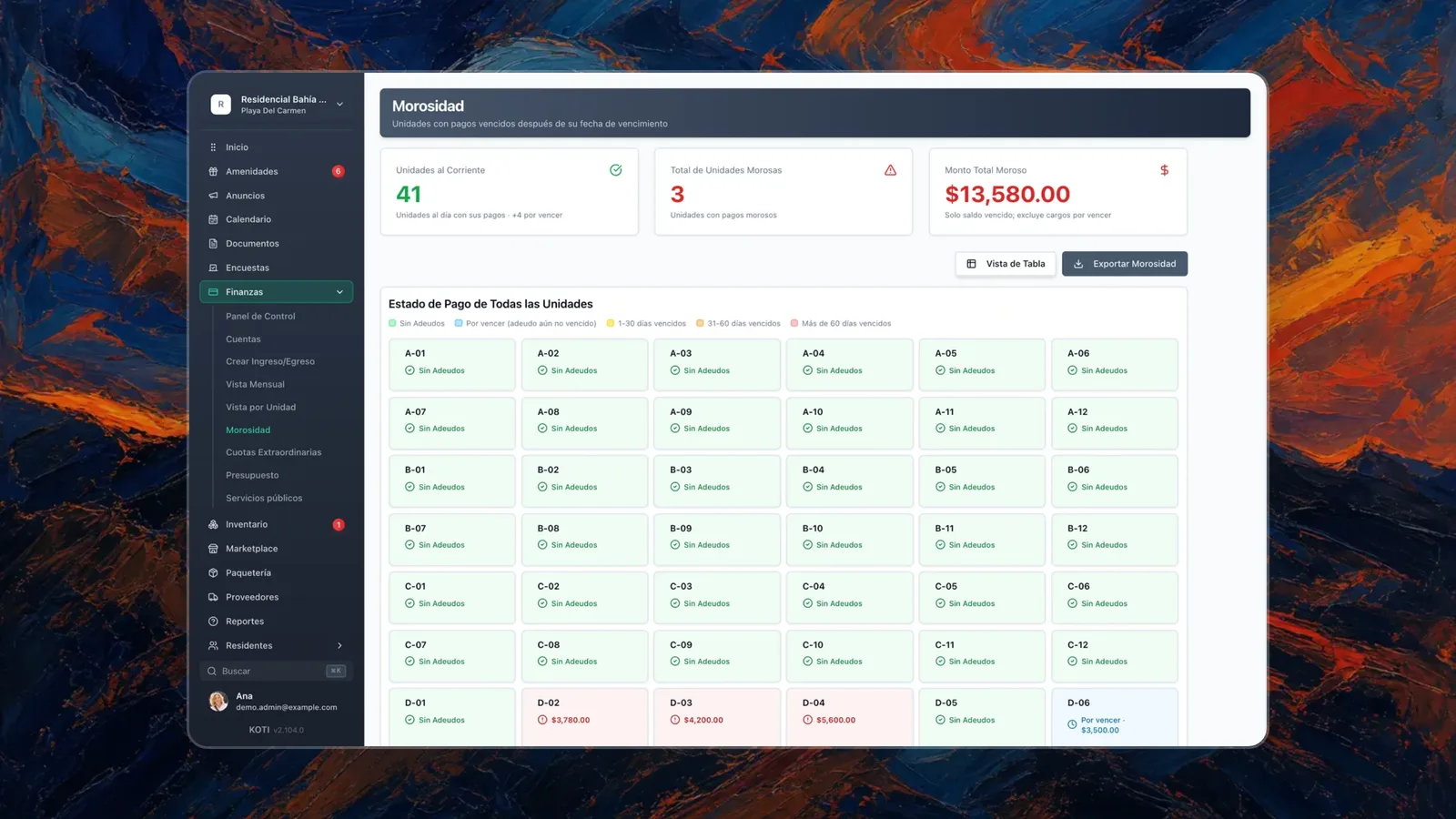
An aging report classifies each unit's debt by days overdue: current, 1-30, 31-60, over 60. With that you prioritise: who just fell behind and only needs a reminder? Who has been three months behind and needs a payment plan? Who has already crossed the arrears threshold that makes the civil executive proceeding available in your state? The delinquency map with a per-unit colour code answers those three questions at a glance. Without that visibility, administrators end up treating every case the same and spending effort where it doesn't belong.
Charges and reminders that go out on their own
Automatic maintenance-fee billing generates the month's charge from each unit's configuration and fires the reminders before and after the due date, without anyone having to remember. And because the late fee is applied from the rule you defined, the consequence stops being an awkward decision somebody has to make every month: it is a rule that was already written down.
A real-time collections dashboard
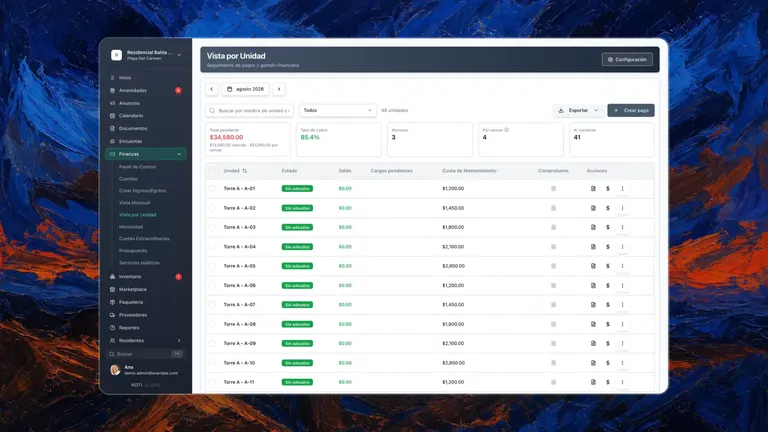
A finance dashboard shows the overall collection rate and the rate by section, collected versus outstanding, the historical trend, and the ranking of units by debt age. With that you make informed decisions, spot patterns (does delinquency rise in certain months?), and arrive at the assembly with figures that came out of the system rather than a spreadsheet built the night before. If you'd rather see the whole financial side in one place, that is the entry point.
Identified payments, without WhatsApp screenshots
The friction isn't only in paying: it's in proving you paid. The resident transfers by SPEI to the community's own CLABE, attaches the proof in their app, and the administrator applies it to the right charge in one click — with no gateway fee, because the money never leaves the community's account. In-app card payment is in development; meanwhile, recording by reference and bank reconciliation are what keep a deposit from ending up orphaned on the bank statement.
Technology doesn't replace human management, but it amplifies it. An administrator with the right tools can run collections for 200 units as comfortably as they used to run 50. And, more importantly, they can spend their attention on the cases that genuinely need it instead of losing an afternoon to work a machine does better.
7 Mistakes Administrators Make When Collecting
Even with the best intentions, many administrators make mistakes that not only fail to solve delinquency but make it worse. These are the 7 most common ones and how to avoid them:
1. Waiting too long to act
The most expensive mistake. Many administrators wait 3, 6, even 12 months before acting, trusting the delinquent owner will "catch up on their own". Every day of inaction sends a clear message: not paying has no consequences. The protocol should fire the day after the due date. Friendliness and promptness are not mutually exclusive.
2. Cutting off the water, or restricting services without the authorisation the law requires
As we saw in the legal section, drinking water is the line no state lets you cross: Mexico City says so outright in article 33 fraction XII, Quintana Roo (art. 43) and Nuevo León (art. 48) exempt it from any suspension, Guanajuato and Sonora allow only restricting it, and Guerrero additionally forbids cutting electricity and domestic gas (Law No. 240, art. 86). Non-essential common services can indeed be restricted in several states, but almost never by the administrator's unilateral decision: in Mexico City the Assembly resolves it (art. 33 fr. XII), as it does in Guanajuato and Sonora; in Quintana Roo and Nuevo León it takes prior authorisation from the Oversight Committee; and in Guerrero, express Committee authorisation plus 48 hours' notice. It is also usually counterproductive: far from motivating payment, it breeds hostility and turns the delinquent owner into a victim in front of their neighbours.
3. Not documenting communications
If it wasn't written down, it didn't happen. Administrators who make calls, verbal agreements or informal notices without documenting them lose all their evidence if the case reaches legal proceedings — and in Mexico City they also lose access to the Procuraduría Social, which requires proof of the prior internal procedure. Every communication, every notice, every agreement should carry a date, its content, and confirmation of receipt. A digital management system automates that log.
4. Treating every delinquent owner the same
The resident who forgot to pay and catches up on one reminder is not the neighbour facing a real financial crisis, and neither is the one deliberately withholding payment as a protest. Each profile calls for a different approach: empathy and flexibility for some, firmness and consequences for others. A rigid protocol that doesn't distinguish between situations creates more problems than it solves.
5. Not offering payment alternatives
If your only option is a transfer to an account number the resident has to dig out of a six-month-old email, you are manufacturing delinquency. Offer several channels and, above all, put the payment details and the unit's reference inside every reminder, so the neighbour doesn't have to look for them anywhere.
6. Lack of financial transparency
If residents don't know how their money is spent, they won't trust management, and that distrust turns into delinquency. Publish monthly financial statements, present detailed reports at assemblies, and keep a financial dashboard the neighbour can open whenever they like. Transparency is the most powerful antidote to delinquency born of distrust.
7. Not using the technology that exists
Running a community's collections with spreadsheets and paper receipts is like navigating with a paper map when you have GPS. Reminder automation, payment tracking, aging reports, reconciliation, automatic documentation: all of it is available and affordable. If what you need is to build the collection process from scratch — payment methods, reconciliation, reminders, incentives — we walk through it step by step in our guide on improving maintenance fee collection.
Avoiding these 7 mistakes won't guarantee you eliminate delinquency completely, but it will guarantee your management is professional, lawful and considerably more effective.
Delinquency in condos is not an inevitable fate: it's a problem with a solution. As we've seen throughout this guide, the key is combining four elements: legal knowledge to act firmly and within your state's law, prevention to remove root causes before they turn into arrears, a staged collection protocol that is fair and documented, and technology that automates the repetitive part.
Remember the premise: delinquency isn't collected — it's prevented. The communities with the best collection rates aren't the ones with the most aggressive lawyers or the harshest penalties. They're the ones that built an ecosystem where transparency creates trust, where paying is fast and easy, where owners understand the value of their contribution, and where the consequences of not paying are clear, fair and consistent.
A necessary note: this guide quotes the text of the state statutes that govern condominium collections, but it does not replace a lawyer. Before starting any legal action, or writing a sanction into your bylaws, verify the instrument currently in force in your state with a real estate law specialist.
If you want to see what all of this looks like inside a platform, Koti's condo management software costs $19 MXN + VAT per unit per month, with no tiers and no volume discounts, and includes the financial dashboard, automatic late fees, per-unit statements and the aging reports we went through here.
Try Koti for free
Simplify your condo management: dues, access and announcements in one place. 14 days free, no credit card.
Official sources
Every article cited in this guide was checked against the text published by the body that issued it. Condominium law in Mexico is state law: always read your own state’s, and confirm the date of the latest amendment before acting.
- Ley de Propiedad en Condominio de Inmuebles para el Estado de Nuevo León
Nuevo León · Last amended: 11-10-2023 (P.O. del Estado No. 128) · Checked: 2026-08-09
- Ley de Propiedad en Condominio de Inmuebles para el Distrito Federal
Mexico City · Last amended: 04-08-2023 (G.O. CDMX) · Checked: 2026-08-09
- Ley de Propiedad en Condominio de Inmuebles del Estado de Quintana Roo
Quintana Roo · Last amended: 12-11-2021 (P.O. del Estado) · Checked: 2026-08-09
- Ley Número 240 de Propiedad en Condominio para el Estado de Guerrero
Guerrero · Last amended: — sin reformas · publicada 27-05-2025 (P.O. No. 42, Alcance I) · Checked: 2026-08-09
- Ley de Propiedad en Condominio de Inmuebles para el Estado de Guanajuato
Guanajuato · Last amended: 30-11-2022 (P.O. Número 238, Tercera Parte) · Checked: 2026-08-09
- Ley de Propiedad en Condominio de Inmuebles para el Estado de Sonora (Núm. 101)
Sonora · Last amended: 21-06-2018 (Decreto No. 217, B.O. No. 21 Secc. II — reforma el primer párrafo del art. 36) · Checked: 2026-08-09
- Ley que Regula el Régimen de Propiedad en Condominio de Inmuebles para el Estado de Oaxaca
Oaxaca · Last amended: 18-09-2021 (Decreto Núm. 2646, P.O. Núm. 38 Décimo Primera Sección; aprobado 18-08-2021) · Checked: 2026-08-09
This guide is general information, not legal advice. For a specific matter, consult a lawyer in your state.
Written by
Equipo Koti
Condo Management Experts
The Koti Smart Communities team shares knowledge and best practices for efficient condo and residential community management.