Delinquency in maintenance fee payments is one of the most serious and frequent problems facing condos in Mexico. Nobody knows exactly how much of it there is: no national official statistic is published, and the estimates circulating among professional administrators run from 30% to 50% depending on the area and the type of development. Treat it as an order of magnitude — but the order of magnitude already says enough: in a 100-unit community that would be between 30 and 50 families behind on payments.
The good news is that delinquency is not an unsolvable problem. With the right process, empathetic communication, and the right tools, it's possible to improve collection and build a payment culture in your community.
In this guide we look at the causes of delinquency, 10 strategies to improve collection, the three numbers you have to look up in your state's statute before penalising anyone, and how automation changes a community's financial management. If what you need is the legal side in depth — what you can and cannot do about someone who has stopped paying, state by state — we cover it in the legal guide to delinquent condo owners.
The Delinquency Problem in Mexican Condos
Before talking about strategies it helps to see what exactly breaks when collections fall, because the damage isn't only accounting.
The impact is devastating:
- Service deterioration: without sufficient resources, security is reduced, cleaning is neglected, and maintenance is postponed indefinitely.
- Property devaluation: a poorly maintained condo loses value in the real estate market, affecting all owners, even those who do pay.
- Neighbour conflicts: delinquency generates resentment between those who pay and those who don't, fracturing community life.
- Legal and structural risk: lack of preventive maintenance can lead to serious infrastructure problems, with legal liabilities for the administration.
- Vicious cycle: residents who do pay see that their fees don't translate into improvements, which demotivates them and can turn them into new delinquents.
It's important to understand that behind every unpaid fee there's a story. Delinquency is rarely simply "bad will." Understanding the real reasons allows us to design more effective and empathetic strategies.
Why Don't Residents Pay Their Fees?
Before implementing any collection strategy, it's essential to understand the reasons behind delinquency. Identifying the cause allows you to apply the correct solution:
1. Forgetfulness or disorganization
Many residents simply forget the payment date. Without automatic reminders, the fee falls to the bottom of the priority list. This is, paradoxically, one of the easiest problems to solve with technology.
2. Distrust in management
When residents don't see clear reports of how their fees are spent, they lose motivation to pay. "Why should I pay if I don't know where my money goes?" is a phrase every administrator has heard. Financial transparency is the best response to this objection.
3. Inconvenient payment process
If paying requires going to a bank, standing in line, or making complicated transfers, many residents postpone it. Limited payment methods are a real barrier that discourages compliance.
4. Financial hardship
It's important to acknowledge that some residents genuinely face financial difficulties. Unemployment, medical emergencies, or economic crises can make timely payment impossible. An empathetic approach with flexible options is more effective than threats.
5. Disagreement with management
Some residents withhold payment as a form of protest: over decisions they consider unfair, construction they didn't approve, or services they consider deficient. While this attitude is not legally valid as justification, ignoring it only worsens the problem.
Understanding these reasons doesn't mean justifying delinquency, but rather designing strategies that address the root of the problem instead of just its symptoms.
10 Strategies to Improve Fee Collection
None of these strategies works on its own. The point is to combine several of them so that collections stop depending on somebody remembering.
1. Offer multiple payment channels
The easier it is to pay, the more people will pay on time. SPEI transfer, direct debit with the resident's bank, over-the-counter deposit, and convenience store payments (OXXO, 7-Eleven) cover very different profiles inside the same community. What none of them can lack is a unique reference per unit: without it, the deposit reaches the bank with no name and ends up on the unidentified-payments pile.
2. Implement automated reminders
Send notifications via email, SMS, or push 5 days before the due date, on the due date, and 3 days after if no payment has been recorded. Consistency in reminders significantly reduces delinquency caused by forgetfulness — and it is the only part of the process that keeps working while the administrator is on holiday.
3. Publish transparent financial reports
Share detailed monthly financial statements showing income, expenses, and where every peso goes. When residents see their money is being used correctly, willingness to pay increases. Use Koti's financial module to generate professional reports automatically.
4. Early intervention
Don't wait for debt to accumulate for months. At 15 days past due, contact the resident directly. An empathetic call asking "Is there anything we can help you with?" is much more effective than a threatening notice on their door.
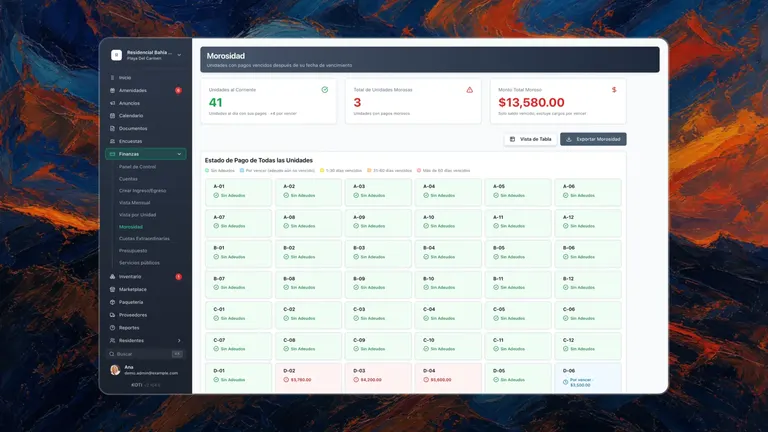
To call on day 15, you first have to know who is on day 15. That is the real problem with early intervention: it isn't the call, it's the list. Delinquency control with an aging report sorts every unit by days overdue with a colour code, and reminders go out on their own before and after the due date — so the day-15 call lands in your calendar instead of showing up three months late.
5. Establish clear and gradual consequences
Define a progressive scheme: a late charge, benefits conditioned on compliance, and as a last resort whichever judicial action your state provides. You do not pick the late rate freely: in Mexico City interest may not exceed 9% per year (art. 33 fr. V), in Oaxaca it may not exceed 20% of the principal (art. 59), and in Quintana Roo the bylaws or the assembly set it but it may not be compounded (art. 43). Make sure these consequences are in the bylaws, inside your state's legal ceiling, and known to everyone.
6. Offer payment plans for accumulated debts
For residents with significant debts, negotiate realistic payment agreements. It's better to receive consistent partial payments than nothing at all. A 6 to 12-month plan with fixed monthly payments can be the difference between recovering the debt or losing it.
7. Create incentives for on-time payment
Recognize and reward those who pay on time: early payment discounts (5-10% in the first days of the month), quarterly raffles among current owners, or public recognition (with their consent) in the community newsletter. Rewarding compliance also has explicit statutory backing in Mexico City, where the Assembly may "grant benefits to owners… in relation to the fulfilment of their obligations" (art. 33 fr. XIV).
8. Foster a sense of community
Organize community events, share condo achievements, and show how fees improve everyone's life. When residents feel part of a community, payment commitment increases naturally.
9. Professionalize invoicing
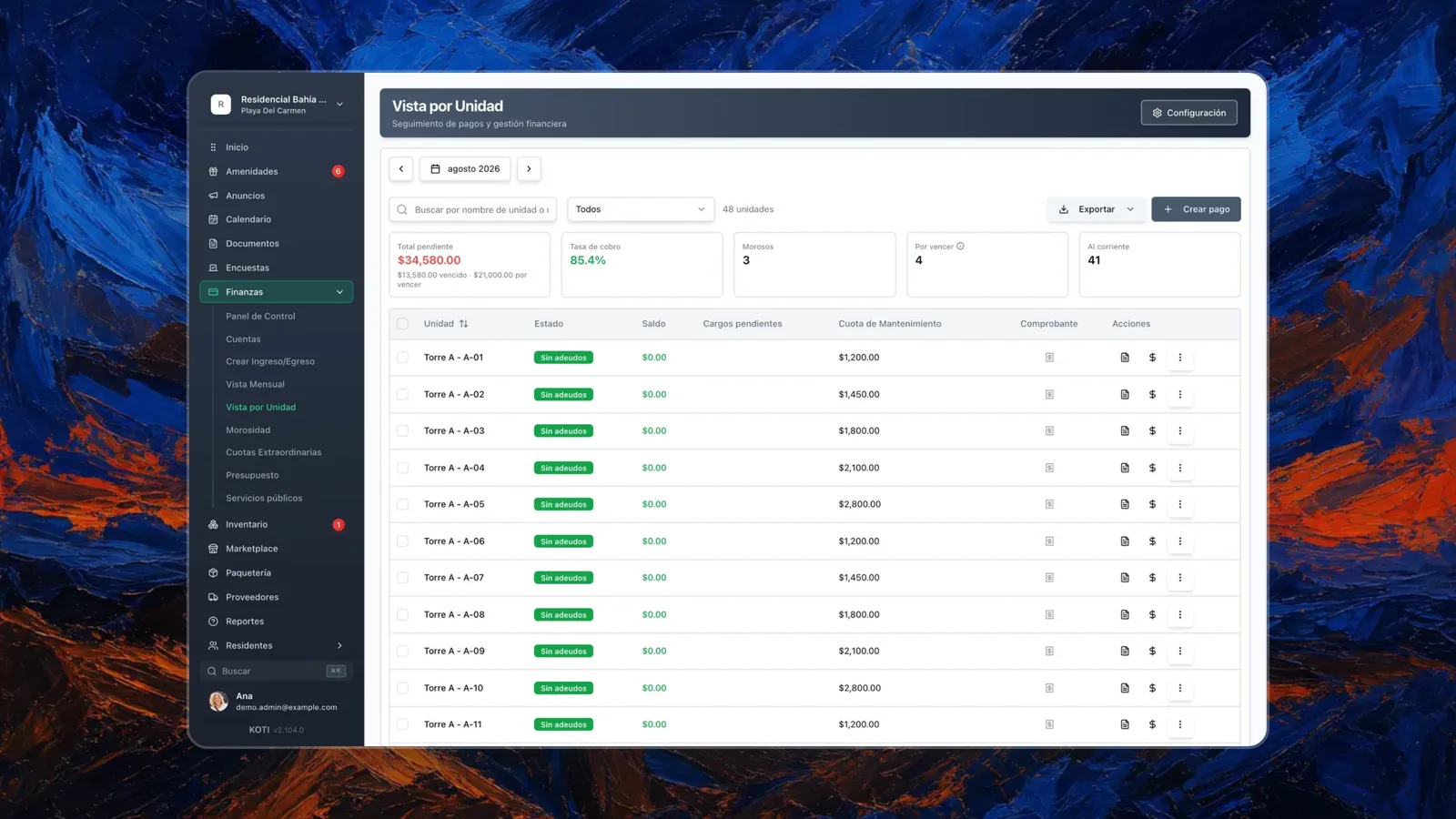
Send clear, professional, and timely account statements. Include the fee breakdown, due date, available payment methods, and the resident's balance. Per-unit statements and receipts are generated and sent on their own, and the resident can download them from their app without asking you over WhatsApp.
10. Automate the whole process
Automation eliminates human errors, reduces administrative costs, and ensures consistency. From charge issuance to reminders to reconciliation, automatic maintenance-fee billing digitizes the entire cycle so you can focus on what truly matters: your community.
Legal Framework: The Three Numbers You Have to Look Up
The first fact changes everything: in Mexico, condominium law is state law, not federal law. There are 32 separate instruments and they differ on exactly the numbers that matter most for collecting. Before writing a single penalty into your bylaws, look up these three in your state's statute:
1. The ceiling on late interest. You don't choose it. In Mexico City it is the legal interest rate and it may not exceed nine percent per year (art. 33 fr. V, cross-referenced by art. 59) — under 0.8% a month, so the widely repeated "2% monthly" is 24% a year and would be unlawful there. In Oaxaca late interest may not exceed 20% of the principal (art. 59). In Quintana Roo (art. 43) and Nuevo León (art. 48) the bylaws or the assembly set the rate, but interest may not be compounded.
2. The arrears threshold for suing. Mexico City allows the action once two ordinary fees or one extraordinary fee are outstanding (art. 59); Quintana Roo (art. 43), Nuevo León (art. 48), Baja California (art. 63), Tabasco (art. 47) and Guerrero (Law No. 240, art. 85) require three ordinary or one extraordinary. And watch out for Estado de México: there the statute creates no executive title — article 36 says fees "constitute civil obligations" enforceable "through the corresponding judicial route", and in exchange allows requesting precautionary attachment of assets.
3. Which services you may restrict, and who decides. Drinking water is untouchable in every state. And the decision is rarely the administrator's: in Mexico City, restricting electricity, gas and other services for non-payment is resolved by the General Assembly (art. 33 fr. XII), not by you.
The federal statute that does reach you is not the Federal Consumer Protection Law — the relationship between an owner and their condominium is not a consumer relationship — but the Federal Law on Protection of Personal Data Held by Private Parties, when you handle resident information. Quintana Roo invokes it expressly in art. 69, which forbids the Administrator from sharing owners' personal information without written consent.
The full detail — what you can and cannot do, with each state's article, the signature formula for the executive title, and the 4-stage escalation protocol — is in our legal guide to delinquent condo owners. And in every case: consult a lawyer specialising in real estate law before acting.
How Automation Transforms Condo Fee Collection
Automation doesn't just save time: it improves accuracy, transparency, and the experience for both administrators and residents.
Key benefits of automating collection:
- Error elimination: charges are generated automatically each month, with no risk of omissions or incorrect calculations.
- Reconciliation by reference: each payment is tied to the right unit through its reference, instead of showing up as an anonymous deposit somebody has to trace.
- Consistent reminders: the system sends timely notifications without depending on someone remembering to do it.
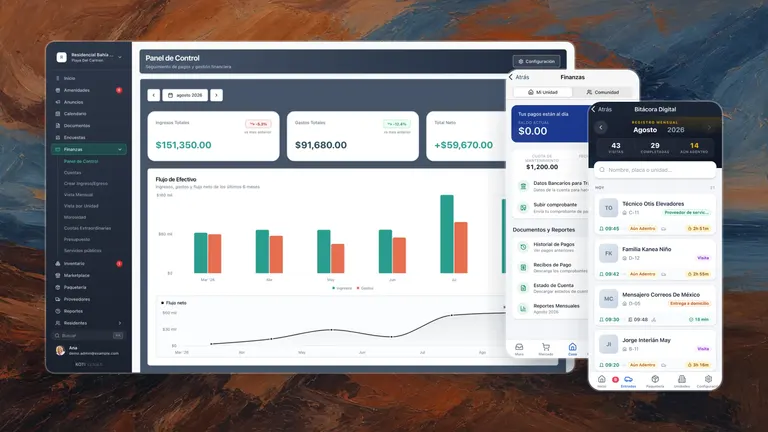
- Real-time visibility: the financial dashboard lets you see the state of the receivables at any time, identifying trends and problems before they escalate.
- Professional reports: generate account statements, delinquency reports, and financial statements with a single click.
- Complete history: every transaction, payment, and communication is recorded, creating an invaluable backup — and, in Mexico City, exactly the evidence the Procuraduría Social will ask for before admitting a procedure.
Resident management as a key piece
An effective collection system starts with a well-organized resident directory. Resident management keeps contact details, unit and role for everyone — owner, tenant, manager — in a single directory that residents themselves keep current from their app. When the directory is up to date, the reminder reaches the right person first time.
From paper to digital
Many condos still manage their finances with spreadsheets, paper receipts, and notebooks. That way of working is error-prone, hard to audit, and consumes valuable time that could be spent improving the community. The digital transition doesn't have to be abrupt: you can start by digitizing fee collection and gradually add more features. If you'd rather see the whole financial side in one place before deciding where to start, that is the entry point.
A note on paying inside the app: today the resident transfers by SPEI to the community's own CLABE and attaches the proof from their phone, and the administrator applies it to the right charge in one click — with no gateway fee, because the money never leaves the community's account. In-app card and SPEI collection is in development.
An Illustrative Scenario: What Moves the Needle, and in What Order
What follows is a modelled scenario, not a real client. It exists to show the order in which to attack the problem and how much to expect from each lever; the numbers are illustrative and your community will behave differently.
Let's model a 120-unit community in Mexico City that starts out like this:
Initial situation:
- Collection rate: 45%
- Accumulated debt: more than 18 months of unpaid fees
- No digital collection system
- Communication only through a physical notice board
- A single payment method: bank deposit, with no per-unit reference
- No periodic financial reports
First block (months 1-2), all friction and visibility:
- Digitizing the resident directory with up-to-date contact information
- Setting up per-unit payment references, so every deposit identifies itself
- Turning on automatic reminders by email and push notification
- Publishing the first detailed financial report
This block usually moves the needle most, and not because it is sophisticated: it attacks the two most frequent causes on the list above — forgetfulness and distrust — and requires no awkward conversation. Owners who were simply forgetting catch up almost on their own once reminders start arriving with the reference inside.
Second block (months 3-6), now on whatever is left:
- An early-payment discount
- Instalment agreements for units with accumulated debt
- Direct contact, unit by unit, prioritised with the aging report
- Monthly publication of the state of the receivables for the whole community
What remains after the first block are the cases with a real cause behind them: financial hardship, disagreement, or debt so large the resident already treats it as impossible. Those aren't solved by one more reminder; they're solved by a realistic agreement and by somebody picking up the phone.
Key lesson: there is no single magic solution, and the order matters. First remove friction and add visibility — it's cheap, it's fast, and it creates no conflict — then work one by one through the cases that survive that. Doing it the other way round means spending the administration's political capital chasing people who simply never got the reminder.
Frequently Asked Questions About Maintenance Fee Collection
How do you collect past-due maintenance fees in a condo?
The first step is to contact the delinquent resident directly to understand their situation. Offer a realistic payment plan that lets them catch up without an impossible financial burden. If there's no response or willingness, gradually apply the consequences set out in the bylaws and permitted by your state law, and as a last resort whichever judicial action applies. Document every communication: in Mexico City, article 59 requires proof of a prior internal mediation and conciliation procedure before going to the Procuraduría Social, so that log is not optional.
What percentage late fee can be charged?
The percentage must be in the condo bylaws and approved at assembly, but within the ceiling your state law sets — and that ceiling can be far lower than people assume. In Mexico City the delinquency interest is the legal interest rate and may not exceed nine percent per year (art. 33 fr. V) — under 0.8% a month. In Oaxaca late interest may not exceed 20% of the principal (art. 59). In Quintana Roo the bylaws or the assembly set the rate, but interest may not be compounded (art. 43). Before writing a percentage into your bylaws, find the article that applies in your state: the widely repeated 2% monthly charge is 24% a year and would be unlawful in Mexico City.
Can you restrict access to common areas for delinquent owners?
Carefully, because it is the most contested point in condominium collections and no condominium statute expressly authorises it. What does have text behind it is the inverse route: Mexico City empowers the Assembly to "grant benefits to owners… in relation to the fulfilment of their obligations" (art. 33 fr. XIV) and limits consultation of the community's books to those who are current (art. 43 fr. IV). If you restrict amenities anyway, do it with a bylaw clause approved at assembly, applied uniformly, and only over non-essential amenities — never over access to their home or to circulation routes, and never over drinking water, which is untouchable nationwide. We break it down state by state in the legal guide to delinquent condo owners.
How do you motivate residents to pay on time?
Combine positive incentives with clear consequences. Offer early payment discounts (5-10%), publicly recognize those who are current, hold quarterly raffles among punctual payers, and above all, demonstrate with transparent reports how every peso is invested. Trust and transparency are the greatest payment motivators.
Is it advisable to hire an external collection service?
Before resorting to a collection firm, exhaust internal options: automated reminders, payment plans, and direct communication. External collection services charge commissions that reduce what's recovered and can damage the relationship with residents. If you decide to use one, make sure they don't employ abusive practices. Note as well that reporting the debt to a credit bureau is not an option: no condominium statute in the country authorises it, and reporting to a credit information society requires being registered as a User with it under the Credit Information Societies Law. For most communities, implementing a financial management platform produces better results at lower cost.
Improving maintenance fee collection is not just a financial matter: it's an investment in the quality of life for your entire community. Every peso collected translates into better security, well-maintained common areas, and a place where families enjoy living.
The strategies we've shared here require no specialized knowledge and no major investment. What they do require is consistency, empathy, and the right tools. Technology can be your best ally: from automatic reminders to transparent financial reports, digitizing the collection process removes friction and builds trust.
Remember that behind every fee there is a person with their own circumstances. An approach combining firmness with understanding will always produce better results than threats or confrontation.
Ready to transform your community's financial management? Koti's condo management software costs $19 MXN + VAT per unit per month, with no tiers and no volume discounts. We also recommend reading our guide on the most common problems in condo management for a comprehensive view of community administration.
Try Koti for free
Simplify your condo management: dues, access and announcements in one place. 14 days free, no credit card.
Official sources
Every article cited in this guide was checked against the text published by the body that issued it. Condominium law in Mexico is state law: always read your own state’s, and confirm the date of the latest amendment before acting.
- Ley de Propiedad en Condominio de Inmuebles del Estado de Quintana Roo
Quintana Roo · Last amended: 12-11-2021 (P.O. del Estado) · Checked: 2026-08-09
- Ley de Propiedad en Condominio de Inmuebles para el Distrito Federal
Mexico City · Last amended: 04-08-2023 (G.O. CDMX) · Checked: 2026-08-09
- Ley que Regula el Régimen de Propiedad en Condominio de Inmuebles para el Estado de Oaxaca
Oaxaca · Last amended: 18-09-2021 (Decreto Núm. 2646, P.O. Núm. 38 Décimo Primera Sección; aprobado 18-08-2021) · Checked: 2026-08-09
- Ley de Propiedad en Condominio de Inmuebles para el Estado de Nuevo León
Nuevo León · Last amended: 11-10-2023 (P.O. del Estado No. 128) · Checked: 2026-08-09
This guide is general information, not legal advice. For a specific matter, consult a lawyer in your state.
Written by
Equipo Koti
Condo Management Experts
The Koti Smart Communities team shares knowledge and best practices for efficient condo and residential community management.