Finance · Delinquency

Delinquency Control & Late Fees for Condominiums

A map where you see at a glance which units are current and which are not, late fees that apply themselves the day after the deadline, and restrictions that make collections enforce themselves without you calling anyone.

No credit card required

after the due date the late fee applies, automatically
+1 dayafter the due date the late fee applies, automatically
the late fee is a flat amount or a percentage of the fee
Flat or %the late fee is a flat amount or a percentage of the fee
optional, on amenity bookings and visitor QR codes for late units
Lockoutoptional, on amenity bookings and visitor QR codes for late units
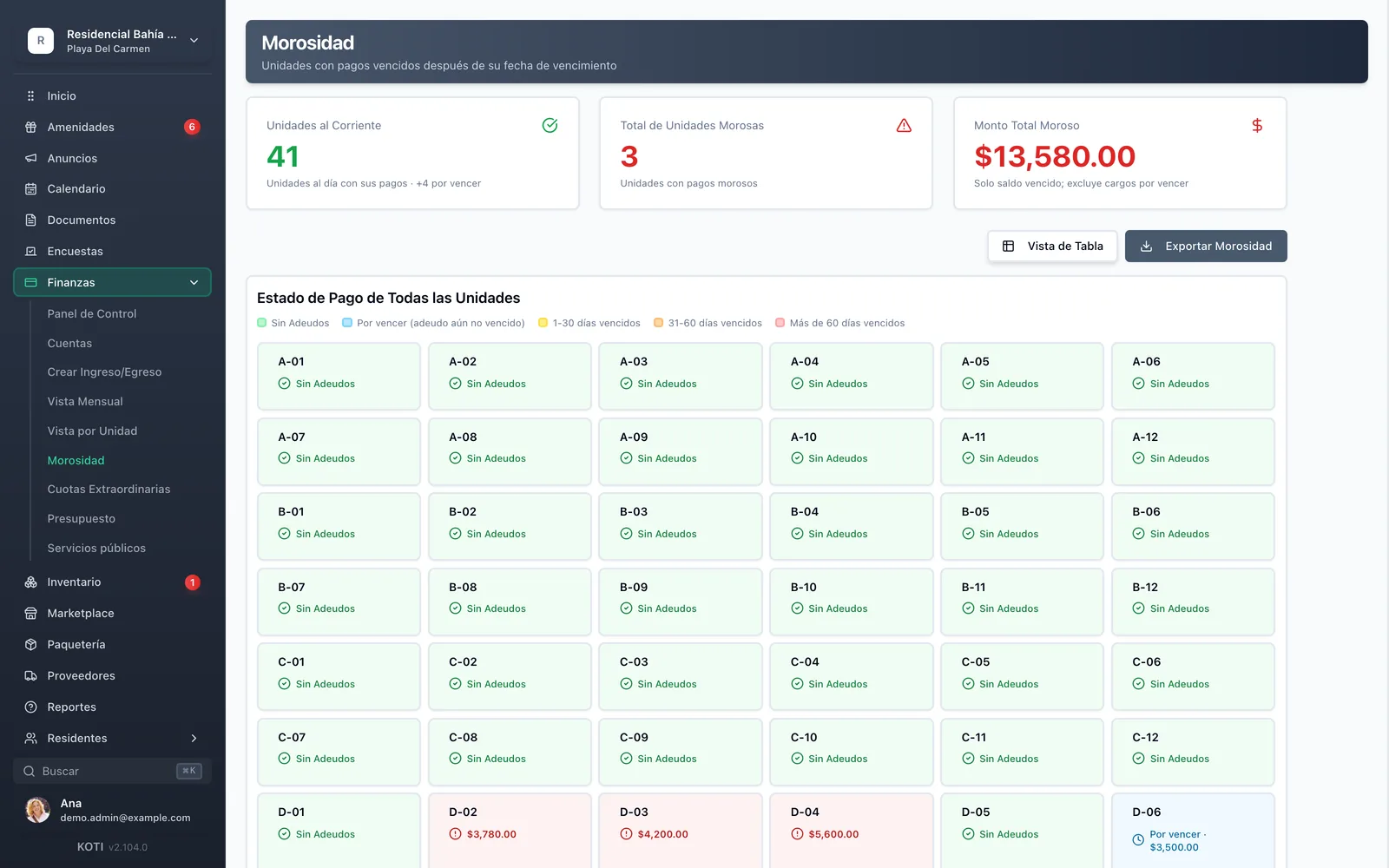
The Koti delinquency map with units that are current, late units, the total overdue amount, and every unit’s payment status colour-coded.

The problem

What changes on day one

Today

Collections are a list of awkward phone calls the manager keeps postponing until it has been three months.

With Koti

The late fee applies itself the day after the deadline, so the rule never depends on somebody picking up the phone.

Today

Nobody knows clearly who owes what, or since when, until the list gets built by hand for the assembly.

With Koti

A per-unit map with five aging states: no debt, due soon, 1-30, 31-60 and over 60 days overdue.

Today

The unit six months behind keeps booking the party room and waving visitors in as if nothing happened.

With Koti

If you switch the restriction on, a late unit cannot book amenities or generate visitor QR codes: the rule enforces itself.

Admin

Management stops chasing residents

First the map: who owes, how much and for how long. Then the consequence, which you no longer have to apply yourself.

The Koti delinquency screen with units that are current, the total number of late units, the overdue amount and the per-unit payment-status grid.

Map

Who owes, how much, and since when

  • Units current, units late and the total overdue amount — overdue balance only, never mixed with charges not yet due
  • Every unit as a coloured card: no debt, due soon, 1-30, 31-60, or over 60 days overdue
  • Switch to table view or export the full delinquency list when it is time to bring it to the assembly
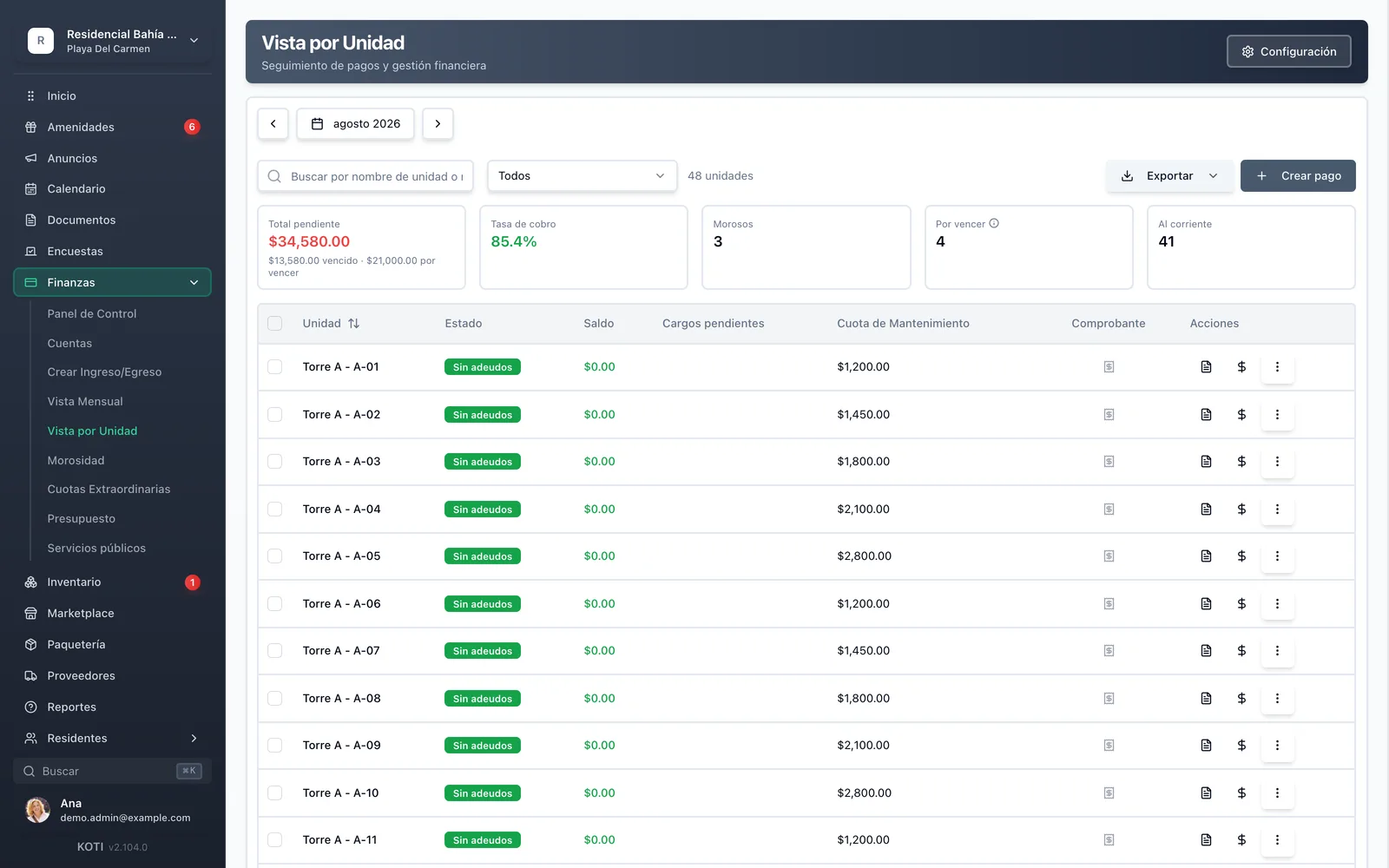
The Koti per-unit view with total outstanding split into overdue and not-yet-due, the collection rate, and counts of late, due-soon and current units.

Collect

Overdue and due-soon, kept apart

  • Total outstanding splits between what is already overdue and what is not, so the delinquency figure never gets inflated
  • The month’s collection rate, next to the count of late, due-soon and current units
  • Apply late fees in batch: select all, deselect whoever is exempt, and run it in one pass

Resident

The resident sees the late fee without you having to say it

The balance and the deadline live in their app, so the awkward conversation stops being the collection channel.

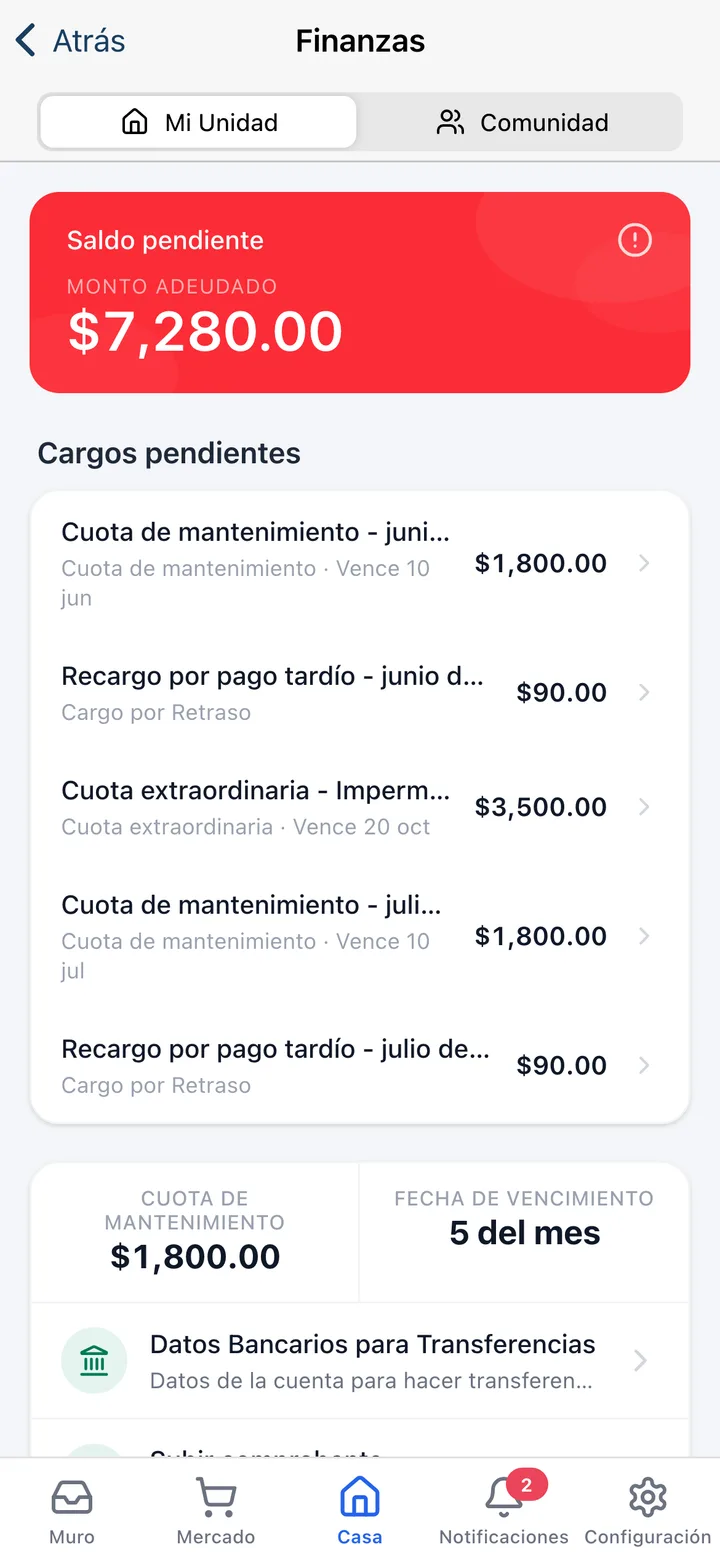
The Koti app finance screen showing an outstanding balance of $7,280.00, itemised into June and July fees, a special assessment and two late-payment surcharges.

Their balance

The deadline, always in sight

  • The unit’s current balance and the month’s due date, on the first finance screen
  • Reminders arrive before and after the due date, by email and in the app
  • With the restriction on, the resident sees exactly why they cannot book — and the moment they are current, it lifts itself

In detail

Delinquency & late fees, in detail

Late fees that apply themselves

You configure the deadline and the late fee — a flat amount or a percentage of the fee — and the system applies it automatically the day after the due date. If you want, you add a grace period in days, a cap on the percentage, and a minimum balance so a few cents of rounding never trigger a charge. The rule is the one the assembly approved; what changes is that it no longer depends on somebody remembering to apply it.

Late fees proposed, not imposed

If you would rather review before charging, you turn on “require approval” and late fees arrive as proposals: you see each unit’s balance, days overdue and calculated amount, edit whatever needs editing, reject specific cases and approve the rest. Automatic does not have to mean blind.

Visual delinquency map

Every unit in the community as a colour grid: at a glance you see which are current and which are not, without reading a single table row. If you prefer the table, it is one click away.

Balance aging

Five states, not two: no debt, due soon, 1-30 days overdue, 31-60, and over 60. A week late and six months late are not the same problem and should not look the same.

Restrictions for late units

Once you enable it, a late unit loses the ability to book amenities and to generate visitor QR codes, with a grace period in days that you set, and with each restriction configured separately. That is the consequence that makes collections enforce themselves: nobody has to deliver bad news, and the incentive to catch up is immediate.

Automatic reminders

Before and after due dates, in email and app. Reminding stops being the manager’s job — which is precisely the part of collections that gets postponed most.

Export the delinquency list

The full delinquency list exports with one button, as PDF, CSV or Excel, with the total overdue amount kept separate from balances not yet due and an aging summary — how many units and how much money sit in each bucket. It is the document you take to the assembly when you have to explain why the budget fell short.

Late fees in batch

When late fees have to be applied or waived across many units at once, batch operations work the same way as with payments: select all, deselect the exceptions, and run it in a single pass.

Built for Mexico

Collections in a Mexican condominium, without confrontation

In a condominium, the person collecting lives in the same place as the person who owes. That is why collections work better as a rule of the system than as a conversation between neighbours.

The late fee the assembly set

A flat amount or a percentage of the fee, with the deadline you agreed on. The system applies your rule, not one of ours.

Restrictions instead of calls

If the community approves it, amenities and QR codes stay blocked while there is a balance. The platform applies the consequence, not the manager in person.

Evidence for the assembly

The delinquency export with balance aging is the backup you need when the topic reaches the agenda.

Your turn: set it up in 5 minutes

Try Koti in your community today, without the headaches.

14-day free trial · No credit card required

Prefer to be shown around? Book a demoMessage us on WhatsApp

Security & compliance

SSL/TLS encryption

All communications encrypted and sensitive data protected in transit and at rest.

LFPDPPP compliant

Personal data protection compliant with Mexican law (LFPDPPP).

Daily backups on AWS

AWS infrastructure with automatic daily backups.

Frequently asked questions

They are configured once: the month’s payment deadline and the late fee, which can be a flat amount or a percentage of the fee. From then on the system applies it automatically the day after the due date, with nobody having to go in and mark it unit by unit.
It depends on what the community decides. Delinquency restrictions are enabled separately — amenity booking and visitor QR generation — and each can have its own grace period in days. When they are on, the restriction applies itself while there is a balance and lifts itself once the unit is current, so management never has to grant or revoke access by hand.
The delinquency map classifies every unit into five aging states: no debt, due soon, 1-30 days overdue, 31-60, and over 60. On top of that, total outstanding is shown split between overdue balance and charges not yet due, so the delinquency figure never gets inflated.
Yes. Delinquency exports from the same screen, with the total overdue amount, the number of late units and each balance’s aging. It is the backup that is normally missing when the topic reaches the agenda.
Yes. The current balance and the due date sit on the first finance screen of their app, and reminders go out automatically before and after the deadline, by email and in the app. Collections stop depending on an awkward conversation between neighbours.

Start with 14 free days

Set up your community in minutes and try all of Koti — no card, no lock-in.

No credit card requiredSee pricing

See everything in Finance
Questions? Chat with us