"How much does a condo administrator charge?" gets typed by two different people on the same day. One is weighing up the profession or has just received an offer: they want to know what the job pays. The other is a board member or an owner about to hire: they want to know what they should pay without underbidding the role or overcommitting.
The two answers have little in common: a salary and a professional-services fee are calculated differently, documented differently, and do not even cover the same things. They come in that order — the salary first, because it answers fast; the fees second, because that is where the money is.
A warning up front: Mexico has no public fee schedule for condominium management. There are job aggregators with verifiable figures and a legal structure that says who sets the fee and where it must be recorded. Every number here carries its source and its date; anything we could not verify is not here.
The salary: what an administrator earns as an employee
Public figures do exist here, and they have to be read for what they are: averages from job aggregators, each with its own stated basis, not a census of the profession.
| Source | Published figure | Stated basis | Read on |
|---|---|---|---|
| Talent.com México | $144,000 a year. Entry level from $96,000; with more experience, up to $266,400 | "Basado en 10000 salarios" — based on 10,000 salaries | August 21, 2026 |
| Jooble México | $181,764 a year, $15,147 a month | "investigamos los salarios reales y los sueldos reales de 428 en todo el país" — we research real salaries and actual pay from 428 nationwide (the site does not say 428 of what) | August 21, 2026 |
Swipe horizontally to see the full table
Talent.com's $144,000 is $12,000 a month; Jooble's $181,764 is $15,147. That is 26% apart for the same role in the same country, and neither is wrong: each aggregator measures a different sample, in different cities, under titles that do not always mean the same thing. Averaging the two averages would invent precision.
Nor do they agree on the shape of the range, so each range has to be attributed to whoever publishes it. Talent.com opens a very wide fan: $96,000 a year at entry level and up to $266,400 with experience, that is $8,000 to $22,200 a month, nearly three times the spread inside one job title. Jooble, on those 428 salaries, publishes a much tighter range — $168,936 to $188,772 a year, $14,078 to $15,731 a month — barely 12% wide. Neither aggregator's floor or ceiling appears in the other.
And something the figure does not say: a salary implies employment — social security, the Christmas bonus, vacation, vacation premium and severance —, so the real cost is higher than the payslip. Comparing "$15,000 in salary" against "$15,000 in fees" is not comparing like with like.
Owner-administrator and professional administrator are not the same job
The law distinguishes two figures and treats them differently. Confusing them is the number-one reason a quote looks expensive.
The owner-administrator is an owner in the same condominium who takes the role on. In Mexico City it is a recognised right: article 16, section IV of the Condominium Property Law for the Federal District (text in force, last amended August 4, 2023) grants owners a place in the administration "en calidad de Administrador condómino; y en su caso con la misma retribución y responsabilidad del administrador profesional, excepto la exhibición de la fianza" — as owner-administrator and, where applicable, on the same pay and responsibility as a professional, with only the bond waived. That "y en su caso" is the hinge: the pay is possible, not automatic — the assembly sets it. It is almost always read backwards: the law does not say the neighbour administers for free, it says they may be paid the same.
In practice many serve unpaid. In Quintana Roo, article 31, section II leaves the assembly to set the pay, "que podrá renunciarse por algún condómino que acepte servir gratuitamente el cargo" — an owner willing to serve for free may waive it. And article 34 adds what almost nobody keeps in mind: under self-administration the role creates no "derechos de carácter laboral" — no employment rights, no seniority, no severance.
The professional administrator is a contracted individual or company. In Mexico City, article 38, section II requires them to file, for registration, the contract signed with the Oversight Committee, "la garantía o fianza correspondiente, así como la certificación expedida por la Procuraduría y haber acreditado el curso para administradores". The appointment goes to the Procuraduría Social within fifteen business days, with a fine if the deadline lapses.
Bond, certification, course and registration all cost money before a single peso is administered: that is why a professional fee is not comparable head-to-head with what a neighbour would charge. The state-level detail is in our guide to the Quintana Roo Condominium Property Law.
The four fee models (and the hybrid)
Almost every quote falls into one of these moulds. What changes is not only the amount: it is who carries the delinquency.
| Model | How it is calculated | Who carries delinquency |
|---|---|---|
| Percentage of collections | A % of the month's actual collections | The administrator |
| Percentage of billings | A % of the fees invoiced, collected or not | The condominium |
| Fixed monthly fee | An agreed amount, the same every month | The condominium |
| Per unit | An amount per unit, times the unit count | The condominium |
| Hybrid | A base fixed fee plus a % of what is recovered above a target | Shared |
Swipe horizontally to see the full table
In the percentage model, the question that decides everything is not the percentage: it is the base. "8% of collections" and "8% of fees" sound identical and are not: on collections the administrator earns more as delinquency falls; on billings they earn the same whether or not a peso arrives.
The fixed fee is the easiest to budget and the easiest to outgrow: if the community expands, the workload rises and the fee does not. Per-unit pricing self-adjusts to size but ignores complexity. And the hybrid is usually fairest when taking over with inherited arrears, though to negotiate one you need the baseline — which is what our guide to maintenance fee collection is about.
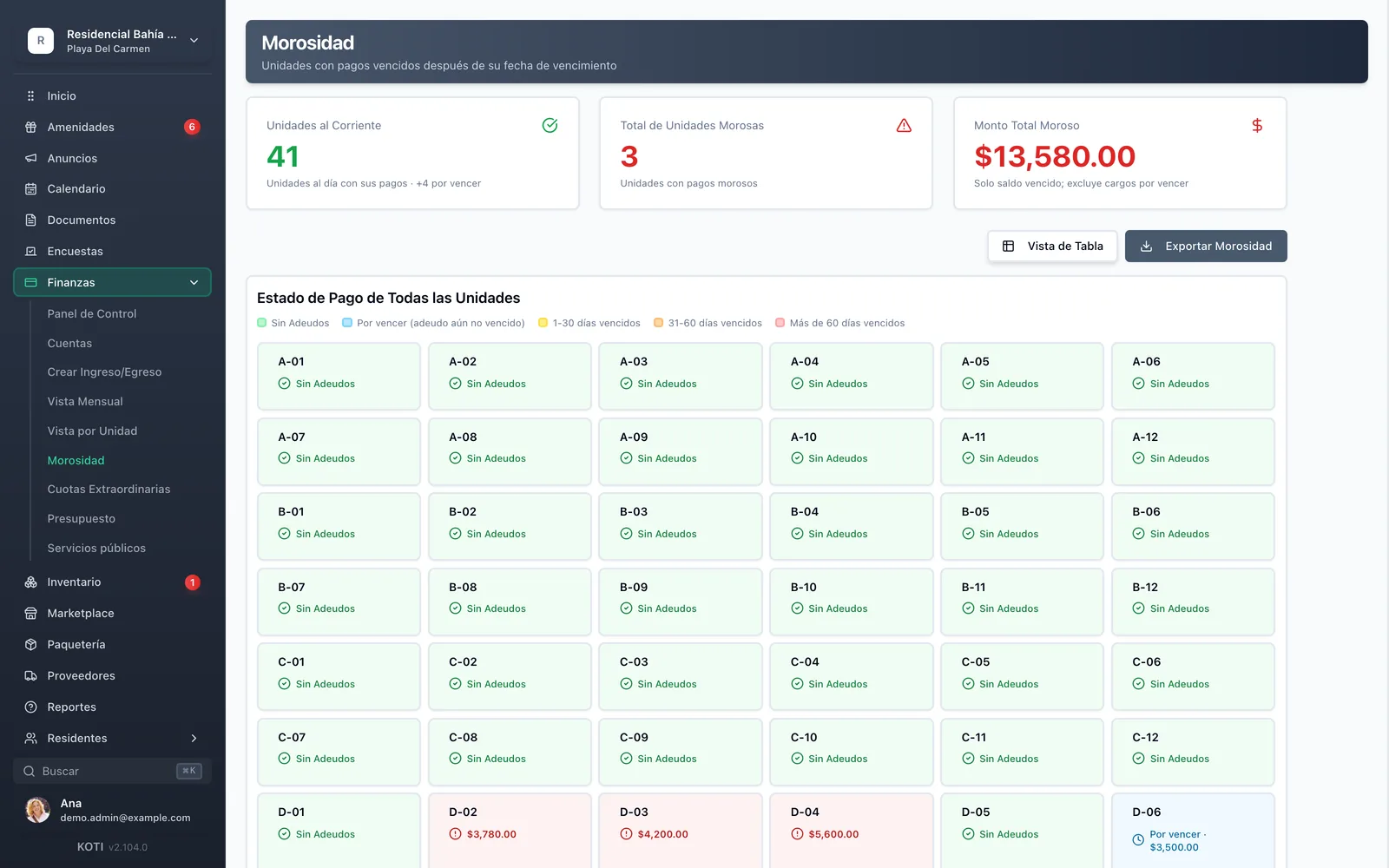
Whatever the model, the first measurement is the real collection rate. If you cannot state that number from memory, delinquency control is the starting point.
What the fee includes and what it almost never includes
There is a legal floor that is not billed separately because it is already part of the job. In Quintana Roo, article 36 requires the administrator to keep the minute book authorised by the Oversight Committee, preserve the records and keep them available for review, prorate common-area consumption on the undivided share, issue a receipt for every item charged, and deliver the account statement obtaining proof of receipt. Quoting "receipt issuance" as an add-on is charging for something the law already demands.
What does fall outside, and has to be asked line by line:
- Staff payroll. Is the firm the employer of the guards, cleaners and gardeners, or does it merely coordinate a payroll the condominium pays? It is the variable that shifts the most risk.
- Accounting and tax invoicing. CFDI stamping, filings, bank reconciliation.
- Legal collections. Confirm who pays the lawyer, and from which fund.
- Works supervision. Usually charged as a percentage of the project.
- Management software. Sometimes included, sometimes separate, sometimes paid twice without anyone noticing.
On invoicing there is a checkable rule: article 35 of the Quintana Roo statute requires the contract to state that an administrator receiving payment "deberá expedir un comprobante que reúna los requisitos previstos por el Código Fiscal de la Federación" — a tax-compliant receipt. The fee is invoiced: ask whether the quoted amount already includes VAT.
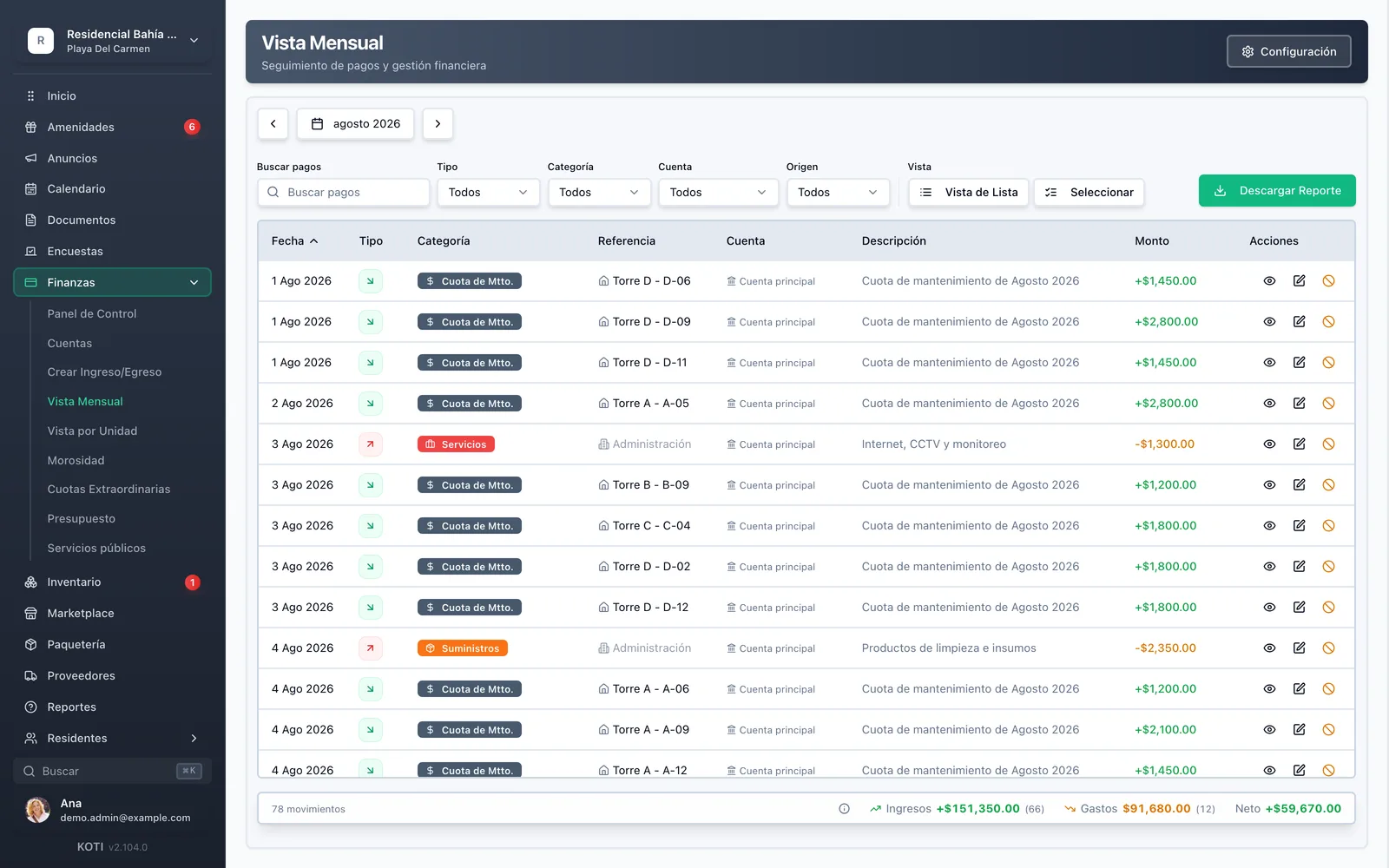
The other side of the deal is evidence: statements and receipts that issue themselves are the difference between a fee that renews without discussion and one that gets relitigated at every assembly.
What moves the number up or down
Two communities with the same unit count can be quoted at twice the difference. The factors, ordered by how much they weigh:
- Carrying the payroll. If the firm hires and pays the staff, it takes on employment risk and charges for it.
- Guard booth and shifts. Continuous security is not one person: it means a rota, cover, a logbook and night supervision.
- Unit count. Scale rules, but not linearly: the jump from 20 to 60 units weighs far less than the jump from 60 to 200.
- Amenities. Pool, gym, event room and roof garden add maintenance, bookings, rules and disputes. Every amenity is a process, not a space.
- Accounting and CFDI included or not. The line most often compared wrongly between two quotes.
- Inherited arrears. Taking over with 30% of the portfolio overdue is a recovery project.
- Spread and turnover. Several towers or phases with separate entrances multiply the walking, and holiday use multiplies entries and incidents.
An orderly community is cheaper to administer: information already captured is time nobody has to bill. Our practical guide to administering a condominium walks through that part.
A worked example: a 48-unit development
The percentages and amounts below are inputs to the example, chosen so all four models cost roughly the same in a normal month. They are not market rates: swap in the ones you are negotiating.
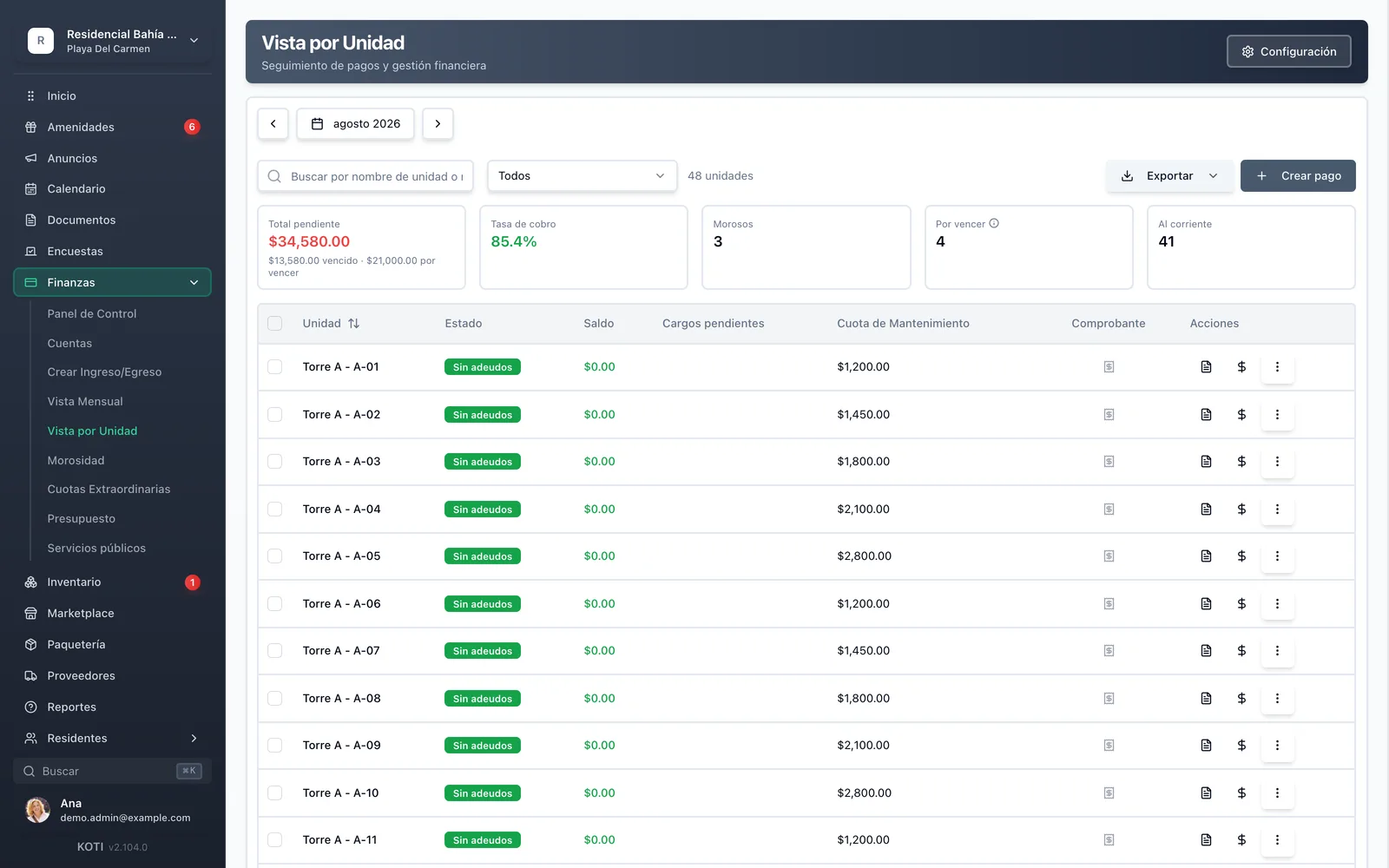
The inputs:
- 48 units, average fee of $1,500 a month
- Fees billed: 48 × $1,500 = $72,000
- Collection rate 85.4% → actual collections = $61,488
The four models, across three collection scenarios:
| Model | Normal month (85.4%) | Bad month (70%) | Good month (97%) |
|---|---|---|---|
| 8% of collections | $4,919.04 | $4,032.00 | $5,587.20 |
| 7% of billings | $5,040.00 | $5,040.00 | $5,040.00 |
| Fixed fee of $5,000 | $5,000.00 | $5,000.00 | $5,000.00 |
| $105 per unit × 48 | $5,040.00 | $5,040.00 | $5,040.00 |
Swipe horizontally to see the full table
Compare the first row with the other three: three of the four models are flat, the administrator earns the same collecting 70% or 97%. Only the percentage of collections moves, and it moves $1,555.20 between the worst and best case, 39% on top of what the bad month would have paid. That spread is the price the community puts on the administrator caring about collections.
Over a year at the normal month's rate, the percentage totals $59,028.48 and the fixed fee $60,000: effectively tied. The difference is not in the total, but in what happens the month things go wrong.
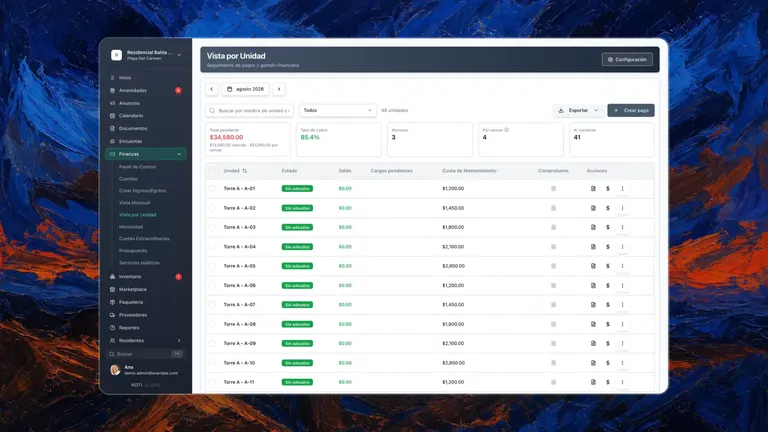
The software line, exactly: with 48 units at Koti's published price of $19 MXN + VAT per unit per month, that is $912 MXN + VAT a month; billed annually, paying 10 and using 12, $9,120 MXN + VAT a year. That is 1.3% of a $1,500 fee and around 1.5% of what came into the account that month.
Where the fee is set and where it has to be recorded
This is not bureaucracy: it is what makes the agreement enforceable the day someone challenges it.
Mexico City. The assembly has the power to "Aprobar la contratación del Administrador Profesional y fijar la remuneración; lo cual quedará asentado en el acta de asamblea correspondiente" (article 33, section III), and article 39 extends it to both figures: "La remuneración del Administrador condómino o profesional será establecida por la Asamblea General debiendo constar en el acta de asamblea". If the fee is not in the minutes, it does not exist.
Quintana Roo. It appears in four places that had better agree: the assembly sets it (article 31, section II); the assembly approves the annual budget "donde se establecerán los honorarios que devengaran el administrador y demás trabajadores" (article 31, section VIII); the bylaws carry the "Bases de remuneración, en su caso, del Administrador" (article 41, section VIII); and the founding deed records the "Nombramiento del administrador, sus remuneraciones en su caso, facultades y poderes" (article 9, section XI).
State of Mexico. Something different happens here: the Law Regulating the Condominium Property Regime in the State of Mexico (last amended April 29, 2024) does not mention the administrator's remuneration in any of its articles. Its catalogue of assembly powers, article 29, has no section for setting it: the fee gets in through the annual budget of section V and through the internal bylaws. The statute will not back you up on its own, so the contract, the minutes and the budget have to do all the work.
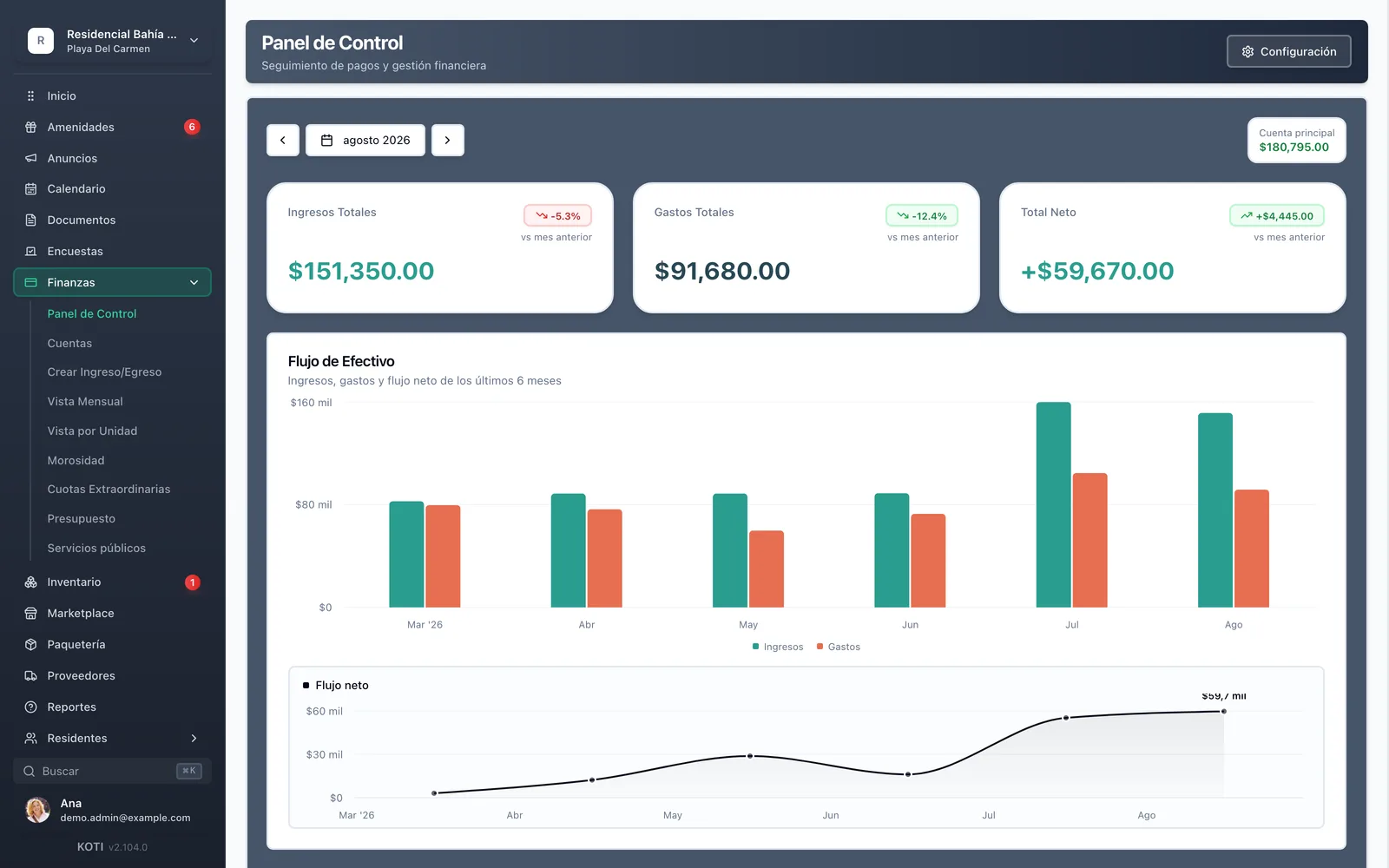
One piece of advice that saves assemblies: approve, alongside the fee, the format in which it will be accounted for. A monthly financial report that looks the same every month turns the annual debate into a five-minute formality.
Why you will not find a Mexican fee schedule
If you searched before landing here, you have met the figure that circulates everywhere: "between 5% and 10% of fees". We went looking for its origin on August 21, 2026 and found no primary source: no industry survey, no fee table from a professional body or chamber, no public study. It shows up repeated across trade articles, in nearly identical wording and without a reference; several warn in their own text that their figures "are only estimates". That does not make the range false — it may describe reality — but it does make it unverifiable, and an unverifiable number should not be used to negotiate a three-year contract.
In other countries the formal reference exists: in Argentina professional chambers publish suggested fee tables per functional unit, dated and updated periodically — CAPHyAI and the Colegio Profesional de Corredores Públicos Inmobiliarios de Córdoba are two examples. Searching for the Mexican equivalent the same day, we found no fee schedule from any national association, chamber or professional body: here the authority regulates the administrator's registration and training, not their price.
So the honest answer to "what does the market charge" is that the Mexican market does not publish its rates. What you can do is force comparability yourself:
- Ask for three quotes against the same brief: same units, amenities and guard-booth shifts, and the same answer to "who employs the staff?".
- Require each to state its model and its base, not just the amount.
- Ask for an itemised list of exclusions, with a price for each add-on.
- Confirm whether it includes VAT and whether software is billed separately.
- Ask for references from two communities of the same size, and call them.
Five questions turn three incomparable numbers into three comparable ones. Worth more than any national average.
The one line item you can close today
Of the whole budget, software is the line you can close today, before signing anything: Koti's price is published, so it does not depend on a quote.
It is $19 MXN + VAT per unit per month, a single rate, with no tiers by community size. Below 40 units a minimum fee of $760 MXN + VAT per month applies. Billed annually you pay 10 months and use 12, and the trial runs 14 days with no card. Work out your number in the pricing calculator and take it to the assembly as a closed line, not a "to be determined".
What that line covers:
- Automatic charges for the fee on the first of the month, with per-unit special assessments.
- PDF account statements residents download from their app, and a receipt carrying the community logo and the administrator's signature when each payment is approved.
- Delinquency with balance aging and automatic reminders before and after the due date.
- Monthly financial report with income, expenses and net balance.
- CFDI 4.0 with automatic stamping, as an optional platform add-on.
- Direct SPEI to the community's own bank account, with the proof the resident uploads and management approves in one click. No gateway fee: the money never leaves the community's account.
One clarification we would rather make ourselves: card and SPEI collection inside the resident app is in development, not live. The full module is in financial tools, and the area-level overview is in the finance hub.
If you came for the salary: the average runs from $12,000 to $15,147 a month depending on the aggregator, and each publishes its own range — Talent.com, $8,000 to $22,200 a month; Jooble, $14,078 to $15,731. Averages from job aggregators, not a census.
If you came for the fee: there is no market number anyone can stand behind, and whoever gives you one without a source is giving you an impression. Choose the model knowing that only the percentage-of-collections model aligns the administrator with collections, demand three quotes against the same brief, and record the agreement in the minutes, the contract and the budget. Work out your software line in the pricing calculator or book a 30-minute demo.
General guidance; not legal or tax advice. The citations correspond to the Condominium Property Law for the Federal District (text in force, last amended in the G.O.C.D.M.X. on August 4, 2023), the Condominium Property Law of the State of Quintana Roo (last amended in the State Official Gazette on November 12, 2021), and the Law Regulating the Condominium Property Regime in the State of Mexico (last amended in the Gaceta del Gobierno on April 29, 2024), all consulted on August 21, 2026. Every state has its own statute: check yours before signing.
Try Koti for free
Simplify your condo management: dues, access and announcements in one place. 14 days free, no credit card.
Official sources
Every article cited in this guide was checked against the text published by the body that issued it. Condominium law in Mexico is state law: always read your own state’s, and confirm the date of the latest amendment before acting.
- Ley de Propiedad en Condominio de Inmuebles para el Distrito Federal
Mexico City · Last amended: 04-08-2023 (G.O. CDMX) · Checked: 2026-08-09
- Ley de Propiedad en Condominio de Inmuebles del Estado de Quintana Roo
Quintana Roo · Last amended: 12-11-2021 (P.O. del Estado) · Checked: 2026-08-09
- Ley que Regula el Régimen de Propiedad en Condominio en el Estado de México
State of Mexico · Last amended: 29-04-2024 (P.O. «Gaceta del Gobierno») · Checked: 2026-08-09
This guide is general information, not legal advice. For a specific matter, consult a lawyer in your state.
Written by
Equipo Koti
Condo Management Experts
The Koti Smart Communities team shares knowledge and best practices for efficient condo and residential community management.