If you manage a condominium in Playa del Carmen, Cancún or Tulum, there is a 43-page, 69-article document that defines almost everything you can and cannot do: the Condominium Property Law of the State of Quintana Roo, last amended in the State Official Gazette on November 12, 2021.
Most administrators have never read it end to end, and that is not negligence: it is a state law, scattered and with no friendly version. But the consequences of not knowing it are very concrete: assemblies that can be challenged over miscalculated quorum, collections that fail because a signature is missing, and sales that stall at the notary's office.
This guide covers what you actually need to know, with the exact article so you can verify it in the official text. One important clarification up front: Mexico has no federal condominium law. Every state has its own, and Quintana Roo's has particularities you will not find in Mexico City's or Jalisco's.
Quorum: measured by ownership share, not headcount
This is the most common and most expensive mistake. The law does not count heads: it counts ownership percentage.
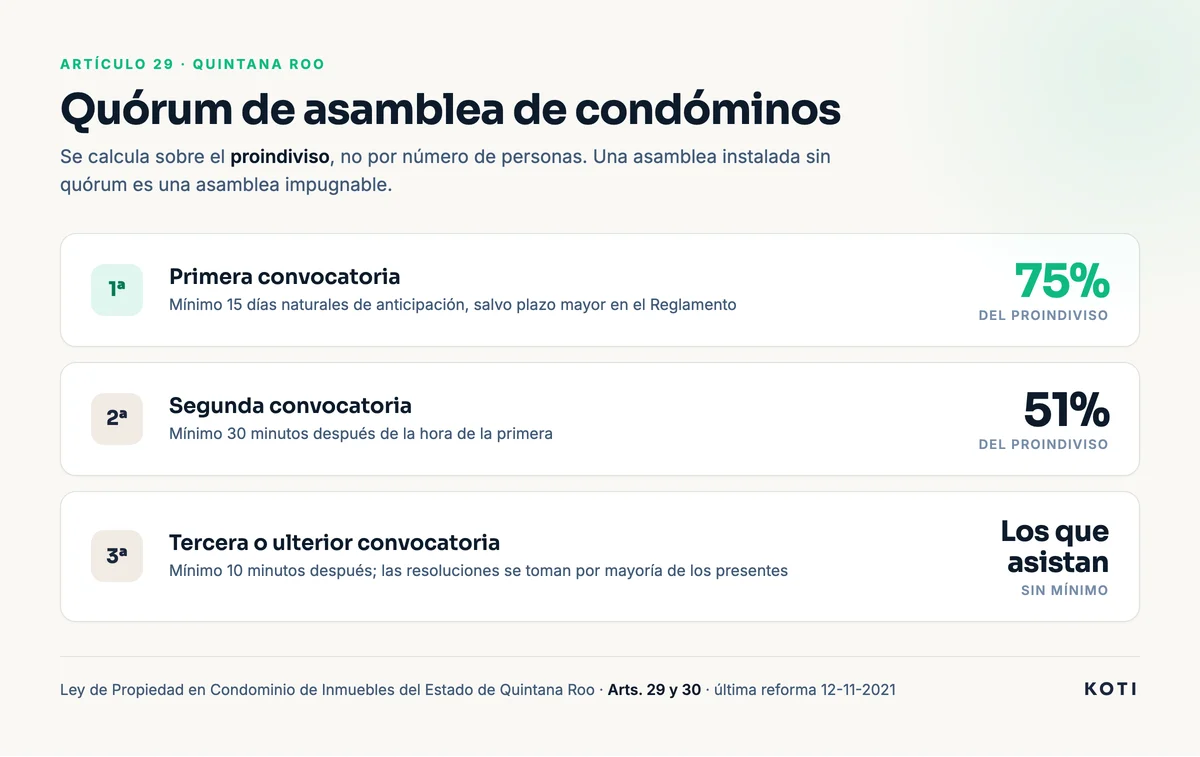
A 40-unit condominium where 22 people show up may not have quorum if those units represent less than 75% of the undivided share. And an assembly seated without quorum can be challenged: everything agreed there is at risk.
The notice periods are legal minimums, not suggestions (Article 30, section II):
| Notice | Quorum | Minimum lead time |
|---|---|---|
| First | 75% of undivided share | 15 calendar days (or the longer period in the bylaws) |
| Second | 51% of undivided share | 30 minutes |
| Third or later | Whoever attends | 10 minutes |
Swipe horizontally to see the full table
In cases of extreme urgency, notice may be given with whatever lead time circumstances demand.
How notice must be served (the WhatsApp group is not enough)
Article 30, section III requires both, not either:
- Verifiable delivery to each owner at their exclusive-property unit, or to the email address they registered for this purpose, with a record kept by the administration.
- Posting the notice in five or more visible locations in the condominium on the day it is issued, with a detailed record signed by the convener, a member of the Oversight Committee and three owners, or before a notary public.
The fact that the law expressly accepts a registered email address is the legal door to digitizing notices. What you cannot skip is proof of delivery: if you cannot prove you gave notice, you did not give notice.
Two more rules that settle most hallway arguments:
- Assembly decisions bind every owner, including those absent and those who dissented.
- If a group representing at least 25% of the undivided share requests an assembly in writing and the Administrator does not convene within 10 business days, they may go to the Civil Court of First Instance or the Alternative Justice Center to have the notice published without altering the requested agenda.
Since 2021, video-conference assemblies are legal
This is the best news in the amendment and almost nobody uses it.
Article 28, section XIV expressly allows the Assembly to meet remotely through electronic, optical or any other technology, including video conferencing, provided the guidelines for that format are met. It also allows those same means to be used for owners' votes and for the communications contemplated in the founding deed or the bylaws.
Owners may attend in person or remotely, and may even be accompanied by lawyers, accountants or interpreters, designating at roll call who will speak on their behalf.
On the Riviera Maya this changes everything. A large share of the inventory in Playa del Carmen and Tulum belongs to owners who do not live in the condominium, the state, or the country. Gathering 75% of the undivided share in a physical room is nearly impossible; gathering it on a properly convened video call is an afternoon's work.
The administrator obligations that get missed most
Article 36 lists the Administrator's duties. These are the ones most often missing when an administration is audited:
- Section I — keep a minute book duly authorized by the Oversight Committee.
- Section III — preserve the condominium's books and records, keep them available for owner review at all times, and hand them over to the next administration.
- Section IV — prorate common-area consumption based on the undivided ownership percentage.
- Section IX — issue a receipt for every item: ordinary fees, maintenance fund, reserve fund, special assessments, late interest, legal fees and penalties, stating outstanding balances.
- Section X — deliver a monthly or bimonthly account statement, obtaining proof of receipt.
The account statement is not a free-form summary: the law lists five mandatory elements.
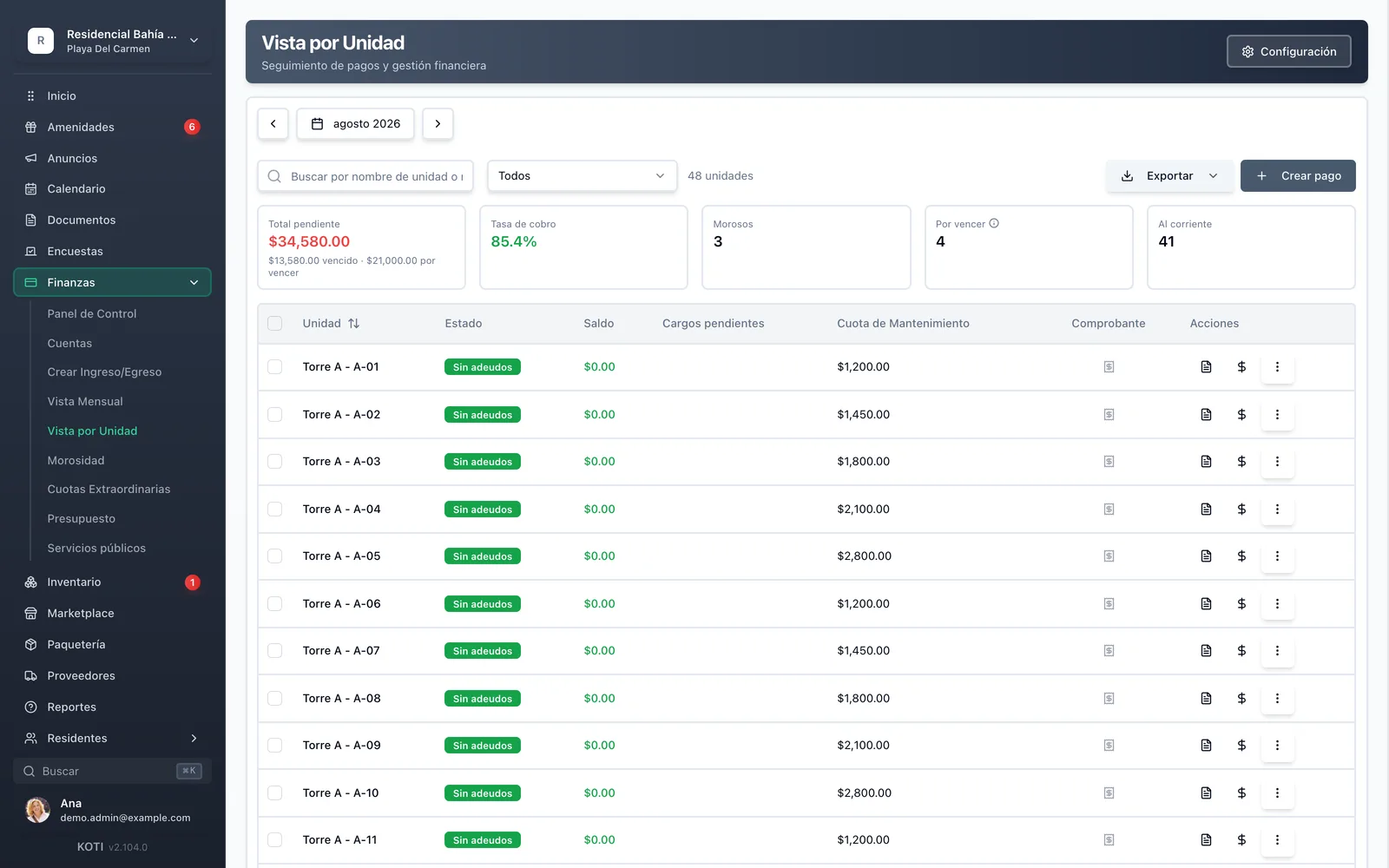
It must show an itemized breakdown of collections and expenses for the period, a consolidated statement of contributions and outstanding fees, the maintenance fund balance and its intended use, the balance of bank accounts and investments with their interest, and the resolutions passed in assembly along with how they were carried out.
That fourth point is the one almost nobody delivers. The law requires showing where the money is, not just what came in and what went out.
Finally, owners have 30 calendar days from the assembly to object in writing. If nobody objects in that window, the information is deemed accepted.
Fees and delinquency: what you actually can do
The fee is not negotiable. Article 42, section I states that maintenance fees are not subject to offset, personal defenses, or any other circumstance that could excuse payment, and that they never lapse. "I don't use the pool" is not a legal argument, and time does not erase the debt.
Interest yes, compounding no. Article 43 allows late interest at the rate set by the bylaws or the assembly, but states it may not be capitalized: you cannot charge interest on interest.
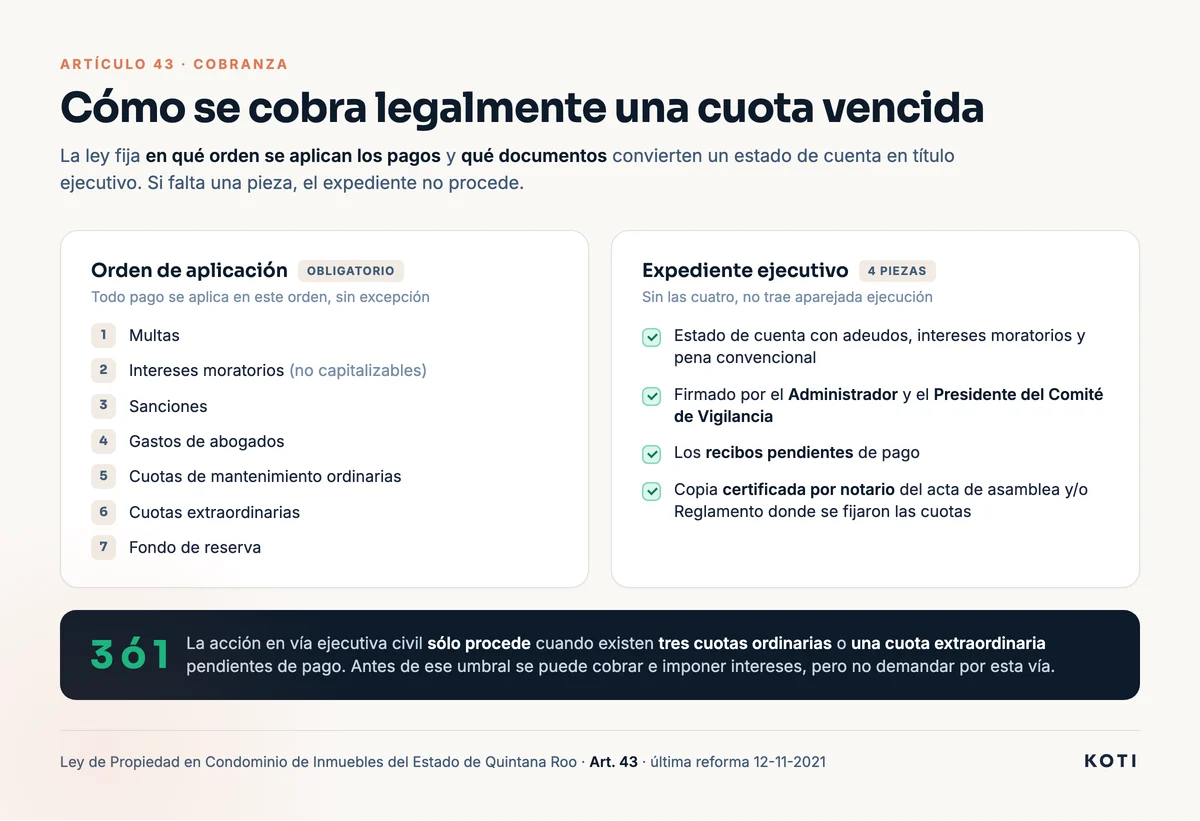
Three rules in Article 43 decide whether a collection succeeds or collapses:
- The application order is fixed. Every payment goes first to fines, then interest, penalties, legal fees, ordinary fees, special assessments, and lastly the reserve fund. That is why a partial payment sometimes does not reduce the current month's fee.
- The threshold is three or one. Civil enforcement proceedings are available only when three ordinary fees or one special assessment are outstanding.
- The file needs four pieces. The account statement is enforceable only if signed by the Administrator and by the President of the Oversight Committee, accompanied by the unpaid receipts and a notarized copy of the assembly minutes or bylaws where the fees were set. One missing signature and the file is useless.
In practice this means collections start long before the lawyer: if you do not know precisely which units crossed the threshold and your receipts are not in order, you are already late.
On suspending services: Article 43 permits it for services enjoyed in private areas and paid from the Maintenance and Administration Fund or the Reserve Fund, but with prior authorization from the Oversight Committee. It is not a unilateral decision by the administrator. And it has one absolute limit: the same paragraph expressly excludes the water service. Electricity, gas or other services covered by the common fund, yes; water, never. Mexico City applies the same prohibition in its article 33 section XII: "the potable water service may not be restricted".
Article 67, section IV adds a lever that is rarely used: an owner who fails to pay on time may face a fine, late interest, and restriction of their voting rights in assemblies. With one nuance that decides whether your next assembly stands or falls: in Quintana Roo this is a sanction, not an automatic effect. Article 68 requires the General Assembly to impose and assess it, summoning the offending owner as well "so that they may state what is in their interest", with the resolution passed by simple majority and served within the following five days. Refusing the vote at the door, with no such prior resolution, is precisely the defect that brings a whole assembly down. (Mexico City works the other way round: article 34 strips the delinquent owner's vote by operation of law, with no resolution needed.)
The no-debt certificate now includes tax receipts
Since the 2021 amendment, Article 46 requires the notary public to demand from the seller, in every sale of an exclusive-property unit:
- The no-debt certificate for maintenance and administration fees and the reserve fund, duly signed by the Administrator.
- The digital tax receipts (CFDI) for the last 3 payments of maintenance fees.
If your administration does not issue CFDI, or the history is not in order, an owner's sale stops at the notary's office. It is one of the most uncomfortable calls an administrator receives, and it is entirely avoidable.
Article 49 is also worth knowing: the debt is secured preferentially by the exclusive-property unit itself, and that security follows the unit even when transferred to third parties. Only alimony claims rank ahead of it. Any interested party may request a statement of outstanding debts from the Administrator, which is legally effective only if signed by the president of the Oversight Committee.
Careful with the delinquency list
The 2021 amendment added Article 69, which many administrators do not know about: the Administrator may request the information the law allows, but may not share any owner information that could be considered sensitive or personal, except with written consent or in the cases contemplated by Mexico's Federal Personal Data Protection Law (LFPDPPP).
Posting names and debts in the neighbors' group chat, in the elevator or at the guard booth is, at minimum, a risk you do not need to take. The law already gave you far stronger collection tools than public shaming: late interest, restriction of voting rights, service suspension authorized by the Oversight Committee, and civil enforcement proceedings.
Compliance checklist
A quick review you can run today on your own administration:
- Minute book authorized by the Oversight Committee
- Oversight Committee of five owners, elected by the assembly, serving up to one year on an honorary basis and current on their payments (Article 40)
- Notices with the Article 30 timelines and documented dual service
- Quorum calculated on undivided share, not on attendees
- Periodic account statement with the five Article 36(X) elements, with proof of receipt
- A receipt for every item, showing outstanding balances
- Late interest set in the bylaws or by the assembly, non-compounding
- Collection file with dual signature ready before hitting three unpaid fees
- No-debt certificate and CFDI for the last 3 payments available on request
- Personal data handled in line with Article 69
If you fail three or more, you are not administering badly for lack of effort: you are administering without a system.
Where Koti fits
Koti does not provide legal advice. What it does is remove the manual work the law requires you to document:
- Account statements per unit, generated automatically and downloadable by residents themselves.
- Payment receipts with the community logo and administrator signature, issued when each payment is approved.
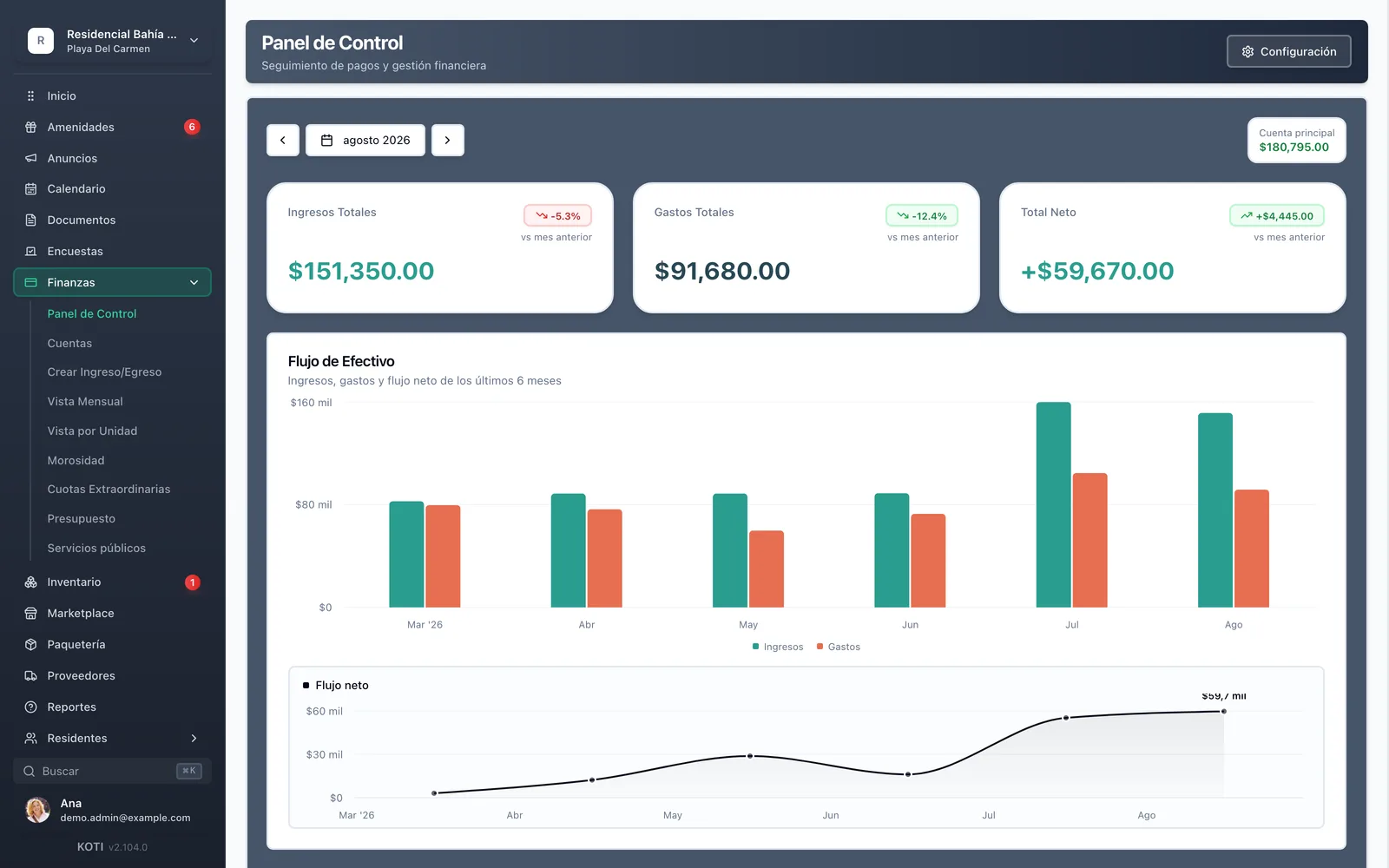
- Monthly financial report with income, expenses, net balance and delinquent units.
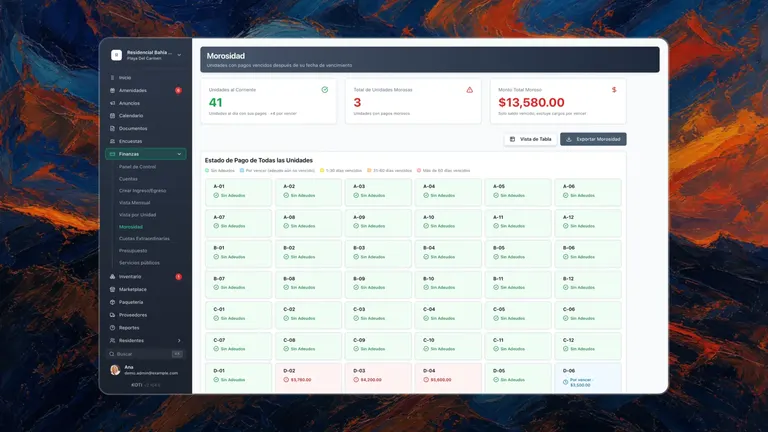
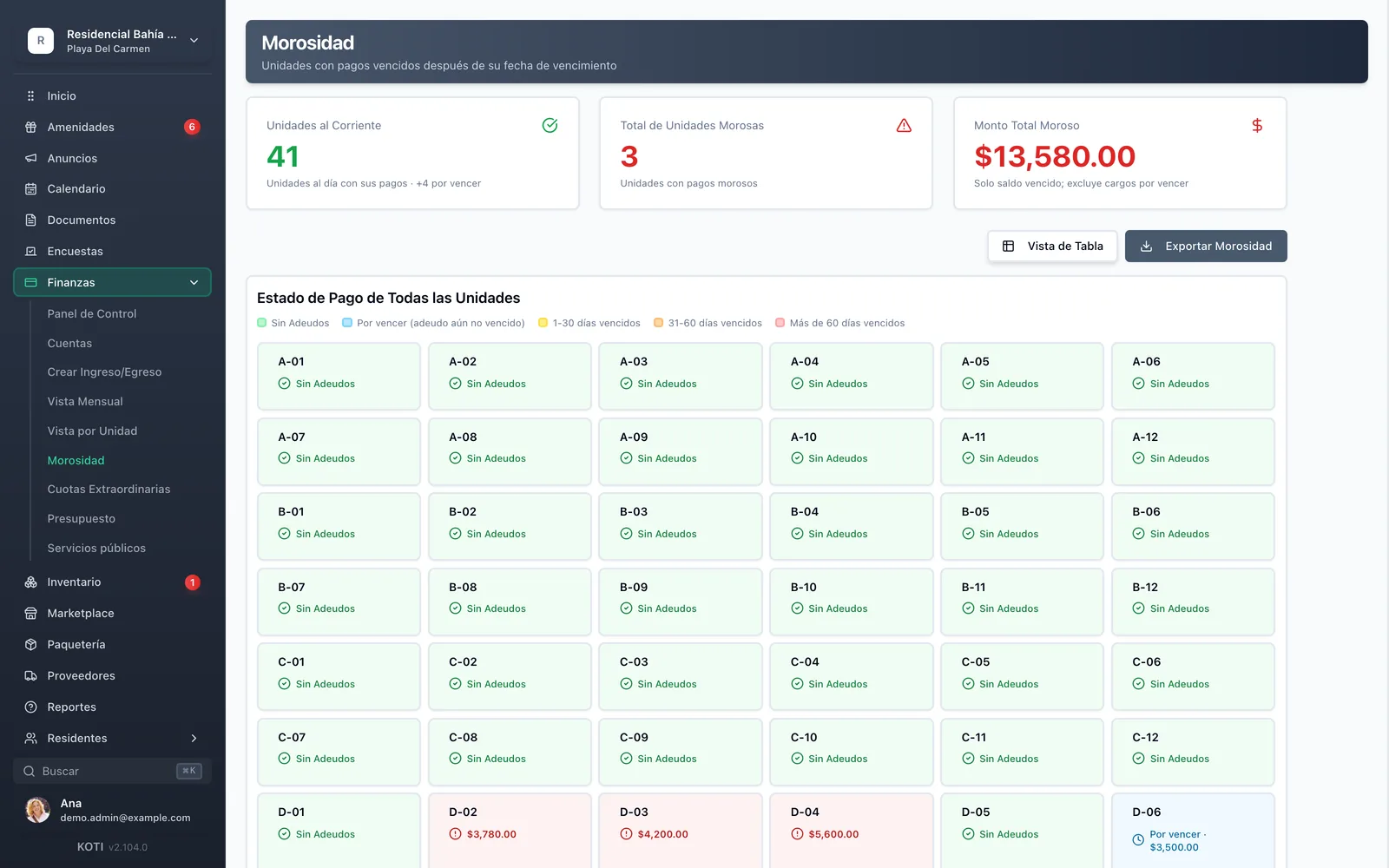
- Delinquency map to see at a glance who is current and who is not.
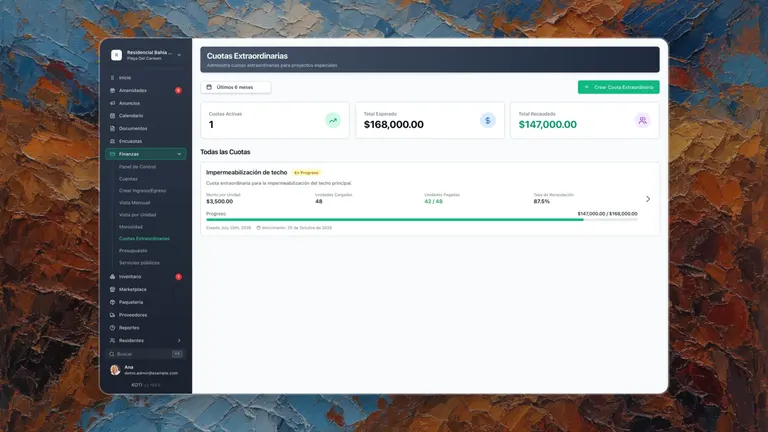
- Automatic late fees, configurable and applied the day after the due date.
- CFDI 4.0 for the tax receipts the notary will ask for.
- Documents to keep minutes and bylaws available to owners at all times.
The law is the same for every condominium in Quintana Roo. The difference between an administration that complies and one that improvises is whether the data is already in order the day someone asks for it.
Quintana Roo's Condominium Property Law is not an obstacle: it is the operating manual you are already being measured against. The articles most often breached (36(X), 43 and 46) are exactly the ones solved with order and systems, not more hours.
If you manage properties in Playa del Carmen, Cancún or Tulum and want to see what your condominium would look like with statements, receipts and delinquency already in order, book a Koti demo.
This article is general guidance based on the Condominium Property Law of the State of Quintana Roo, last amended in the State Official Gazette on November 12, 2021. It does not constitute legal advice. For a specific matter, especially a collection proceeding or a challenge to an assembly, consult a lawyer.
Try Koti for free
Simplify your condo management: dues, access and announcements in one place. 14 days free, no credit card.
Official sources
Every article cited in this guide was checked against the text published by the body that issued it. Condominium law in Mexico is state law: always read your own state’s, and confirm the date of the latest amendment before acting.
- Ley de Propiedad en Condominio de Inmuebles del Estado de Quintana Roo
Quintana Roo · Last amended: 12-11-2021 (P.O. del Estado) · Checked: 2026-08-09
This guide is general information, not legal advice. For a specific matter, consult a lawyer in your state.
Written by
Equipo Koti
Condo Management Experts
The Koti Smart Communities team shares knowledge and best practices for efficient condo and residential community management.