An assembly with no minutes did not happen. A resolution that was never recorded cannot be executed, cannot be collected and cannot be defended: the only thing that survives the meeting is the paper.
And the paper is almost always wrong. Most minutes circulating in Mexico are meeting notes — "the pool was discussed, it was agreed to raise the fee" — with no verified quorum, no per-item vote, no owners and no signatures. That is not minutes: it is a summary, and any dissatisfied owner can knock it down.
This guide is the document: a complete format for condominium assembly minutes with a worked example you can copy, the model notice that precedes them, and the specific mistakes that make them challengeable. If what you need is how to run the assembly — dates, turnout, logistics, follow-up — that lives in the guide to organising a condominium assembly: that article is the process, this one is the document.
One warning that applies to the whole text: Mexico has no federal condominium law. Every state has its own, and they differ precisely on what decides whether your minutes hold. Here we verify five — Mexico City, Quintana Roo, Nuevo León, Jalisco and the State of Mexico — against each one's text in force; if your state is not among them, the guide to condominium laws in Mexico gives the wider picture.
What makes minutes valid (and what does not)
Minutes are not valid because they are well written. They are valid because they prove three things, in this order:
- That the assembly was called the way your state's statute requires: notice period, notice content, method of service and proof of that service.
- That it was seated with a quorum. Not "a lot of people showed up": the exact figure, measured in the unit your state uses.
- That every resolution was voted on separately, recording votes in favour, against and abstentions.
Miss any one of the three and the rest is decoration. In Jalisco this is literal: article 1025 of the State Civil Code provides that any matter discussed at the assembly that is not covered by the agenda has no legal force whatsoever, unless one hundred percent of persons and interests were represented. If a special assessment was approved under "general matters", that assessment does not exist.
And there is one detail almost nobody records. In Mexico City, article 31 section II of the Condominium Property Law for the Federal District requires owners present with voice and vote to sign the attendance list annexed to the minute book in order to count towards the quorum. A list with no signatures is not proof of quorum: it is a list of names.
The content the statute requires, item by item
Of the five statutes we checked, only one writes out the list of what minutes must contain — and it pays to read closely which minutes that list actually binds. Article 31 section VIII of the Mexico City statute first requires the secretary to enter the minutes in the book authorised by the Procuraduría Social. It then handles the condominium with no book: if the assembly was lawfully called and there is no minute book, the minutes may be drawn up on separate sheets recording that circumstance — and it is those minutes that the statute says must contain place, date, opening and closing time, agenda, signatures of the participants, list of attendees, assembly resolutions and the proceedings of the general assembly, with the Procuraduría to be notified within no more than fifteen business days.
As a mandate, then, that list reaches the minutes drawn up on separate sheets, not the ones entered in the book. But it is the only written content list in the five statutes and the most demanding of them, so use it as a checklist anywhere. Read it slowly, because three of those items almost never appear:
- Closing time, not just the opening one. It is what lets anyone reconstruct whether there was actually time to work through every agenda item.
- List of attendees in addition to the participants' signatures. They are different documents: the list is taken at the start against the owner register; the signatures are collected at the close.
- The proceedings, not just the resolutions. What was presented, who objected and why. Minutes that list only resolutions erase the deliberation, which is exactly what gets examined when someone challenges them.
Jalisco's answer to the same problem — minutes that cannot be entered in the book — is different and more expensive: article 1012 section VI of the Civil Code provides that when the minutes cannot be entered in the book, they must be notarised to be valid, before a notary resident in or with jurisdiction over the condominium's municipality.
Quorum: ownership share, headcount, or both
This is where an assembly falls apart, and hardly ever out of carelessness: the answer changes from state to state, and sometimes changes within the same state depending on the item being voted.
- In Quintana Roo the quorum is pure ownership share: 75% on first call, 51% on second (article 29). But article 28 section VI clarifies that although a vote is worth its percentage of ownership, to elect, re-elect or remove the Administrator or the Oversight Committee each residential unit is worth one single vote. Same assembly, two arithmetics.
- In Mexico City the statute measures the quorum in owners (article 32 section IV) and the vote in ownership share (article 31 section III). It is not a contradiction: they are two different things, and the minutes have to record both.
- In Nuevo León and Jalisco the quorum is a percentage of ownership: 51% of the undivided share and 51% of condominium rights.
- In the State of Mexico it works the other way round: article 28 section II grants one single vote per owner, regardless of how many units they own, except in commercial and industrial condominiums.
The practical conclusion: always record both figures, how many owners attended and what percentage of ownership they represent. Minutes that say only "37 people attended" are useless in Quintana Roo; minutes that say only "74.6% of the undivided share" do not prove a Mexico City quorum. If your register already carries the ownership share unit by unit — the same number used to calculate the maintenance fee — both fall out for free.
| State | Minimum notice | First-call quorum | Second call | Basis of the vote |
|---|---|---|---|---|
| Mexico City | 7 calendar days | 75% of owners | Simple majority of the total; third call, whoever attends | Ownership share |
| Quintana Roo | The minimum period set by the bylaws; failing that, 15 calendar days | 75% of the undivided share | 51% of the undivided share; third call, whoever attends | Ownership share, except electing the administrator and committees: one vote per unit |
| Nuevo León | 10 calendar days, unless the bylaws set more | Ordinary 51%; extraordinary 51% on first and later calls | Ordinary: those present | Undivided share |
| Jalisco | 15 calendar days; 20 for extraordinary | Ordinary 51% of condominium rights | Between 7 and 15 days later, whoever attends | Condominium rights |
| State of Mexico | 10 days; 5 for extraordinary | More than 50% of owners | Whoever attends | One vote per owner |
Swipe horizontally to see the full table
One more factor decides a lot of votes: delinquent owners. In Mexico City and Nuevo León (article 34 in both statutes) a delinquent owner loses the vote by operation of law, keeps the right to speak and does not count towards the seating quorum. The two define delinquency differently — two ordinary fees in Mexico City, a single one in Nuevo León — and both carve out assemblies called to amend the constitutive deed, extinguish the regime or affect ownership: there, the delinquent owner does vote.
Quintana Roo is stricter still, and also automatic. Article 32 suspends the right to vote for as long as the non-payment subsists — of ordinary or special fees, late interest, legal fees or any penalty in the condominium's favour, with no carve-out by subject matter — and requires that unit's ownership share not to be counted towards seating the Assembly; the delinquent owner keeps the right to attend and give an opinion. Separately, article 67 section IV lets the Assembly impose, as a sanction and after hearing the offending owner (article 68), a fine and interest on top of the vote restriction. They are two different tracks: the article 32 suspension needs nobody's resolution; the article 67 sanction does. If the underlying problem is collections, the legal guide on delinquent neighbours covers it.
Model notice you can copy
Minutes begin with the notice: if the notice is defective, no later drafting saves them. This model follows Mexico City's requirements (article 32 sections I and IV), the strictest on content. Adjust the notice period and the quorum using the table above before using it in another state.
CONDOMINIO VILLA SERENA
Calle Palma 145, Colonia Del Valle Centro, Benito Juárez, Mexico City.
NOTICE OF ORDINARY GENERAL ASSEMBLY
Pursuant to articles 31 and 32 of the Condominium Property Law for the Federal District and to the condominium's Internal Bylaws, Ana Ruiz Medina, in her capacity as Administrator, summons the owners and occupants of Condominio Villa Serena to the Ordinary General Assembly to be held on Saturday 14 March 2026, in the condominium's multipurpose room, under the following
AGENDA
1. Attendance list, quorum verification and lawful seating of the assembly.
2. Appointment of chair, secretary and two vote counters.
3. Administration's report for 1 January to 31 December 2025.
4. Approval, where applicable, of the 2025 statements of account, with the Oversight Committee's report.
5. Approval, where applicable, of the 2026 expense budget and of the monthly ordinary fee per unit.
6. Approval, where applicable, of a special assessment of $4,800.00 MXN per unit, in three instalments, to replace the pressure-booster system and waterproof the roofs, per the three attached quotations.
7. Election of the Administrator and of the three members of the Oversight Committee for the 2026-2027 term.
8. General matters, no resolutions.
9. Assignment of owners and committed dates.
FIRST CALL: 10:00 hrs, with 75% of the owners in attendance. Should that quorum not be reached, the assembly will be held on SECOND CALL at 10:30 hrs with a simple majority of the total owners and, where applicable, on THIRD CALL at 11:00 hrs with whichever owners attend, resolving by majority of those present.
Supporting documents for items 3 to 6 are available as of today in the "Asamblea 2026" folder of the document hub and at the management office.
Representation is accepted by simple written proxy under the Internal Bylaws; no person may represent more than two owners, and the Administration may not represent any owner.
Resolutions of the assembly bind every owner, including those absent and those who dissent.
Mexico City, 7 March 2026.
Ana Ruiz Medina — Administrator. Signature.
Three notes. Item 6 carries an amount, a scope and payment terms: "financial matters" is not an agenda item, it is an invitation to have the resolution struck down. Item 8 says "no resolutions" on purpose, because of the Jalisco rule and because in Nuevo León article 29 section XI only allows a topic to be registered there if owners representing at least 10% of the undivided share request it in writing 72 hours in advance. And the seven days are the legal floor, not the target: send the notice two or three weeks out and keep proof of every send. A community-wide announcement with a per-recipient delivery report is exactly that proof.
Complete model of condominium assembly minutes
This is the document. It is written with worked numbers on purpose, because the most common defect is not drafting but arithmetic: minutes where the vote does not reconcile with the declared quorum. Replace the data, keep the structure.
MINUTES OF THE ORDINARY GENERAL ASSEMBLY OF CONDOMINIO VILLA SERENA
Entered on folio 41 of the Minute Book authorised by the Procuraduría Social of Mexico City.
In Mexico City, at 10:30 hrs on Saturday 14 March 2026, the owners and occupants signing the attendance list attached as Annex 1 having gathered in the multipurpose room of Condominio Villa Serena, Calle Palma 145, Colonia Del Valle Centro, Benito Juárez, following the notice issued on 7 March 2026 and served under article 32 of the Condominium Property Law for the Federal District, proceedings were as follows.
FIRST. Quorum verification and seating. The condominium comprises 48 private-property units. The attendance list was signed by 37 owners: 31 in their own right and 6 through a representative holding a simple written proxy. Of those, units A-104, B-207, C-301 and C-410 fall under article 34 of the statute for owing two or more ordinary fees, and therefore keep the right to speak, do not vote and do not count towards the seating quorum. The countable quorum was 33 owners, equal to 68.75% of all owners and 74.6% of the undivided share. The 75% of owners required on the 10:00 hrs first call not having been reached, and the statutory thirty minutes having elapsed, the assembly was declared lawfully seated on second call at 10:30 hrs, with a simple majority of the total owners.
SECOND. Appointment of the table. Owner Jorge Peña Uribe (B-102) was appointed chair and Administrator Ana Ruiz Medina secretary; the assembly designated Lucía Fernández Toledo (A-301) and Raúl Ibarra Sandoval (C-205) as vote counters. All four accepted.
THIRD. Administration's report. The secretary presented the 2025 report (Annex 4). Units A-201, B-110 and C-402 took part in the question round; their observations on landscaping spend are recorded in that annex. Informational item, not put to a vote.
FOURTH. 2025 statements of account. The statements having been presented and the Oversight Committee's report read, they were put to a vote: in favour 68.2% of the undivided share (29 units); against 4.1% (2 units); abstentions 2.3% (2 units). Total counted: 74.6% of the undivided share, 33 units. FOURTH RESOLUTION: the 2025 statements of account are approved as presented. Responsible: the Administration. Committed date: 21 March 2026.
FIFTH. 2026 budget and ordinary fee. The expense budget of $2,184,000.00 MXN per year having been discussed, it was put to a vote: in favour 71.9% of the undivided share (30 units); against 2.7% (3 units); abstentions 0%. FIFTH RESOLUTION: the 2026 budget is approved and the monthly ordinary fee is set at $3,790.00 MXN per unit, payable in advance within the first five days of each month, effective 1 April 2026. Responsible: the Administration. Committed date: 1 April 2026.
SIXTH. Special assessment. The three quotations in Annex 6 having been presented, the matter was put to a vote: in favour 62.0% of the undivided share (26 units); against 9.8% (5 units); abstentions 2.8% (2 units). SIXTH RESOLUTION: a special assessment of $4,800.00 MXN per unit is approved, in three equal instalments due 30 April, 31 May and 30 June 2026, earmarked exclusively for replacing the pressure-booster system and waterproofing the roofs, and the works are awarded to the supplier in quotation 2 for $187,300.00 MXN. Responsible: the Administration, with the Oversight Committee's sign-off on each payment. Committed date: 31 July 2026.
SEVENTH. Election of Administrator and Oversight Committee. Candidacies having been registered, the vote returned: in favour 70.5% of the undivided share (31 units); against 4.1% (2 units). SEVENTH RESOLUTION: Ana Ruiz Medina is re-elected as Administrator and the Oversight Committee is appointed, composed of [names], for the term 1 April 2026 to 31 March 2027. Those elected proved to the assembly that they are current on their obligations.
EIGHTH. General matters. Three points were raised: weekend noise in the parking area, pruning of the west green area, and pool hours. None was put to a vote, as none is covered by the agenda; the Administration is instructed to include them in the next notice.
NINTH. Dissenting vote. The owner of unit C-108 asked that their vote against the SIXTH RESOLUTION be recorded, on the grounds that the payment period is insufficient. It is recorded verbatim.
TENTH. Close. There being no further business, the assembly closed at 13:05 hrs on the same day.
ANNEXES. 1) Signed attendance list, with unit, name, percentage of undivided share and capacity of attendance. 2) Proxies received. 3) Notice and proof of service. 4) Report and 2025 statements of account with the Oversight Committee's report. 5) 2026 budget. 6) Quotations for the sixth item.
SIGNATURES. Chair: Jorge Peña Uribe. Secretary: Ana Ruiz Medina. Vote counters: Lucía Fernández Toledo and Raúl Ibarra Sandoval. Oversight Committee members in attendance: [names]. Owners who asked to sign: [names].
Notice that the arithmetic reconciles at every item: 68.2 + 4.1 + 2.3 = 74.6, and 29 + 2 + 2 = 33. That is the first check a lawyer runs when trying to void your minutes, and the easiest one to pass.
How to record the vote on each resolution
A properly recorded resolution has five components, none of them optional: what was presented, how it was voted, what was resolved verbatim, who executes it and by when. A resolution with no owner and no date is the one nobody carries out, and the one that reappears word for word at next year's assembly.
On the "how it was voted", three rules that avoid most challenges:
- Never write "approved unanimously by those present" without the figure. If an owner later proves they were there and voted against, the word "unanimously" turns a debatable resolution into false minutes.
- Record abstentions separately. They are neither votes in favour nor against, and in several states the threshold is measured against the total undivided share, not against the votes cast.
- Watch the large owner. In Quintana Roo, if a single owner represents 20% or more of the undivided share the resolution also needs a favourable majority of the remaining percentage (article 28 section VIII); in Nuevo León that threshold is 30% (article 29 section VII); in Mexico City it applies above 50% (article 31 section VII). A resolution that ignores that second majority is valid on paper and voidable in court.
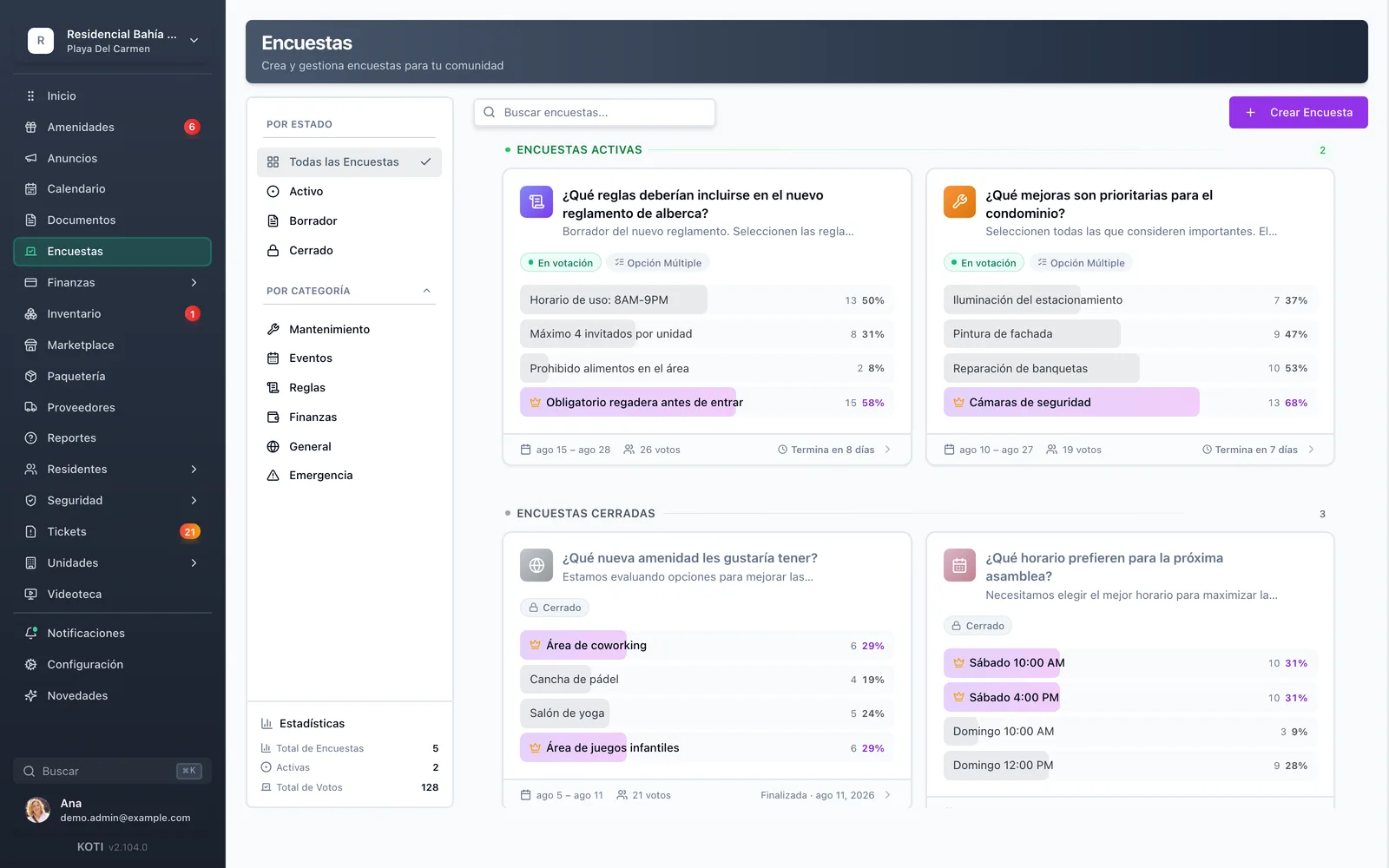
Walking into the vote with no idea how the community is leaning is what stretches assemblies to five hours. Sounding it out beforehand with an indiviso-weighted poll does not replace the assembly's vote — that is the statute talking, not the software — but it tells you which item will be fought over and which passes in three minutes.
Signatures, minute book and notarisation
Who signs, where it is entered and when you have to visit a notary is the most state-specific part of all, and the costliest to get wrong: minutes that should have been notarised and were not cannot be registered, and a resolution that is not registered is not enforceable against a third party.
| State | Authorises the book | Signs the minutes | Mandatory notarisation |
|---|---|---|---|
| Mexico City | The Procuraduría Social (art. 31 sec. VIII) | Chair, secretary, the oversight committee members who attended and any owners who ask to sign | Only if it amends the constitutive deed (registered with the Public Registry) or the internal bylaws (registered with the Procuraduría) — art. 31 sec. IX |
| Quintana Roo | The oversight committee (art. 36 sec. I); note that art. 28 sec. XII of the same statute gives it to the Assembly | In this order: secretary, chair of debates, vote counters, attending oversight committee members and, where applicable, a notary (art. 28 sec. XII) | If it amends the deed and/or bylaws: notarised and registered, attaching the minute, the attendance list and the recording (art. 28) |
| Nuevo León | The Advisory and Oversight Committee; the Administrator keeps a minute book duly authorised by that committee (art. 38 sec. I) | Chair, secretary and a member of the Advisory and Oversight Committee (art. 29 sec. IX) | Every extraordinary assembly's minutes, notarised and registered; of the ordinary ones, only those the assembly decides (art. 29 sec. IX) |
| Jalisco | The municipal secretary, on the first usable page (art. 1012 sec. VI) | The code does not list signatories; related documents are kept as an appendix | The minutes appointing the administrator and their bond (art. 1013), and any minutes that cannot be entered in the book (art. 1012 sec. VI) |
| State of Mexico | The municipal secretary (art. 28 sec. V) | The comptroller of the board authorises the minutes (art. 28 sec. V) | The condominium's internal bylaws (art. 29 sec. IX) |
Swipe horizontally to see the full table
Three rules catch administrations out. In Nuevo León, every extraordinary assembly's minutes — the one approving a special assessment, amending the bylaws or affecting common areas — must be notarised and registered, no exceptions and regardless of what the assembly decides. In Quintana Roo notarisation requires attaching the recording of the meeting: if your assembly was held by video conference and nobody recorded it, the minutes cannot be notarised in full. And in Jalisco article 1025 bis of the Civil Code — in force since the reform published on 27 April 2021 — allows remote sessions, but conditions their validity on four requirements: full visual identification of those taking part, real-time interaction and intercommunication allowing genuine deliberation, votes being roll-call with the record entered, and keeping an audiovisual record of the session and its resolutions. The recording is not a courtesy: it is a validity requirement.
The seven mistakes that make minutes challengeable
None of these is exotic. All of them show up in real minutes, and almost all are fixed before the assembly, not after.
- The notice misses the period or the required content. The most-used argument because it is the easiest to prove. In Jalisco, someone who did not attend because they were not lawfully summoned can sue for the resolutions' unenforceability within 30 calendar days of the assembly (article 1023).
- There is no proof of service. A perfect notice nobody can evidence is the same as no notice.
- Something was resolved that was not on the agenda. An express rule in Jalisco and good practice everywhere else.
- The quorum was measured on the wrong basis — headcount where it should have been ownership share, or the reverse — or delinquent owners who should have been excluded were counted.
- An owner was denied the vote who was not yet delinquent in that state. The trigger changes: two ordinary fees in Mexico City, a single one in Nuevo León, and in Quintana Roo any outstanding amount, late interest and legal fees included.
- Signatures are missing, or the signing order is. In Quintana Roo article 28 section XII fixes even the sequence. Watch representation too: in Mexico City nobody represents more than two owners and the administrator none (article 31 section IV); in Nuevo León the cap is four (article 29 section V); in Quintana Roo nobody represents more than 20% of the owners, and neither the administrator nor the oversight committee may represent anyone (article 28 section VII).
- The minutes were signed but never entered in the book or notarised. The quietest one: nobody notices until the resolution has to be registered or the administration handed over.
If you only check one thing before the next assembly, check the attendance list: printed with the register already loaded, with unit, name, percentage of undivided share, account status and a signature column. That single document holds up or brings down everything else, and it comes straight out of an up-to-date unit and resident register.
The clocks that start when the assembly ends
The assembly ends and clocks start running that almost nobody has in their calendar:
- Mexico City: the Administrator must inform each owner in writing of the resolutions within the following 7 business days (article 31 section IX). If the minutes were drawn up on separate sheets, there are 15 business days to notify the Procuraduría Social (section VIII).
- Jalisco: the 30 calendar days to sue for unenforceability. And a device almost nobody uses: at an extraordinary assembly, the 75% of rights that article 1023 demands may be completed within those 30 days with absent owners who authentically declare themselves aware of the resolutions and approve them. If you fell three units short, the statute gives you a month to close the gap.
- Quintana Roo and the State of Mexico: the secretary keeps the book available to owners and informs them of the resolutions in writing (art. 28 sec. XIII and art. 33 sec. V).
The obligation is always the same: deliver the minutes, do not file them away. Publishing them signed, with their annexes, in the document hub with owner-level access satisfies the requirement and leaves a dated trail. Minutes that exist only in the outgoing administrator's folder are the minutes that vanish at the next handover.
Where Koti fits
Koti does not draft minutes and does not give legal advice. What it does is keep ready the material the minutes are drafted from, and the place the minutes live afterwards:
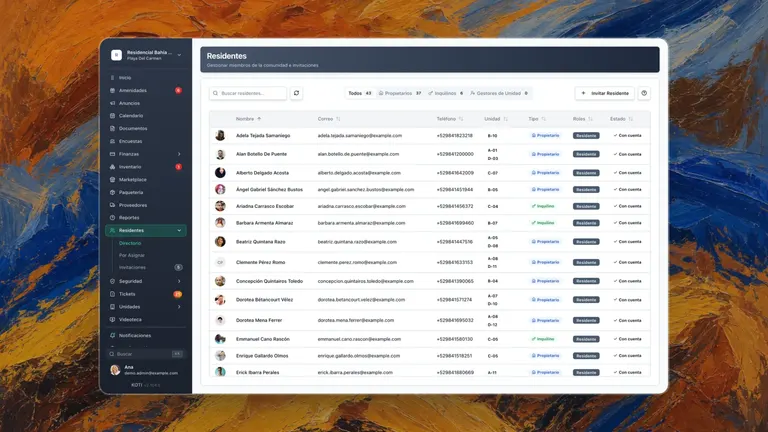
- A unit register with ownership shares captured, which is what turns an attendance list into proof of quorum instead of a list of names.
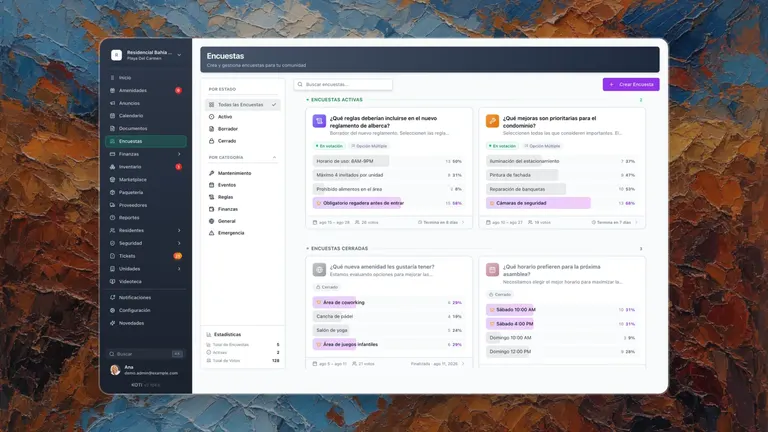
- Polls with three voting modes — per resident, per unit, or weighted by ownership share — exportable as CSV with per-unit detail. It is the annex most minutes are missing.
- Announcements and notices with a per-recipient delivery report: queued, sent, delivered, opened, bounced or failed, downloadable as a PDF. That is the proof of service the statute will ask you for.
- A document hub with three access levels — admin, owners or everyone — and version control, so the Assembly Minutes folder is available to owners at all times and always opens the current version.
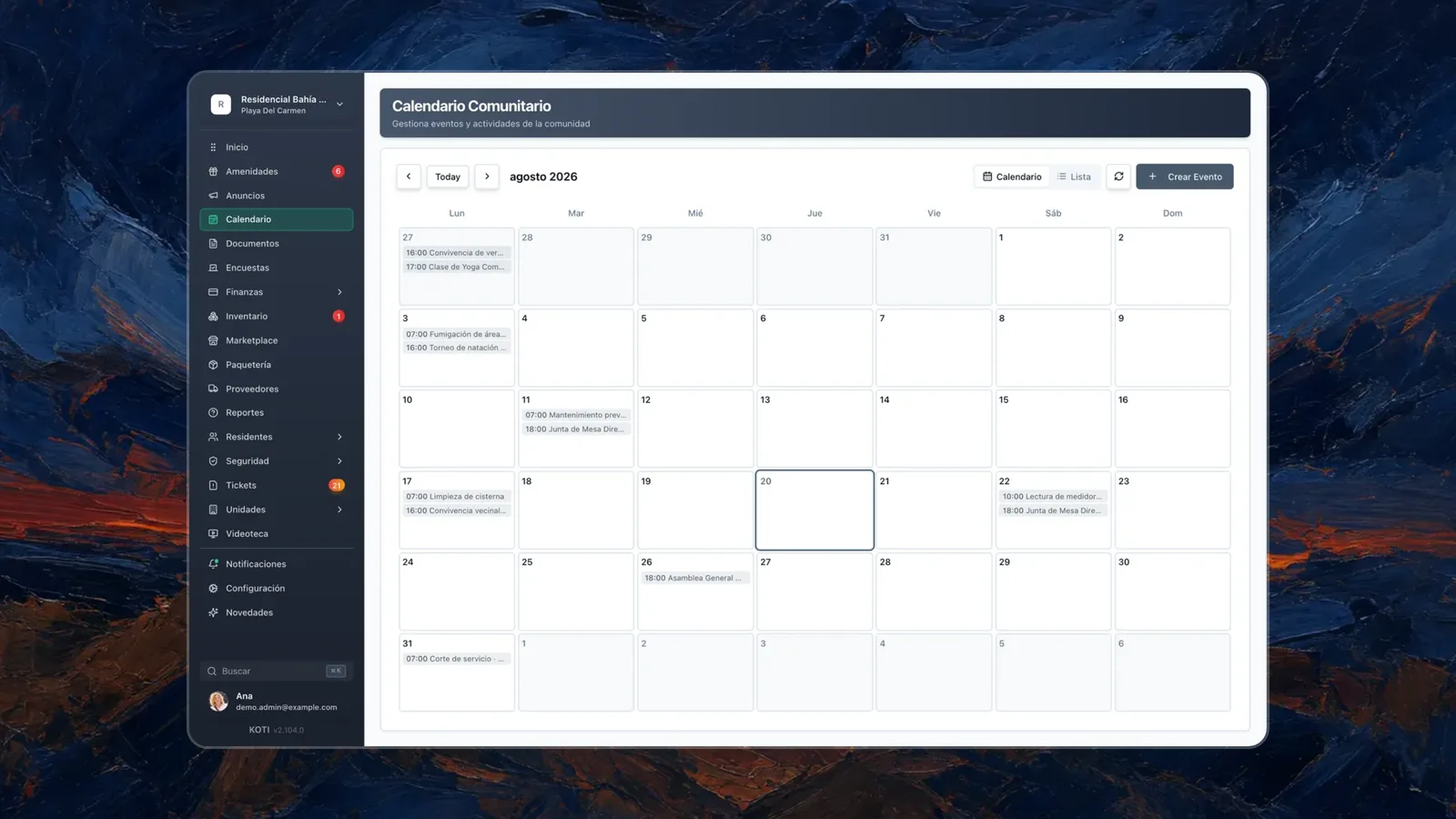
- A community calendar so the assembly date lands in every neighbour's app with a reminder, not just in the WhatsApp group.
None of those pieces is the minutes. All of them are what makes drafting them take an afternoon instead of a week, and what keeps them there when the administration changes.
Minutes are not paperwork: they are the only document that gives force to what the community decided. Done well, they support collecting a special assessment, back the removal of an administrator, and survive a change of administration. Done badly, they turn three hours of assembly into nothing.
The good news is that the work that decides whether the minutes hold happens before the meeting: an up-to-date register with ownership shares, the notice with its proof of service, the attendance list printed with the data already loaded. With that ready, drafting the minutes is transcription.
Want to see your condominium with the register, the notices and the minutes already in order? Check Koti's plans or book a demo.
General guidance based on the texts in force as of 21 August 2026 of: the Condominium Property Law for the Federal District (last amended GOCDMX 4 August 2023); the Condominium Property Law of the State of Quintana Roo (last amended POE 12 November 2021); the Condominium Property Law for the State of Nuevo León (last amended P.O. 11 October 2023); the Civil Code of the State of Jalisco (last amended P.O. 18 June 2026); and the Law Regulating the Condominium Property Regime in the State of Mexico (last amended POGG 29 April 2024). It does not constitute legal advice: for a specific matter, especially challenging an assembly or notarising minutes, consult a lawyer or a notary.
Try Koti for free
Simplify your condo management: dues, access and announcements in one place. 14 days free, no credit card.
Official sources
Every article cited in this guide was checked against the text published by the body that issued it. Condominium law in Mexico is state law: always read your own state’s, and confirm the date of the latest amendment before acting.
- Ley de Propiedad en Condominio de Inmuebles para el Distrito Federal
Mexico City · Last amended: 04-08-2023 (G.O. CDMX) · Checked: 2026-08-09
- Ley de Propiedad en Condominio de Inmuebles del Estado de Quintana Roo
Quintana Roo · Last amended: 12-11-2021 (P.O. del Estado) · Checked: 2026-08-09
- Ley de Propiedad en Condominio de Inmuebles para el Estado de Nuevo León
Nuevo León · Last amended: 11-10-2023 (P.O. del Estado No. 128) · Checked: 2026-08-09
- Código Civil del Estado de Jalisco
Jalisco · Last amended: 18-06-2026 (Decreto 30196/LXIV/26, P.O. secc. VII) · Checked: 2026-08-09
- Ley que Regula el Régimen de Propiedad en Condominio en el Estado de México
State of Mexico · Last amended: 29-04-2024 (P.O. «Gaceta del Gobierno») · Checked: 2026-08-09
This guide is general information, not legal advice. For a specific matter, consult a lawyer in your state.
Written by
Equipo Koti
Condo Management Experts
The Koti Smart Communities team shares knowledge and best practices for efficient condo and residential community management.