Every year, between October and December, an administrator sits down with a spreadsheet and decides how much every neighbour will pay for the next twelve months. It is the most repeated calculation in the job and the one that derails the most assemblies, because at the assembly the result is almost never what gets argued about: the method is.
How a maintenance fee is calculated has a short answer and a long one. The short one: the annual budget divided by twelve, prorated by the ownership share the founding deed assigns to each unit. The long one is this guide, because every word in that sentence hides a decision someone will challenge — what goes into the budget, how much goes to the reserve fund, why ownership share and not equal shares, and what to do with the hole delinquency leaves.
We run the whole calculation on a 48-unit condominium, with tables you can lift straight into your assembly deck. The articles cited are verified against the text in force of each state statute; the figures are illustrative.
The budget first, the fee second
The fee is not a number you pick: it is a quotient. The annual expense budget goes on top; twelve months and each unit's ownership share go underneath.
And the administrator does not approve the budget. In Mexico City it is an express power of the General Assembly to "discuss and, where applicable, approve the expense budget for the following year" (Art. 33, s. IX); in Quintana Roo the wording is almost identical and adds that this is where the administrator's fees are set (Art. 31, s. VIII). Walking in with the fee already calculated and no budget behind it is the fastest way to lose the vote.
The expense lines of almost any Mexican condominium, with illustrative figures for 48 units and a 24-hour guard booth:
| Line item | Annual (MXN) | Of total |
|---|---|---|
| Payroll: 24/7 security, cleaning, gardening | $1,104,000 | 54.1% |
| Preventive maintenance: pumps, elevator, pool, gates | $312,000 | 15.3% |
| Administration: management fees, accounting, software | $240,000 | 11.8% |
| Utilities: common-area power, water, guard-booth internet | $186,000 | 9.1% |
| Insurance: liability and common-area damage | $48,000 | 2.4% |
| Operating subtotal | $1,890,000 | 92.6% |
| Reserve fund | $94,500 | 4.6% |
| Contingency | $56,700 | 2.8% |
| Annual total | $2,041,200 | 100% |
Swipe horizontally to see the full table
That produces the number that matters: $2,041,200 divided by 12 = $170,100 a month to spread across the 48 units.
Three rules that keep a budget from running out in August:
- Budget from this year's real spending. Payroll rises with the minimum wage and with the Christmas bonus, that thirteenth month almost always forgotten.
- Spread over twelve whatever is paid in one shot, like the insurance policy or the elevator's major service. Otherwise December is always a hole.
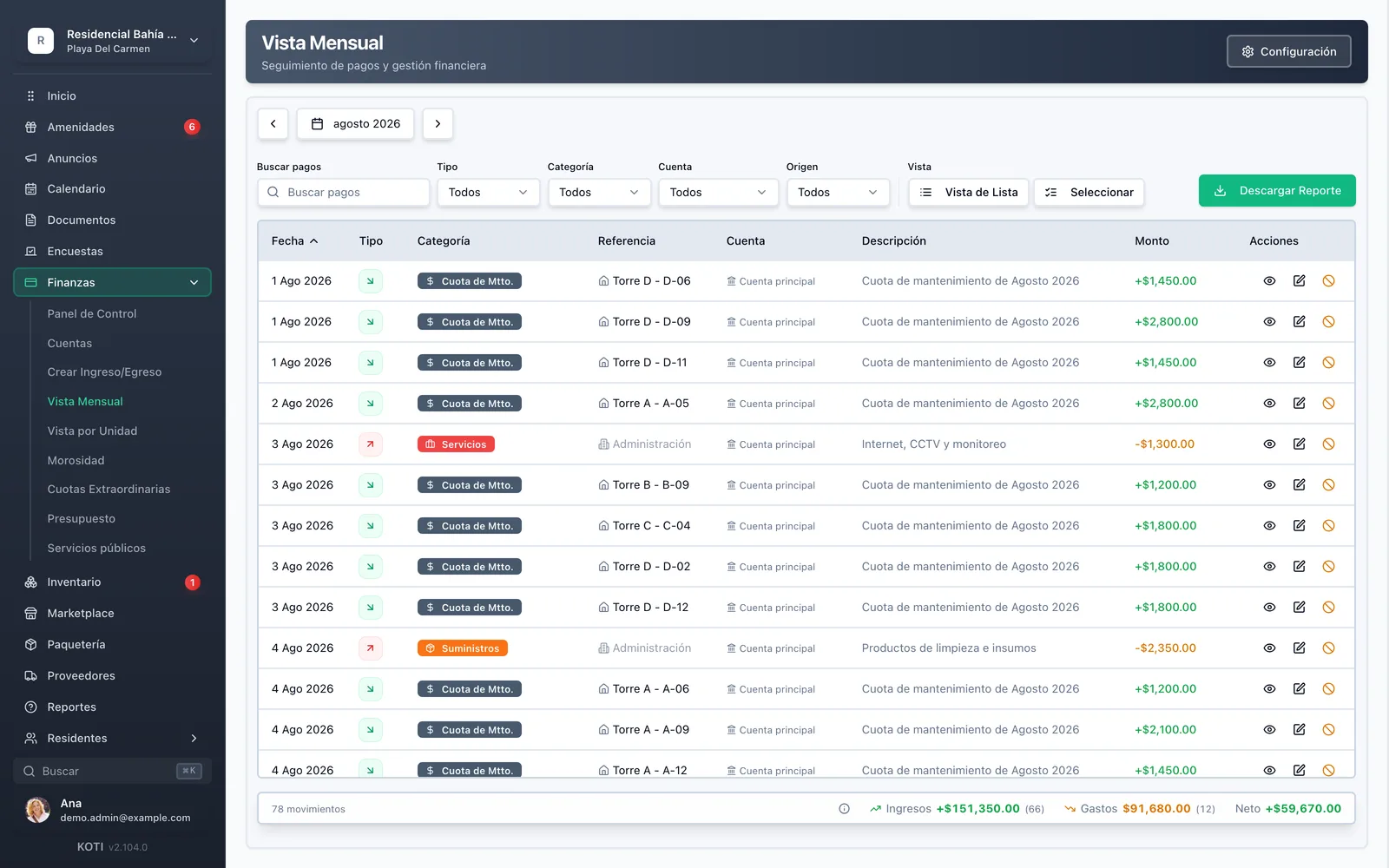
- Close against actual spending, not the estimate. The monthly report, filterable by category, is the input for next year's budget.
The reserve fund: what your state statute actually requires
This is where the trade's most repeated false fact circulates: that the law requires 5% to 10% of the annual budget to go to the reserve fund. We read the text in force of five state statutes — four condominium laws and one civil code — and none sets a percentage. What they do set is who decides the amount and how it is split.
| State | What it says about the reserve fund | Article |
|---|---|---|
| Mexico City | Built from fees, and the amount "shall be set in proportion to the percentage of undivided share". No minimum. | Art. 55, s. II |
| Quintana Roo | Reserves for "extraordinary, emergency and unforeseen expenses"; the assembly sets the fees. | Arts. 2 s. XIV and 31 s. IX |
| Jalisco | Owners contribute to "constitute and preserve reserve funds, based on the percentage each private unit represents of the condominium". | Arts. 1026 and 1006 s. XI |
| Nuevo León | Made up "in proportion to the undivided share corresponding to each owner"; the first contributions are set by the internal bylaws. | Arts. 46 s. II and 45 s. II |
| State of Mexico | Made up "in proportion to the value of each exclusive-property unit", per the founding deed. The maintenance fund must hold three months of expenses in advance. | Arts. 30 and 34 |
Swipe horizontally to see the full table
That last line is the only quantified obligation these five statutes place on the funds, and it is not about the reserve: it is about the liquidity of the maintenance fund. It is also the best starting point for any state.
There is a numeric ceiling in the State of Mexico, but it applies to the fee, not to the reserve, and only in one narrow scenario: where the condominium comprises sixty or more exclusive-property units and an administration committee or an administrator is elected per lot or per block, that committee or administrator "shall set the fees or contributions on the basis of the commercial value of the property taken as of the day of the determination, and these may not exceed 1% of that value" (Art. 30). It is a ceiling, not a floor: it does not say how much to charge, it says how far.
So how much? The criterion that survives an assembly is not a round percentage, it is a list: enumerate the assets with a schedulable replacement — waterproofing, façade paint, pumps, gate motors, pool equipment, elevator — write down replacement cost and remaining useful life for each, divide cost by years and add it up. That is your minimum annual contribution.
One detail the statutes handle separately, and at two different intensities: in the State of Mexico the reserve fund, while unused, must be invested in fixed-income securities redeemable on sight (Art. 30); in Nuevo León both funds may be invested in on-sight securities while preserving liquidity for short-term obligations (Art. 46, s. III). A duty in one, a permission in the other, but the practical consequence is the same: a separate account, not mixed in with operations.
Prorating by ownership share, or an equal fee for everyone
The indiviso is the ownership percentage the founding deed assigns to each unit. The administrator does not invent it and the assembly does not vote it, and it is the default allocation criterion in all five statutes reviewed:
- Mexico City: "by distributing the expenses in proportion to the percentage of undivided share each privately owned unit represents" (Art. 55, s. I).
- Quintana Roo: "in the proportion their ownership percentage represents of the condominium's undivided share" (Art. 26, s. V).
- Jalisco: "based on the percentage each private unit represents of the condominium" (Art. 1026).
- Nuevo León: "in proportion to the undivided share corresponding to each owner" (Art. 46, s. II).
- State of Mexico: "in proportion to the value of each exclusive-property unit, as established in the founding deed" (Art. 30).
So where does an equal fee for everyone fit? Through three doors, and it is worth knowing which one you are using.
The deed or the bylaws say so. Nuevo León sends the first contributions and the contribution basis to the internal bylaws (Arts. 46 s. II and 45 s. II), Jalisco sends the formation of the funds and the payment basis there too (Art. 1006, s. XI), and the State of Mexico refers to the deed.
The assembly defines the collection scheme. In Mexico City it may set the fees "determining the collection system or scheme it deems most appropriate and efficient" (Art. 33, s. V). It is a real power, but it coexists with Art. 55: if you depart from the ownership share, put it in the minutes.
The law orders it. The least known case: in Mexico City's social-interest and low-income condominiums, "fees shall be set on the basis of the number of privately owned units the condominium comprises, regardless of the proportion of the undivided share, except for non-residential properties" (Art. 77, Title Five). For the dwellings, an equal fee is the rule there, not an option — and Art. 55 anticipates it when it carves out that Title.
Read the exception before applying it: if that same condominium also holds shops or offices, their fees "may be adjusted" on a different criterion. Where a social-interest condominium also contains units of a use other than residential, the General Assembly determines their ordinary and extraordinary fees "in proportion to the percentage of undivided share each represents against the undivided-share area of the smallest dwelling", which serves as the unit of measure, "or on commercial criteria" (Art. 77, second paragraph). Dwellings by unit count; commercial units by proportion or commercial criteria.
How an ownership-share table is read and captured is developed in the guide to the maintenance fee by ownership share.
The calculation, step by step, in a 48-unit condominium
Take the earlier budget — $170,100 a month — and a building with three unit types. Areas and ownership shares come from the founding deed:
| Type | Area | Units | Share per unit | Share of the type |
|---|---|---|---|---|
| A — studio | 65 m² | 12 | 1.4840% | 17.8080% |
| B — two bedrooms | 90 m² | 24 | 2.0548% | 49.3152% |
| C — three bedrooms | 120 m² | 12 | 2.7397% | 32.8764% |
| Total | 4,380 m² | 48 | — | 99.9996% |
Swipe horizontally to see the full table
Each unit's fee is one multiplication: fee = monthly spend × ownership share. Next to it, what each would pay if the community split it equally ($170,100 ÷ 48 = $3,543.75):
| Type | Share | Fee by share | Fee split equally | Monthly difference |
|---|---|---|---|---|
| A — studio | 1.4840% | $2,524.28 | $3,543.75 | +$1,019.47 |
| B — two bedrooms | 2.0548% | $3,495.21 | $3,543.75 | +$48.54 |
| C — three bedrooms | 2.7397% | $4,660.23 | $3,543.75 | −$1,116.48 |
Swipe horizontally to see the full table
There it is, with numbers, the argument that repeats in every Mexican assembly: with an equal fee each studio pays $12,233.64 more a year and each large unit $13,397.76 less. It is not an opinion about fairness; it is the arithmetic effect of changing the divisor, and it is better shown than discovered.
Two details separate a professional calculation from an improvised sheet:
- The rounded fees do not add up to the budget. Here they add to $170,099.16: 84 centavos short, the peso rounding of 48 multiplications. Absorb them in the contingency line. What you must never do is move an ownership share to balance the table: that means amending the deed.
- An ownership-share table almost never adds to 100.0000%. Here it adds to 99.9996%. If yours adds to 97% or 103%, that is not rounding: it is badly captured, and must be fixed before you bill on it.
The special assessment and when it needs an assembly
A special assessment is not just a higher ordinary fee: it is a charge with its own cause, amount and purpose, and the statutes treat it separately.
Mexico City is the most explicit about when it applies (Art. 55, s. III): when the administration and maintenance fund cannot cover an extraordinary current expense, or when the reserve fund cannot cover works, major repairs and supplies such as paint, waterproofing or pump replacement. In both cases the amount is distributed by ownership share.
On who approves it, three rules combine:
- The assembly sets the fees. In Mexico City the power expressly reaches those for extraordinary expenses (Art. 33, s. V, read with Art. 55, s. III). In Quintana Roo (Art. 31, s. IX) and the State of Mexico (Art. 34) the text is written around the fees for the maintenance and reserve funds; for whatever those funds do not cover, Quintana Roo provides that "when this fund is not enough or unforeseen works must be carried out, the administrator shall call a general assembly so that, as the bylaws provide, it resolves what is appropriate" (Art. 26, s. I).
- If it funds new construction, in Mexico City the matter belongs to an Extraordinary General Assembly (Art. 29, s. II, item c). Replacing a pump is not building a palapa.
- Jalisco adds the golden rule: when improvement or voluntary work is decreed, "the same resolution shall set the basis for covering its cost" (Art. 1026). Approving the work without approving where the money comes from leaves half the resolution unsigned.
The example's waterproofing costs $168,000 and all 48 units take part:
| Type | Assessment by share | Assessment split equally |
|---|---|---|
| A — studio | $2,493.12 | $3,500.00 |
| B — two bedrooms | $3,452.06 | $3,500.00 |
| C — three bedrooms | $4,602.70 | $3,500.00 |
Swipe horizontally to see the full table
And if the roof only protects one tower, the split is not across all 48: elements in exclusive use are charged to those who use them, in Jalisco (Art. 1026) as in the State of Mexico (Art. 35). The house at the back does not pay for tower B's elevator.
The special assessments module creates the concept once, applies it only to the participating units and lets you choose the split: equally, proportionally to each unit's monthly fee, or by entering every amount by hand. That "proportionally to the monthly fee" is the useful shortcut: if your ordinary fee is already prorated by ownership share, the assessment reproduces the share without recapturing the table.
Budget against what you collect, not what you bill
Everything above calculates what you bill. What funds operations is what comes in.
Collection rate = collected ÷ billed for the period. With the example's $170,100 a month and an 88% rate, $149,688 arrives and $20,412 a month is missing. Over a year, $244,944: more than two and a half times the entire reserve fund. Which is why delinquency is not a collections topic but a budget assumption.
The obvious temptation is to divide the budget by the collection rate: $170,100 ÷ 0.88 would give $193,295 and a fee 13.6% higher for everyone. Think twice: you are charging the people who pay for the consumption of the people who do not, and the argument collapses the moment someone does the division. The statutes tie the fee to prorating the expense, not the expense plus somebody else's arrears.
What does work is treating delinquency as a liquidity problem and not a pricing one:
- A contingency line with a number, not a gesture: in the example, $56,700 a year.
- A cash cushion. The State of Mexico makes it an obligation: the maintenance fund "shall be sufficient to hold in advance the cash covering three months of expenses" (Art. 30). Even where your state does not require it, three months is the number.
- A measured collection rate. If you do not know your real percentage over the last twelve months, you are not budgeting: you are hoping.
- A real hole is closed with an assessment, not with the reserve (Mexico City, Art. 55, s. III, item a).
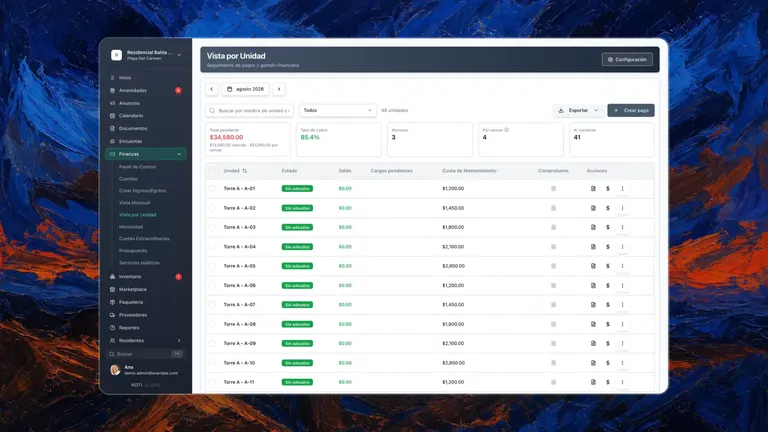
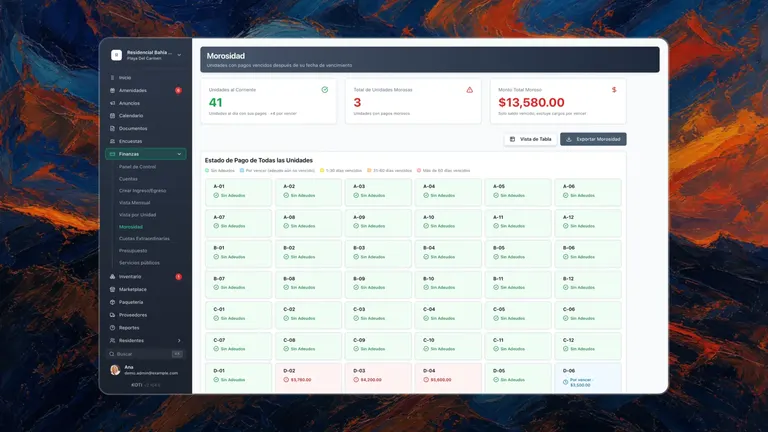
Measuring it stops being manual when the system computes it: the delinquency module sorts balances by age — 1 to 30 days, 31 to 60, over 60 — and exports the report you take to the assembly. A week late and six months late are not the same problem.
This post is the calculation. The collection process is in the fee collection guide, and what you can legally do about someone who has stopped paying is in the legal guide to delinquent owners.
Four mistakes that sink the calculation at the assembly
None of these is an arithmetic error. They are all method errors, and every one can be challenged:
- Prorating by square metres when the deed already fixes the ownership share. They look alike, but the indiviso may fold in parking, storage or value criteria that built area does not reflect.
- Leaving the reserve fund at zero "because nothing will be spent this year". All five statutes treat it as a fund built from fees, not as a surplus.
- Charging an assessment with no minutes recording its cause, its amount and the basis for covering the cost.
- Changing the allocation scheme by hallway vote. Check which door allows it and leave a record; how that decision is documented is in the owners' assembly guide.
And a warning that applies to all of the above: check your state's statute, and check you are reading the version in force. Mexico has no federal condominium law, there is one per state, and search engines return repealed texts with the same confidence as current ones. Nuevo León is the perfect example: the 1993 law still comes up first and the one that governs is the 2017 law, amended in October 2023. Which law applies in each state is covered in the guide to condominium law in Mexico.
Where Koti fits
Koti does not calculate your ownership shares — that number belongs to your deed. What it does is stop the result of the calculation from living in a sheet only one person understands:
- A different fee per unit, defined per unit and not per community: the minimum condition for prorating by ownership share.
- Automatic charges on the first, per each unit's own configuration.
- Separate funds: maintenance, reserve, contingency and capital works are managed as community accounts, each with its own balance and reports.
- A measured collection rate: the per-unit view separates overdue from not-yet-due, and exempt units are marked "not billed" so they never skew the percentage.
- Assessments with their own books: units charged, units paid and expected total versus collected total.
- The report you take to the assembly: income, expenses, net balance and delinquent units, exportable to PDF, CSV and Excel.
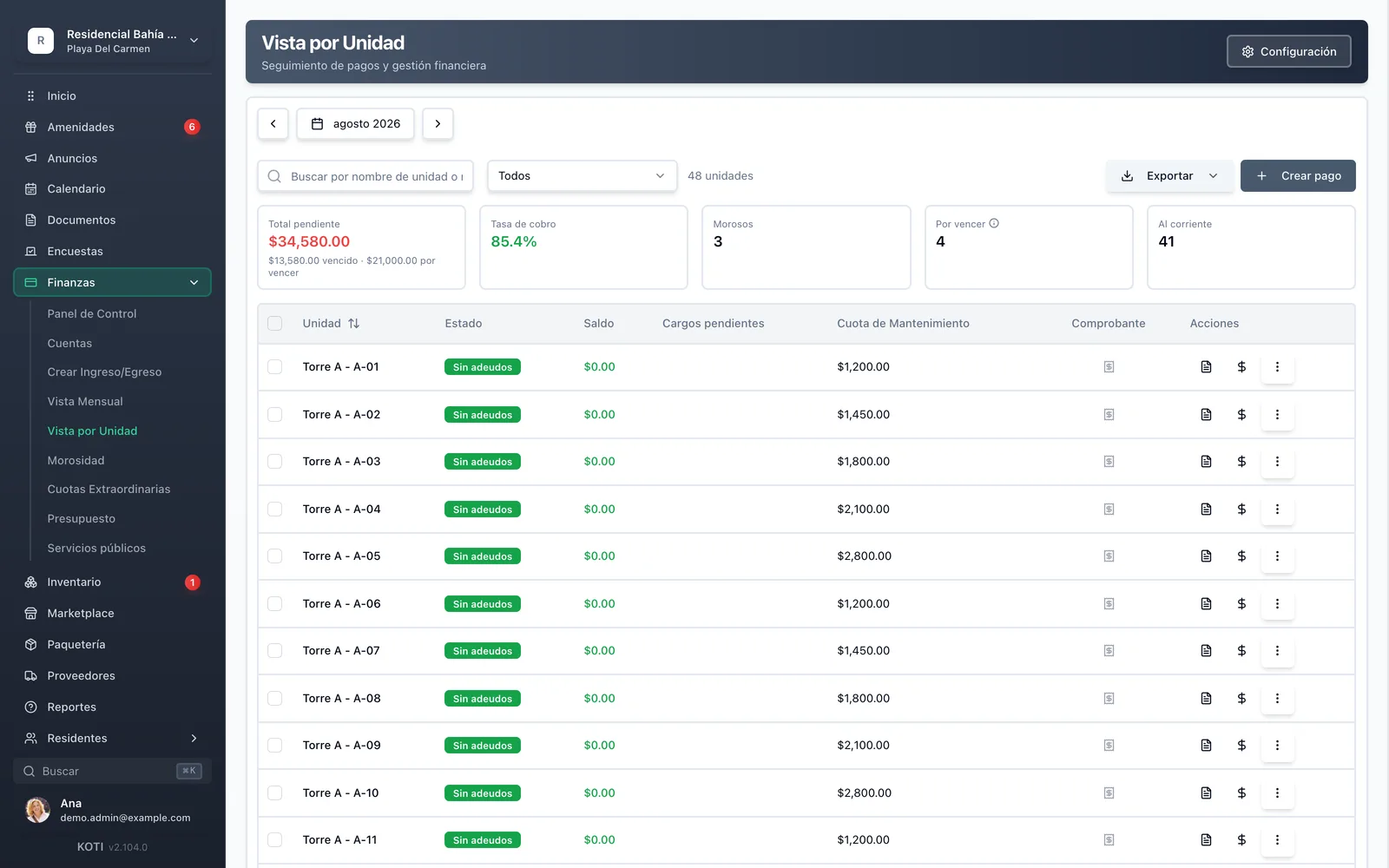
All of it costs $19 MXN + VAT per unit per month, one price with no tiers and no steps. To see the whole thing, start with the finance suite.
A well-made calculation is not the one that produces the lowest number: it is the one you can defend line by line when someone questions it. A budget approved by the assembly, a reserve fund with a technical basis, prorating by the deed's ownership shares, assessments with minutes, and a measured collection rate. Five pieces, and all five fit on one slide.
The arithmetic almost never fails. What fails is that the number lives in a sheet only one person understands, that the fee gets keyed in by hand every month, and that nobody knows what was actually collected until it stopped being enough. If you want to see your community with the proration loaded and the collection rate in plain view, book a demo.
General guidance, not legal or accounting advice. The citations come from the text in force of the condominium statutes of Mexico City (last amended 04-Aug-2023), Quintana Roo (12-Nov-2021), Nuevo León (11-Oct-2023) and the State of Mexico (29-Apr-2024), and from the Civil Code of the State of Jalisco. Check your own state's statute before approving a budget.
Try Koti for free
Simplify your condo management: dues, access and announcements in one place. 14 days free, no credit card.
Official sources
Every article cited in this guide was checked against the text published by the body that issued it. Condominium law in Mexico is state law: always read your own state’s, and confirm the date of the latest amendment before acting.
- Ley de Propiedad en Condominio de Inmuebles para el Distrito Federal
Mexico City · Last amended: 04-08-2023 (G.O. CDMX) · Checked: 2026-08-09
- Ley de Propiedad en Condominio de Inmuebles del Estado de Quintana Roo
Quintana Roo · Last amended: 12-11-2021 (P.O. del Estado) · Checked: 2026-08-09
- Código Civil del Estado de Jalisco
Jalisco · Last amended: 18-06-2026 (Decreto 30196/LXIV/26, P.O. secc. VII) · Checked: 2026-08-09
- Ley de Propiedad en Condominio de Inmuebles para el Estado de Nuevo León
Nuevo León · Last amended: 11-10-2023 (P.O. del Estado No. 128) · Checked: 2026-08-09
- Ley que Regula el Régimen de Propiedad en Condominio en el Estado de México
State of Mexico · Last amended: 29-04-2024 (P.O. «Gaceta del Gobierno») · Checked: 2026-08-09
This guide is general information, not legal advice. For a specific matter, consult a lawyer in your state.
Written by
Equipo Koti
Condo Management Experts
The Koti Smart Communities team shares knowledge and best practices for efficient condo and residential community management.