The law that governs your condominium in Mexico City is still called, to this day, the Ley de Propiedad en Condominio de Inmuebles para el Distrito Federal. It was published in the Gaceta Oficial del Distrito Federal on 27 January 2011, and its most recent amendment was published in the Gaceta Oficial de la Ciudad de México on 4 August 2023. The name sounds like a historical archive; the text is what binds you today.
That is worth saying up front, because it is the first source of error: copies stamped "last amended 2017" circulate freely, and a bill for a new condominium law sits in committee at the city Congress, summarized by more than one article as though it were already in force. It is not. The second source of error is more expensive: Mexico has no federal condominium law — the matter is state law, and what you learned managing properties in Jalisco or Quintana Roo does not transfer to the capital as-is.
This guide walks through what you actually need to know, with the exact article so you can check it against the official text.
How the regime is created
The regime does not exist until it is recorded in a public deed. Of everything Article 9 requires, two items become operational every month: the description of each exclusive-property unit with the percentage of undivided ownership (indiviso) assigned to it (sections II and IV), and the Internal Bylaws (section IX). That percentage is not a dormant notarial detail: it splits the fees and weighs the votes.
The deed and any other act affecting ownership are recorded with the Public Property Registry (Article 10). To amend it, Article 11 requires a combination almost nobody remembers in full: an Extraordinary Assembly attended by at least a simple majority of the owners, but with votes representing 75% of the condominium's total value. Attendance by headcount, decision by ownership share.
If your internal bylaws are the template the developer left behind, how to write condominium bylaws that actually work covers that ground.
The two kinds of assembly and the quarterly rule
The General Assembly is the condominium's supreme body, and it comes in exactly two kinds (Article 29):
| Kind of assembly | When it is held | Legal basis |
|---|---|---|
| Ordinary | Quarterly, to report on the state of the administration and deal with the condominium's business | Art. 29, s. I |
| Extraordinary | When urgent matters arise, and always to amend the founding deed or the Internal Bylaws, voluntarily wind up the regime, carry out new construction, or decide in case of destruction, ruin or rebuilding | Art. 29, s. II |
Swipe horizontally to see the full table
Read it again: quarterly. Four ordinary assemblies a year, not one. The section was amended on 13 January 2015, so gathering the community once in December stopped being a tradition and became a breach of article 29. The opposite mistake costs too: the four cases in section II are closed, and calling an extraordinary assembly outside them takes genuine urgency.
The mechanics of building the agenda and drafting the minutes are covered in how to run an owners' assembly.
Notice: who convenes and how it is served
The notice must state who is convening, the kind of assembly, the date and place inside the condominium and the agenda (Article 32, section I).
How it is served (section II). Personally, by posting the notice in a visible place in the condominium and on its door, or by leaving it inside each unit where possible. Mexico City's law does not mention email, unlike Quintana Roo's. Send the notice by email and through the app as well — it leaves a trail — but do not let that replace the service the law actually requires.
Who may convene (section III). The Administrator, the Oversight Committee, the Procuraduría in the cases the law lists, and the owners themselves by filing the notice with the Procuraduría: 20% in condominiums of 2 to 120 units, 15% from 121 to 500, and 10% above 501. And one line that settles entire arguments: owners who are delinquent or in breach have no right to convene.
An announcement board that also sends the notice by email, with delivery receipts unit by unit does not replace article 32 service, but it proves you also told people.
Quorum, votes and ownership share: where an assembly collapses
The deadlines and quorums in section IV of Article 32 are legal minimums, not suggestions:
| Notice | Seating quorum | Timing |
|---|---|---|
| First | 75% of the owners | 7 calendar days' advance notice (ordinary assembly) |
| Second | Simple majority of all owners | 30 minutes after the first |
| Third | Whichever owners attend, resolving by majority of those present | 30 minutes after the second |
Swipe horizontally to see the full table
Here is Mexico City's trap: attendance is expressed in owners, but the vote is not. Article 31, section III gives each owner votes equal to their unit's percentage of undivided ownership. You seat the meeting by counting heads and decide it by counting shares; if your minutes blur the two, you have handed anyone a way to challenge the resolution. From the same article: voting is personal and direct, no one represents more than two owners, and the administrator may represent none (section IV). And whatever is agreed binds everyone, including those absent and those who dissented.
The minutes go into the minute book authorized by the Procuraduría, which the secretary must keep in sight; if the book does not turn up they are drawn up on separate sheets, recording that circumstance, and the Procuraduría is informed within fifteen business days. Afterwards the Administrator informs each owner in writing within 7 business days of the resolutions adopted (Article 31, sections VIII and IX). Keeping the minutes in a repository with access levels for admin, owners and everyone turns that duty into a thirty-second search.
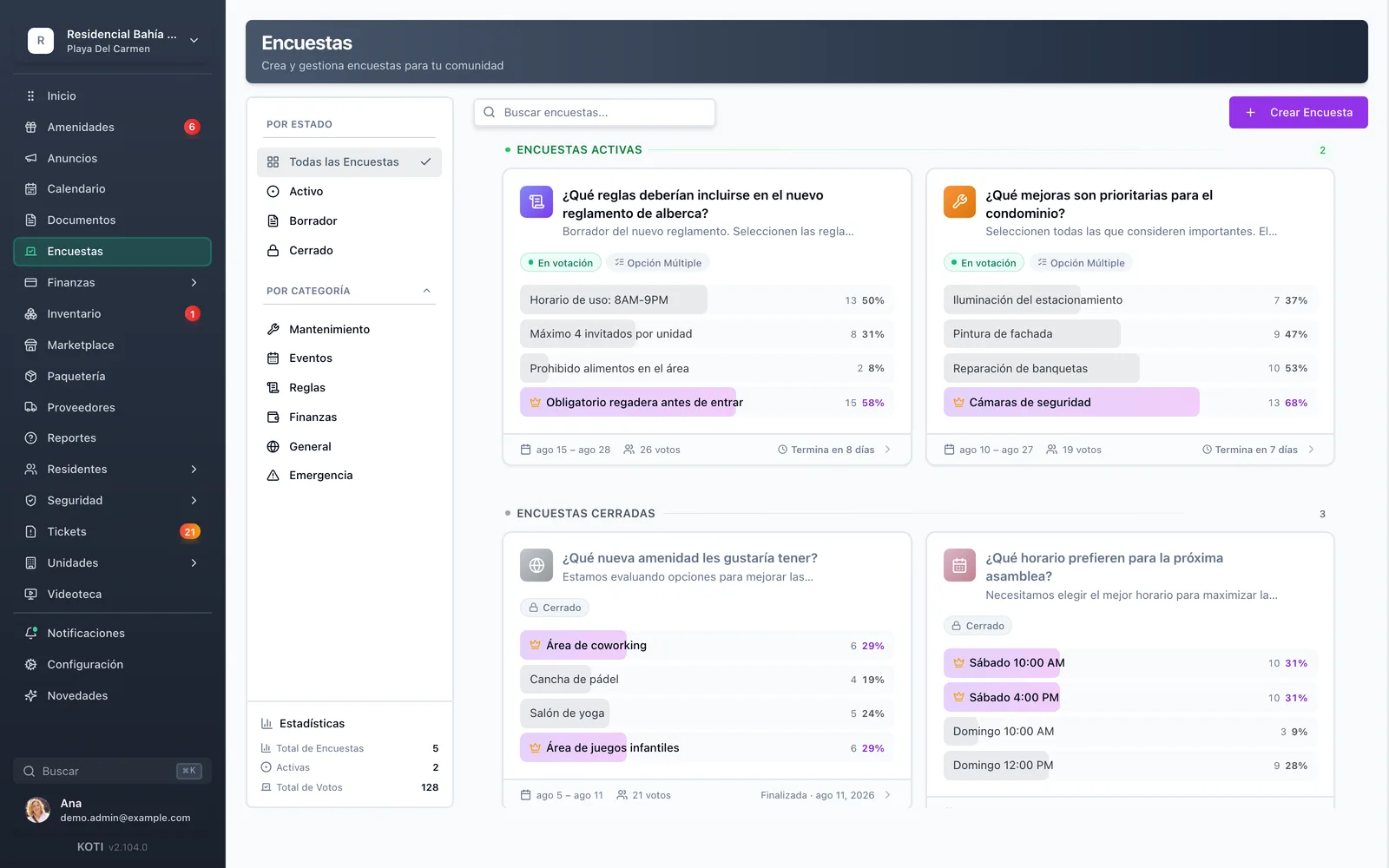
Polling first does not replace the formal vote, but a poll that can be weighted by ownership share and exported per unit tells you whether the resolution has the numbers before you convene.
The administrator: requirements, removal and handover
The condominium is run by whoever the General Assembly appoints (Article 37), which distinguishes the Owner-Administrator — an owner who is not a professional administrator — from the Professional Administrator. Article 38 requires the owner-administrator to prove they are current on their own obligations from the start and throughout their term; the professional to file the contract with the Oversight Committee, the bond and the certification issued by the Procuraduría; and both to take the training within 30 calendar days (Article 81) and register the appointment with the Procuraduría within 15 business days, because it is fully valid against third parties and authorities only for whoever can show a current registration. The term is one year, renewable for two more consecutive terms (Article 42).
The Oversight Committee is two to five owners, serving one year on an honorary basis (Articles 47 and 48). It reviews the accounts, issues an opinion on the account statements, supervises how the funds are invested, and is jointly and subsidiarily liable for the administrator's irregularities it knew about and failed to report to the assembly (Article 49).
Removal. The Assembly may freely appoint, ratify and remove the Administrator (Article 33, section II): it does not need serious cause, it needs an assembly. And the final paragraph of Article 43 adds a route for breach of any of its sections — revocation of the mandate at the request of at least 20% of the owners, ratified by the assembly.
Handover. Article 44 requires the outgoing administration to hand over to the incoming one, within no more than seven calendar days, every document: account statements, minute book, securities, property, and everything related to administrative and judicial proceedings. After that, the incoming administration may start whatever administrative, civil or criminal actions apply, and Article 87, section VII punishes that breach with 50 to 300 times the current UMA.
The monthly account statement: the five items in article 43
This is the easiest duty to audit, because the article spells out exactly what it must contain. Article 43, section XII requires delivering monthly, to each owner, an account statement approved by the Oversight Committee and obtaining proof of receipt. It must show:
- Item a) — an itemized statement of income and expenditure for the previous month.
- Item b) — the amount of outstanding contributions and fees, with the itemized breakdown available to the owners who ask for it, withholding for safety the personal data of owners and occupants.
- Item c) — the balance of bank accounts and invested funds, stating interest.
- Item d) — a detailed list of amounts payable to suppliers.
- Item e) — an itemized list of delinquent owners and the amounts they owe.
The owner has eight days from the day after delivery to object; once that passes they are deemed to agree. Notice the tension between items b) and e): the law asks for the delinquency list and, in the same breath, orders personal data withheld, so the prudent reading is to identify by unit rather than by name. And do not confuse the two clocks: the statement goes monthly to each owner, and separately the Assembly reviews and approves the half-yearly statements (Article 33, section VIII).
With per-unit statements generated automatically, that monthly delivery stops being an afternoon in a spreadsheet.
Fees, funds and the 9% interest cap
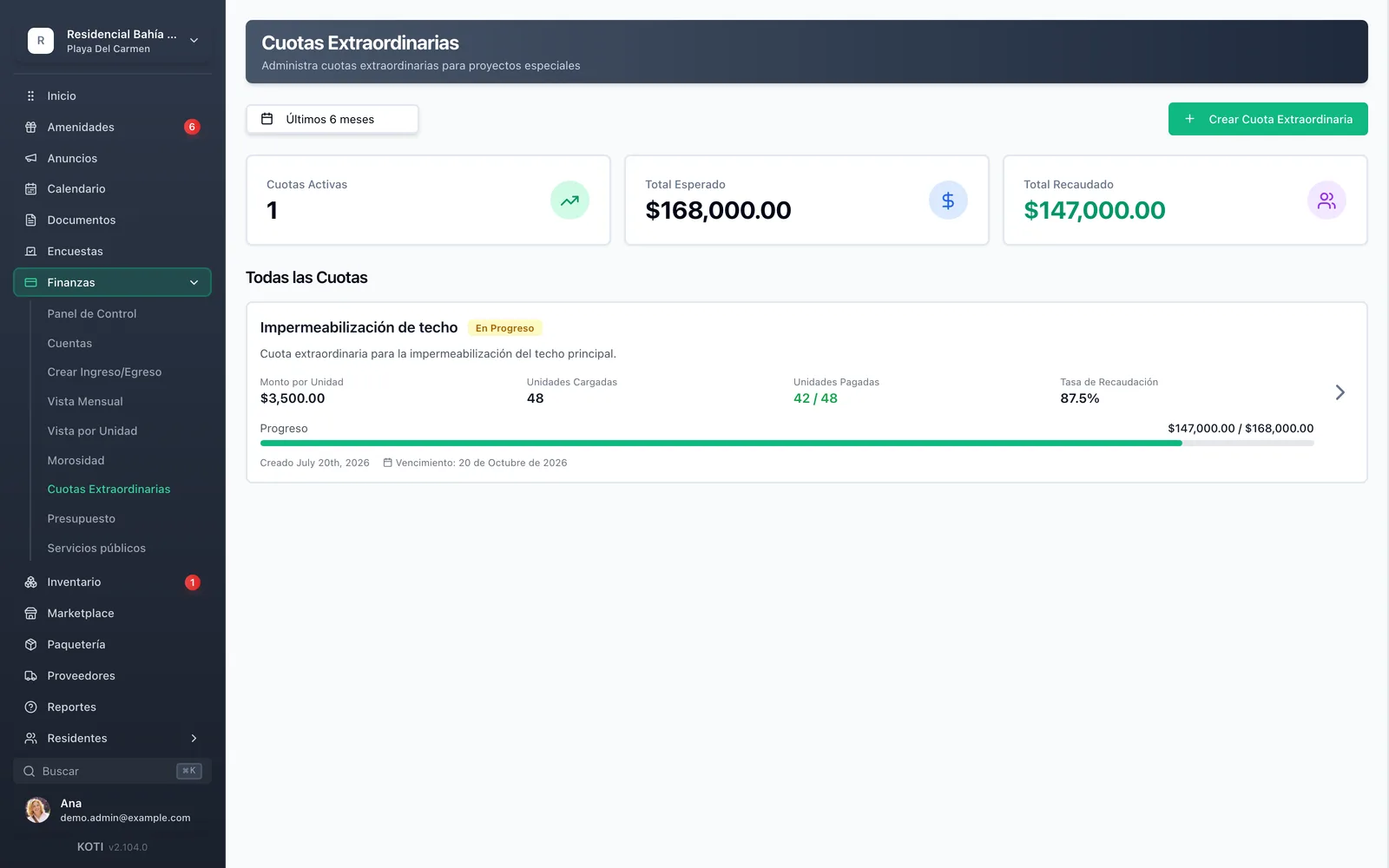
Article 55 requires the fees the Assembly sets to be paid on time and defines what they are for, all split in proportion to each unit's ownership share: the administration and maintenance fund for day-to-day common-area spending, the reserve fund for tools, machinery, labour, works and maintenance, and extraordinary expenses, available when either fund falls short — paint, waterproofing, pump replacement, cistern cleaning or major repairs.
Article 56 is the legal answer to the classic "but I never use the pool": fees are not subject to offset, personal defences or any other circumstance that could excuse payment. With one escape hatch worth knowing: if the owner proves they lack the means or is in declared insolvency, the Assembly may agree they pay with work for the condominium.
And the number almost nobody quotes correctly: on unpaid fees, treating each outstanding fee separately, the rate is the statutory interest, which may not exceed nine percent per year (Article 33, section V). If your bylaws say 5% a month, they are far above the legal cap. Before approving a fee, review how the maintenance fee is calculated by ownership share.
Delinquency: what counts as delinquent in Mexico City, and what you can do
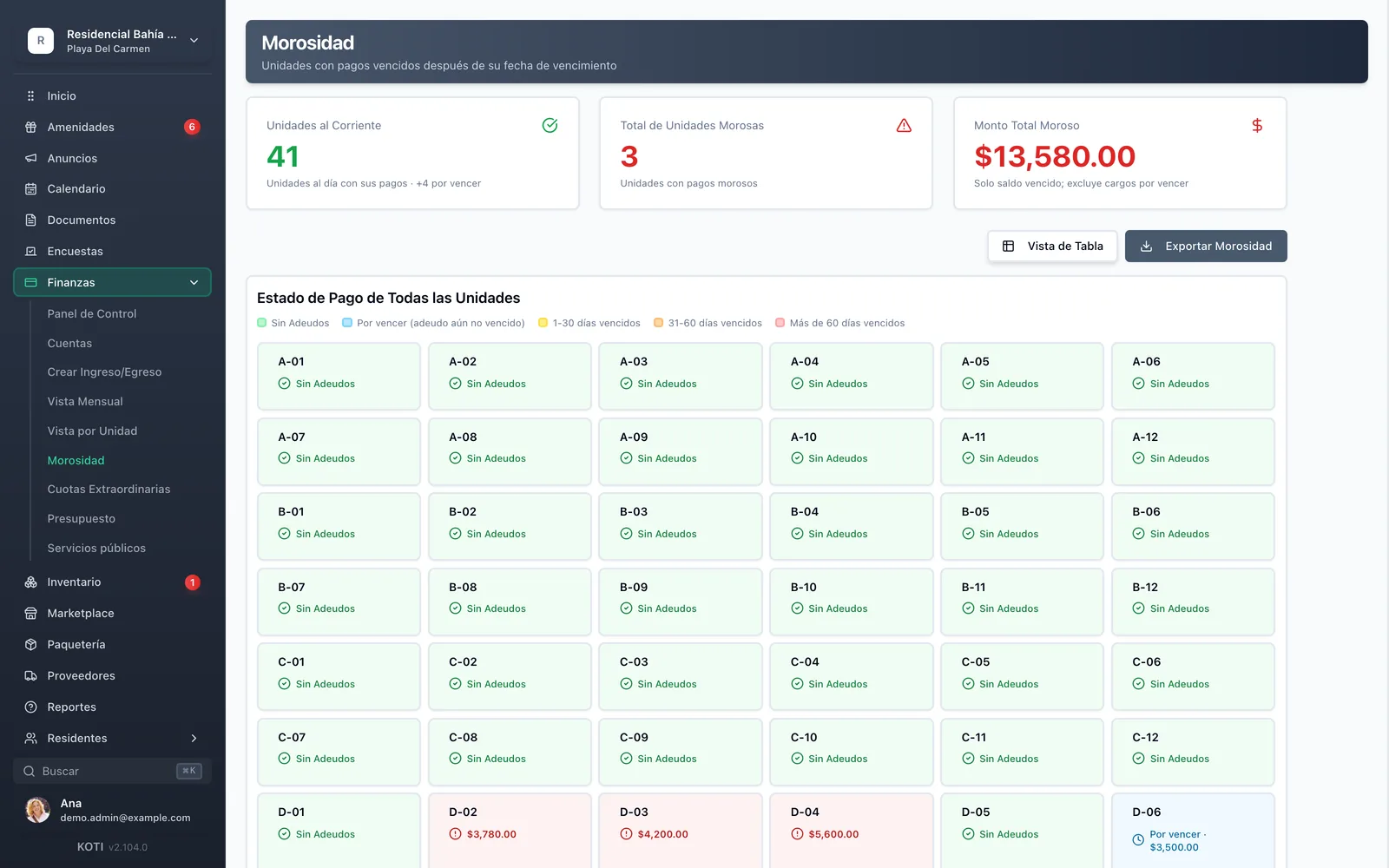
Article 34 defines the delinquent owner precisely, and the threshold is not the same as in other states: two or more unpaid fees for the maintenance and administration fund and the reserve fund; one unpaid extraordinary fee; or a final judgment ordering unpaid damages to the condominium.
The effect operates by operation of law, with nobody having to resolve it first: the delinquent owner's vote is suspended while their right to speak is always preserved, they are not counted towards the seating quorum, and they are barred from being elected Owner-Administrator or a member of the Oversight Committee. With one express exception: they do vote in assemblies convened to amend the founding deed, wind up the regime or affect title to the property.
Restricting services. The General Assembly decides this, not the administrator acting alone: Article 33, section XII empowers it to resolve on restricting electricity, gas and other services for non-payment, provided those services are paid for out of those ordinary fees. And it closes with an unqualified prohibition: "the potable water service may not be restricted".
Court collection. Article 59 opens the civil enforcement route with a file of mandatory pieces: the statement of liquidated debts signed by the Administrator and the president of the Oversight Committee, the unpaid receipts, and a copy certified by a Notary or by the Procuraduría of the minutes or bylaws where the fees were set. It is available with two ordinary fees or one extraordinary fee outstanding.
The debt follows the unit. The new owner takes it with those charges attached (Article 28) and is jointly liable unless the Administrator has issued the no-debt certificate (Article 60), issued in no more than five business days from the day after the request (Article 43, section XXV).
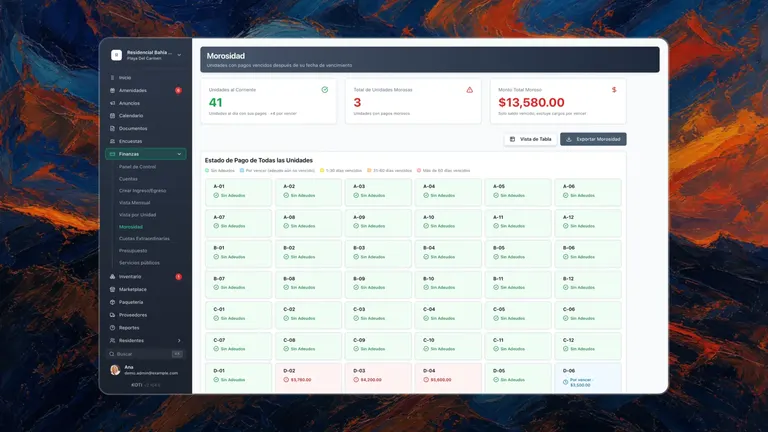
For the full protocol, see delinquent neighbours: what the law says and how to collect; a per-unit delinquency map with late fees that apply themselves is the record that holds it together.
PROSOC and the penalties
PROSOC — the Procuraduría Social de la Ciudad de México — appears in this law in three roles. Registration and training: it authorizes the minute book, registers the administrator, certifies the professional and teaches the mandatory courses (Articles 38, 43 s. I and 81).
Dispute resolution: it has jurisdiction over conflicts between owners, or between them and their Administrator or Oversight Committee, through conciliation, arbitration and the administrative sanctions procedure, applying the principle that a deficient complaint is supplemented in the owner's favour (Article 63). Before conciliation you must show prior mediation before the Administrator or the committee (Article 64).
Sanctions: Article 87 sets fines in Unidades de Medida y Actualización:
| Breach | Fine | Section |
|---|---|---|
| Failing to pay ordinary, extraordinary and reserve fees on time | 10 to 100 UMA | Art. 87, s. IV |
| Administrator or Oversight Committee mishandling or failing to oversee the funds, abusing the office or failing in their duties | The applicable fine increased by 50%, and the Procuraduría may revoke the registration | Art. 87, s. V |
| Failing to produce the minute book at a lawfully seated assembly | 50 to 200 UMA | Art. 87, s. VI |
| Failing the article 44 handover | 50 to 300 UMA, up to double for repeat offences | Art. 87, s. VII |
Swipe horizontally to see the full table
And there is a ladder beyond the fine: Article 88 empowers the Assembly to compel performance through the civil courts and, where the breach is repeated or serious, to seek penalties that may even reach the sale of the property.
Compliance checklist for a Mexico City condominium
A review you can run on your own administration today, with the article beside each line:
- Four ordinary assemblies a year, not one (art. 29, s. I)
- Notice of an ordinary assembly given 7 calendar days in advance, with 30 minutes between notices (art. 32, s. IV); an extraordinary one of extreme urgency, with whatever advance the circumstances demand (art. 32, s. V)
- Service in person and posted in a visible place, documented (art. 32, s. II)
- Quorum counted in owners, voting counted in ownership share (arts. 32 s. IV and 31 s. III)
- Minute book authorized by the Procuraduría, in sight at every assembly (arts. 43 s. I and 31 s. IX)
- Resolutions communicated in writing within 7 business days (art. 31, s. IX)
- Administrator registered with the Procuraduría and trained within 30 calendar days (arts. 38 and 81)
- Monthly account statement with the five items, Oversight Committee approval and proof of receipt (art. 43, s. XII)
- A receipt for every payment you take (art. 43, s. XI)
- Late interest within the 9% annual cap (art. 33, s. V)
- Service restriction resolved by the assembly, and never potable water (art. 33, s. XII)
- No-debt certificates within five business days (art. 43, s. XXV)
- Oversight Committee seated and with real access to the accounts (arts. 47 and 49)
If you fail three or more, the problem is not effort: it is that there is no system.
Where Koti fits
Koti does not provide legal advice. What it does is remove the manual work behind everything the law obliges you to document:
- Per-unit account statements, generated automatically and downloadable by the resident.
- A receipt when each payment is approved, carrying the community's logo.
- Configurable late fees, applied automatically the day after the due date.
- A delinquency map showing which units crossed the article 34 threshold.
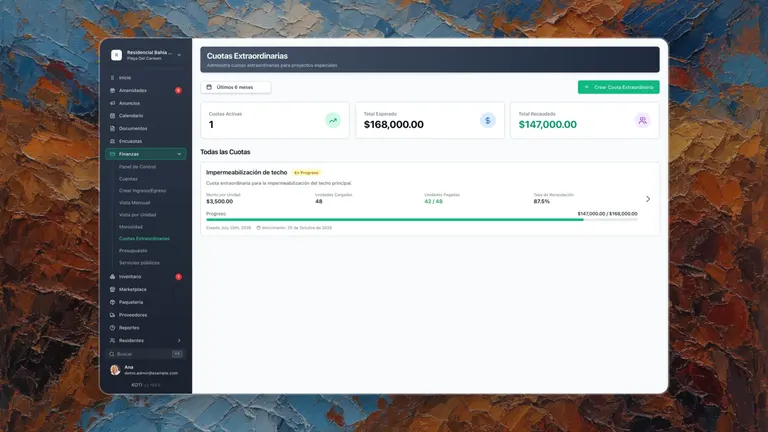
- Special assessments with per-unit amounts and a live collection rate.
- Financial reports of income, expenses and cash flow, exportable for the assembly report.
- Documents with three access levels: admin, owners and everyone.
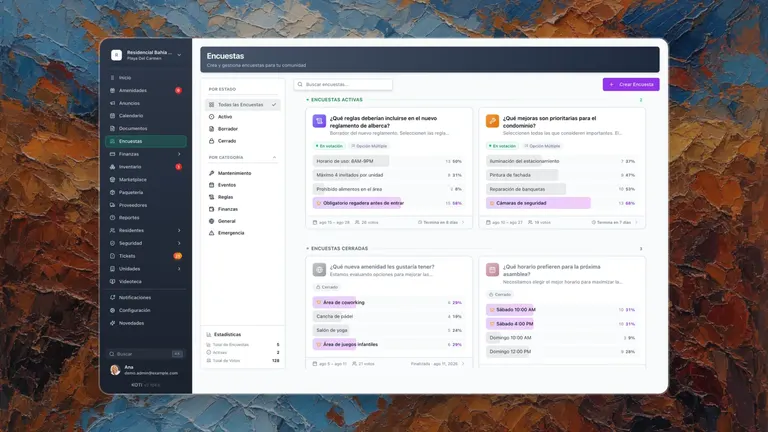
- Polls with one vote per resident, per unit, or weighted by ownership share, exportable to CSV.
- Stamped CFDI 4.0 issued when the payment is recorded, available as a platform add-on.
And one honest clarification: card, transfer and SPEI payment inside the app is in development. Today payments are recorded by reference and bank reconciliation.
This law is not written to make your life difficult: it is written to make the administration auditable. The three articles that put a clock on you — 29(I) with its four assemblies a year, 43(XII) with its monthly account statement, and 44 with its seven-calendar-day handover — are not solved with more hours: they are solved with order.
If you manage properties in Mexico City and want to see what your condominium would look like with statements, receipts and delinquency already in order, take a look at condo management software for Mexico City or the per-unit pricing: $19 MXN + VAT per unit per month, with a minimum fee of $760 MXN + VAT below 40 units, and a 14-day trial with no card.
This article is general guidance based on the Ley de Propiedad en Condominio de Inmuebles para el Distrito Federal, published in the Gaceta Oficial del Distrito Federal on 27 January 2011, last amended in the Gaceta Oficial de la Ciudad de México on 4 August 2023; text verified on 21 August 2026. It does not constitute legal advice. For a specific matter — an enforcement collection, removing an administrator, or challenging an assembly — consult a lawyer.
Try Koti for free
Simplify your condo management: dues, access and announcements in one place. 14 days free, no credit card.
Official sources
Every article cited in this guide was checked against the text published by the body that issued it. Condominium law in Mexico is state law: always read your own state’s, and confirm the date of the latest amendment before acting.
- Ley de Propiedad en Condominio de Inmuebles para el Distrito Federal
Mexico City · Last amended: 04-08-2023 (G.O. CDMX) · Checked: 2026-08-09
- Ley de Propiedad en Condominio de Inmuebles del Estado de Quintana Roo
Quintana Roo · Last amended: 12-11-2021 (P.O. del Estado) · Checked: 2026-08-09
This guide is general information, not legal advice. For a specific matter, consult a lawyer in your state.
Written by
Equipo Koti
Condo Management Experts
The Koti Smart Communities team shares knowledge and best practices for efficient condo and residential community management.